 By
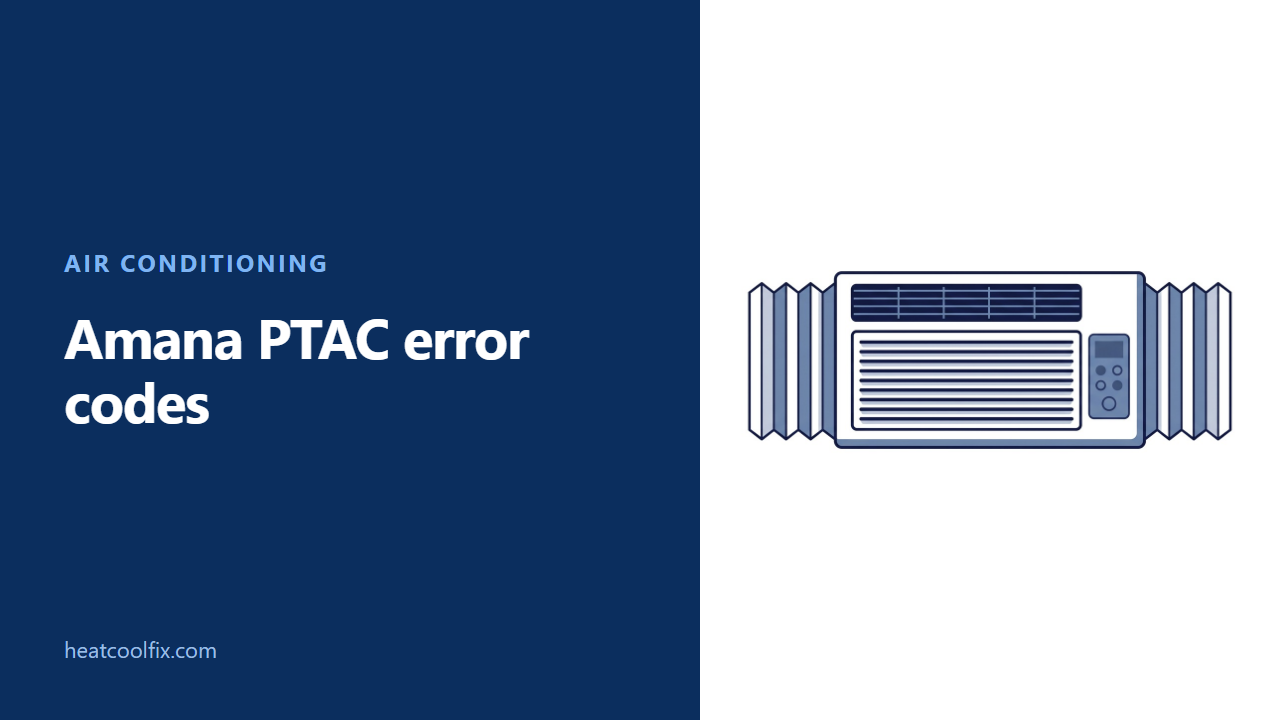
Amana's J/K series service table identifies L4 as an indoor coil too hot in heating and L6 as electric discharge air too hot. L3 means the indoor coil is frosting. Match the model and control first, then check the accessible filter with the unit off. Internal electrical tests belong to a technician.
Amana PTAC error codes point to different parts of the heating system. In Amana’s J/K series service table, L4 means the indoor coil is too hot in heating, while L6 means the electric heat discharge air is too hot.
If your room is cold, those two messages need a different investigation from L3, which Amana labels as an indoor coil frosting condition. Keep the full code and the operating mode together.
Before you start
What to carry: a torch, your model information and a phone for the message. Have a vacuum available if you plan to clean the accessible intake filter.
Gas or electric? Amana describes the PTC as electric heat only in heating mode. A PTH can use reverse cycle heat pump operation or electric heat. This guide follows the PTC/PTH J/K controls in service manual RS4200007.
Renting or staying in a hotel? Tell maintenance the room number, code and whether the fan runs. Leave equipment settings and service work with the person responsible for the unit.
The GE Zoneline guide is for a different PTAC control. Its button sequence and F codes do not apply to the Amana chart below.
Amana’s service manual requires all power to be disconnected before service and warns that multiple power sources may be present. It is written for trained HVAC technicians.
Keep the electrical covers and splash guard in place. This guide’s owner maintenance step is the accessible filter, using Amana’s OFF setting instructions below. Heater, relay, capacitor and motor tests belong to service.
Keep the model and control with the code
Separate a status report from a setting
Use the model information from your records or a safely accessible label. Save the exact code, including its letter, and say whether it appeared in a diagnostic report or a configuration menu.
Amana’s J/K manual describes PTAC Connect diagnostics as well as the control’s status reporting. Its app pairing procedure involves a button under the front cover and splash guard, so ask maintenance to retrieve the report if it is not already available.
The distinction between menus matters. In this manual, Amana uses C4 and C5 in configuration for room number fields, while its diagnostic chart uses C4 for a frozen indoor coil and C5 for outdoor recirculation.
Do not change a configuration value because its label resembles a fault code.
The heating faults to identify first
For L4 or L6, start with the air path
Amana’s diagnostic section identifies filter cleaning as the first maintenance step for a status light associated with restricted airflow. Use the filter procedure below, and tell maintenance about anything covering the unit’s intake or discharge.
Amana gives d6 its own entry for an indoor blower motor issue. If the fan is silent or sounds wrong, include that observation with the code instead of repeatedly asking for more heat.
For a PTH, Amana says the heat pump and electric heater do not operate together.
| J/K diagnostic code | Meaning in Amana’s service table |
|---|---|
| L4 | Indoor coil too hot in heat |
| L6 | Electric discharge too hot |
| d6 | Indoor blower motor issue |
| d5 | Outdoor DC motor issue |
| LC | Outdoor coil hot lockout |
| LE | Outdoor coil frosted lockout |
| LF | Outdoor coil frost lockout |
| LH | C3 configuration error |
These are descriptions of what the control reports. In particular, Amana labels LE and LF separately; keep the letter as shown rather than combining them into a generic freeze code.
L3 and C4: the indoor coil is getting cold
Clean the accessible intake filter
Amana calls L3 “frosting indoor coil” and C4 “frozen ID coil” in its diagnostic chart. Its maintenance section asks for intake filter cleaning monthly, or more frequently in dirty or dusty conditions.
- Set the unit’s mode switch to OFF before cleaning, as Amana instructs.
- Grasp the filter’s molded handle at the front edge below the discharge grille and lift the filter straight up.
- Amana permits a vacuum or running water for cleaning its permanent intake filter. Reinstall it using the reverse of the removal procedure.
If your front or filter arrangement differs, stop at identification and use that model’s owner instructions. Do not pull the chassis out of the wall sleeve to follow a filter tip.
Amana says a status light that remains after filter care needs its diagnostic code reviewed and may need additional coil maintenance. Leave internal coil access to service. The room unit cooling guide covers broader airflow symptoms when no code is available.
Some messages describe room control
Ask maintenance about a room control message
Amana’s diagnostic table includes Fd for front desk control, oP for open door lockout, Ur for an unrented room and L5 for load shedding. These entries belong in the service report even though they do not name a failed motor or heater.
In a managed building, ask whether the room is enabled and whether a door contact or energy setting is involved. Do not move wires, bypass a contact or change the room number to defeat the control.
Amana also lists Fp as room freeze protection and HP as room heat protection.
What each one takes
| Next step | What it involves |
|---|---|
| Identify the model and diagnostic code | No parts; the exact report and operating mode |
| Clean the intake filter | Basic maintenance using the removable filter and OFF setting |
| Check an Fd, oP or Ur message | Building maintenance reviews room controls and contacts |
| Investigate a returning L4 or L6 | A service visit to assess airflow and the heating system |
| Investigate d5 or d6 | Motor and electrical diagnosis by a trained technician |
Questions people ask
Is L3 the electric heater overheating?
No. Amana’s J/K diagnostic table assigns L3 to indoor coil frosting. L6 is its electric discharge temperature alert. This distinction is why the letter and number need to stay together.
Where is the Amana PTAC error codes PDF?
The source here is Amana service manual RS4200007, January 2023, saved from an HVAC archive. Its diagnostic tables are on printed pages 39 to 41. Use the model and control covered by that edition.
Should I restore factory settings to clear a fault?
Keep the existing configuration until the fault is identified. Amana’s manual includes settings for unit type, room identity and attached controls; changing them is a different task from reading a diagnostic message.
Does a PTC have a heat pump fault?
Amana identifies PTC as a standard cooler and describes its heating as electric heat only. PTH is its standard heat pump model. Check that distinction before applying a heat pump explanation.
What if the code is from an older DigiSmart or a PBH?
Match it to that series’ own manual. This page does not extend the J/K app, configuration labels or diagnostic definitions to every older Amana control.
The other room heating and cooling guides: GE Zoneline codes, a room unit that will not cool and heat pump not heating.
Sources: Amana Service and Troubleshooting, Package Terminal Air Conditioner / Heat Pump, Standard and Remote Applications with LED Controlboard, R32 and R-410A, RS4200007 (January 2023), PTC/PTH J/K series; pages 1 to 3, 12 to 15, 30 and 38 to 41. Manufacturer-authored PDF saved from an HVAC archive mirror.