 By
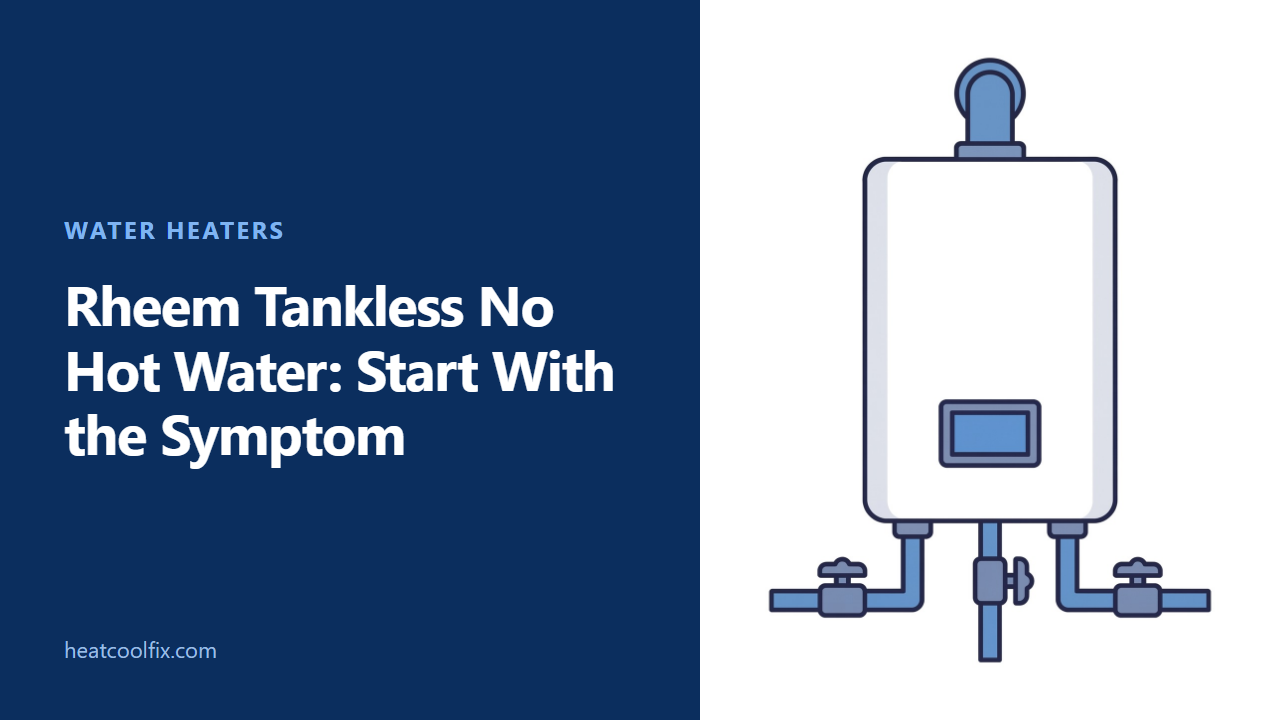
Rheem separates not enough or no hot water from water that is not hot enough. For the named gas tankless models here, the first branch includes power, water supply and insufficient demand. The low temperature branch also includes the gas supply and plumbing bleed-over. Match the symptom before ordering parts.
The useful first question for a Rheem tankless heater is what comes out of the tap. Is there no water, a steady stream that stays cold, or water that warms up but never gets hot enough?
Rheem’s troubleshooting tables separate those symptoms. Start with the branch that fits what you can see, rather than assuming a gas tankless heater needs the same reset as a storage tank.
Before you start
What to carry: a torch, your phone and a thermometer suitable for checking tap water. Rheem’s operating instructions describe measuring the water stream rather than assuming the displayed setting is the delivered temperature.
Gas or electric? This page covers gas tankless heaters. Its examples are the RTG-95DVLN-3 with manual AP22009 Rev 06 and the IKONIC ECOHSR160iN with AP22745 Rev 07. Rheem tankless electric heaters and gas storage tanks have different controls and checks.
Check the model match once. Rheem’s RTG product page links the noncondensing manual, and its IKONIC product page links the condensing manual used here. Both original PDFs are saved with this guide’s sources.
A code is showing? Continue with Rheem tankless error codes. That guide also covers filter cleaning; this one follows the symptom when there is no code.
Renting? Contact maintenance with the model and the difference between no flow, cold flow and warm water.
For overheating or gas that fails to shut off, the RTG manual says to close the manual gas control valve. It also says to close that valve after fire, flooding, submersion or physical damage, and not use the heater until qualified service has checked it.
Both troubleshooting sections require electrical power off before protective covers are removed and reserve electrical, gas, burner, control and vent repairs for qualified service. Leave the heater closed during the checks below.
Rheem warns that water above 125 degrees F can cause severe scalding. Do not increase temperature as an ignition test. Keep hands clear of the hot stream when taking a thermometer reading.
When the heater seems completely off
Check power and the normal operating control
For the RTG family supplied with AP22009, Rheem’s first no hot water row says to turn the unit on using POWER ON/OFF. A later row separately lists disconnected electrical power and a shut water supply.
Look at the accessible plug and the labelled circuit state. The IKONIC AP22745 table also starts with the unit being off and directs you to its electrical supply.
Keep these checks outside the case. If the supply is present but the display will not respond, the next job is control or electrical diagnosis, not an improvised pilot lighting attempt.
When a small hot draw stays cold
Try a fuller hot draw and check the fixture outlet
Rheem’s two cited tables list a hot faucet not fully opened and insufficient water demand. Their remedy is a fuller hot water draw. They explain that inadequate incoming water volume turns the main burner off.
Open one hot tap fully and see whether the water heats. The same tables list a dirty fixture aerator, so inspect and clean that removable outlet screen if its flow is restricted. Compare the result with a second fixture before changing heater parts.
For the RTG-95DVLN-3 manual used here, Rheem distinguishes a minimum activation flow of 0.4 gpm from a minimum continuous operating flow of 0.25 gpm. The same section requires at least 14 psi of water pressure. These requirements belong to AP22009, not every tankless model.
When the hot side has little or no water
Separate supply restriction from a heating failure
Both Rheem tables include a water shutoff valve that is not completely open, a shut water supply, frozen piping and a dirty water filter. Check the accessible water supply valve only if you can identify it confidently; do not force an unfamiliar valve.
If the failure began during freezing weather, include that in your service request. AP22009 says the built in electric freeze heater protects internal components, while external piping and valves need additional protection. Removing electrical power also removes that heater’s power.
For a power outage in freezing conditions, Rheem gives a draining procedure and requires checking for frozen or leaking components when returning the unit to service. Have the installer handle that recovery if you cannot establish the condition of the heater. Do not keep trying to fire it with a suspected frozen water path.
When the water warms, but stays too cool
Compare temperature, gas supply and fixture mixing
Under water not hot enough, both manuals list a low temperature setting, a gas valve not completely open, low gas pressure and bleed-over in a hot water fixture. Those are separate possibilities; cool water does not identify a failed burner.
Rheem’s operating instructions say the tap temperature can vary with season and pipe length. Compare a careful thermometer reading with the displayed setting. For the IKONIC manual here, the user interface will not change the temperature set point while a hot faucet is open.
If a setting correction is needed, use the normal operating instructions and their scald precautions. AP22745 recommends 120 degrees F. Avoid treating a higher setting as a cure for a restriction or a supply fault.
Rheem sends low gas pressure to the gas utility or gas contractor to verify the meter and piping size. Its bleed-over row goes to a dealer or qualified technician. Report whether the temperature problem affects every fixture or only one, and leave pressure adjustment and mixing valve repair to service.
When the problem followed installation or maintenance
Ask the installer to finish the water side investigation
The no hot water charts in AP22009 and AP22745 both include reversed hot and cold water connections. If the unit has never supplied hot water since installation, give that detail to the installer before authorizing replacement electronics.
The same lists include a mixing valve malfunction, a dirty inlet filter and heat exchanger scale. Describe any work done immediately before the symptom started.
If these external checks do not explain the failure, request diagnosis using the matching troubleshooting table. Rheem reserves the gas, electrical, burner, vent and safety device repairs for qualified service.
What each one takes
| Finding | What the next job involves |
|---|---|
| Unit off or supply disconnected | External supply and controller check, then electrical service if it remains unresponsive. |
| Heat appears only with a fuller hot draw | Fixture flow and restriction checks using the model’s activation requirement. |
| Little water after freezing weather | Checking the water path, freeze protection and possible leaks before return to use. |
| Warm water below the intended temperature | Compare the setting with measured water temperature, then gas or mixing diagnosis. |
| No hot water from a new installation | Installer review of supply valves, water connections and commissioning. |
Questions people ask
Does a running fan mean the burner is heating?
No. Both cited tables call fan rotation after closing the hot tap a normal post-purge that clears flue gases.
Why can it keep running at less flow than it needs to start?
AP22009 specifies separate activation and continuous flow requirements.
Why will the IKONIC temperature setting not change?
AP22745 says to close the hot water faucet before changing the user interface set point. That operating restriction comes before suspecting a broken display.
Will its freeze heater protect the outside pipes?
AP22009 says its electric heater protects internal components only. External piping and valves need additional freeze protection.
Is no code enough to rule out a plumbing problem?
No. Rheem’s symptom chart includes restricted water supply, fixture mixing, a dirty aerator and reversed water connections without requiring a displayed fault.
The other tankless guides: Rheem tankless codes and filter care, tankless water heater problems and no hot water in the house.
Sources: Rheem RTG-95DVLN-3 product documentation and linked Use & Care Manual AP22009 Rev 06, troubleshooting pages 74 and 75, water supply and operating sections; Rheem IKONIC ECOHSR160iN product documentation and linked Use & Care Manual AP22745 Rev 07, troubleshooting pages 104 and 105, temperature and safety sections