Indirect Water Heater Not Heating or Running Out Fast
 By Ray Bennett · Updated 17 October 2026 · 11 min read · Checked against the sources at the end
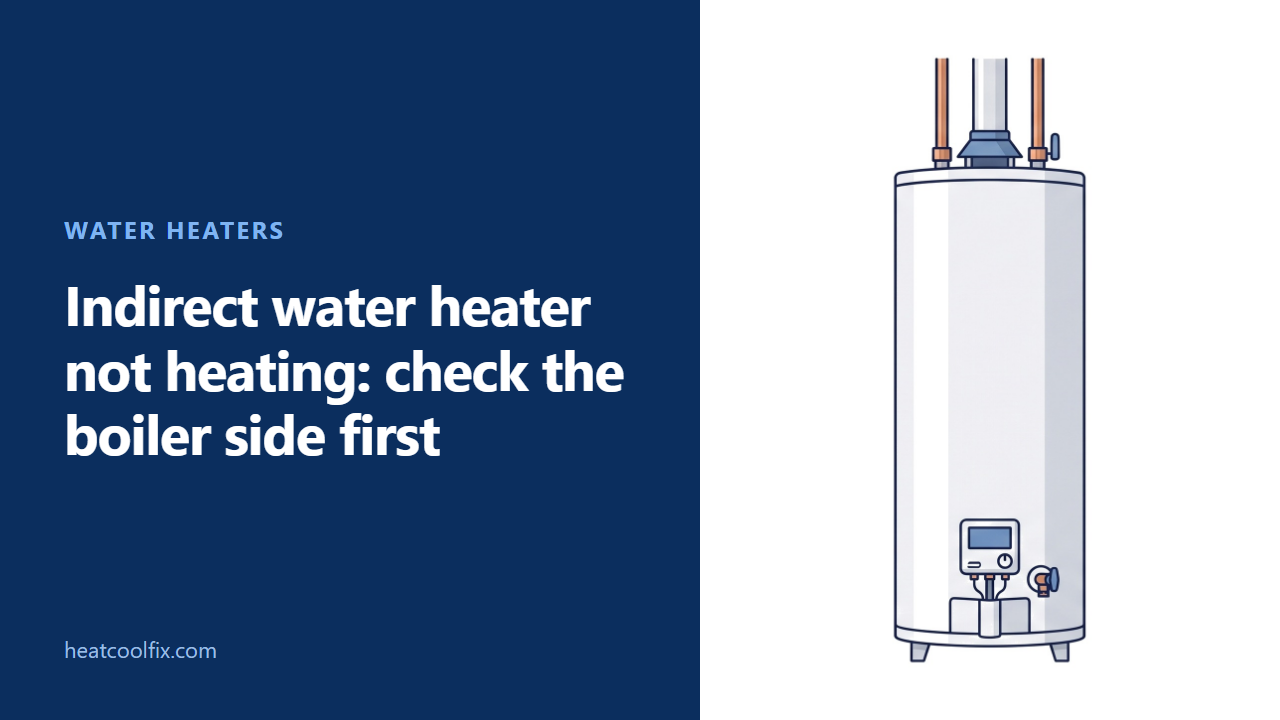
An indirect water heater is heated by the boiler: its thermostat calls the boiler, and a pump or zone valve sends boiler water through the tank. The makers' tables start there: the boiler not running, the pump or zone valve not working, or the tank thermostat set too low. Running out fast points to the setting, the boiler's temperature or more demand than the tank holds.
An indirect water heater not heating is a tank that is not getting heat from the boiler. Utica says that when its H2O tank’s thermostat calls, it starts the water heater’s pump and the boiler, and U.S. Boiler says its Alliance SL can be fed by its own pump or by a zone valve off the heating pump.
So the makers’ tables start on the boiler side. For no hot water, Peerless and Utica list the boiler not running, the pump not running, the zone valve not opening and the thermostat set too low, and HTP’s list starts with the zone valve, the pump and the settings.
Before you start
What to carry: a torch, a kitchen thermometer for the hot tap, and a bucket with gallon marks and a watch for the shower test in check 4.
Gas, oil or electric? The tank is heated by the boiler: Utica says its thermostat starts the water heater’s pump and the boiler. A tank with its own gas burner or electric elements is a different machine: a hot water heater not working.
Which tank is it? The label names it: U.S. Boiler’s Alliance SL, Weil-McLain’s Aqua Plus, HTP’s SuperStor Ultra, Peerless’s Partner and Utica’s H2O are the tanks this page draws on. Find the thermostat on the tank and the boiler’s own controls before you start.
Renting? New York’s tenants’ rights guide from the Attorney General says landlords are required to keep the plumbing and heating systems in good and safe working order, so tell the landlord.
Water far too hot is an emergency. U.S. Boiler says that if extremely hot water comes from a tap, shut off the boiler’s main switch at once and call service, and do not run it until the cause is found and fixed.
Power off before a cover comes off. HTP says disconnect the electrical supply before any maintenance and let the heater and its pipes cool first. On the Alliance SL, U.S. Boiler says shut off the power to the heater before its thermostat cover comes off, and that any change to the setting is for qualified service personnel.
Never block the relief valve. Peerless and Weil-McLain say plugging the relief valve or its pipe can cause excessive pressure in the tank and severe injury or death, and Peerless and HTP warn that the water it lets out is scalding, so keep clear of the end of its pipe.
What is the hot water doing?
Run the hot tap nearest the tank and feel how hot it gets, then think about when it fails.
No hot water at all points to the tank not calling, or the boiler, pump or zone valve not answering it: checks 1 and 2. Warm but never hot points to the settings: checks 2 and 3. Hot, but it runs out points to the settings or to more demand than the tank holds: checks 2 to 4. Slowly worse over time can be scale on the coil or air in the loop: check 5. Too hot: check 6.
No hot water
Does the tank call, and does the boiler answer?
The tank’s call. On the Alliance SL, U.S. Boiler says the thermostat’s light is green when powered, blinks while it calls for heat, and stays solid when it is satisfied. Weil-McLain’s Aqua Plus control can show its setting, or OFF.
What should happen next. Weil-McLain’s checklist asks three things during the tank’s call: does the boiler’s pump start, does the zone valve open, and does the boiler fire? U.S. Boiler says the thermostat calls when the tank falls below its setting, so run the hot water until the tank calls, then watch for each one.
If one does not. Peerless’s table gives a boiler that does not run, with the main service switch and fused disconnect to check. For a pump that does not run, it says check its power supply and switching relay, and for a zone valve that does not open, its power supply. Utica adds checking the fuses and resetting a tripped breaker, and HTP says a zone valve that will not open can be opened by hand or replaced. Each part has its own guide: a boiler not working, a boiler circulator pump not working and a zone valve not working.
Warm, or it runs out
The tank thermostat setting
Where it starts. U.S. Boiler sets the Alliance SL’s thermostat to 120 degrees at the factory, Utica sets the H2O’s to 125, and Weil-McLain gives 120 as a typical starting point on the Aqua Plus. Peerless sets the Partner’s thermostat to its lowest at the factory, and says the boiler’s limit must be at least 20 degrees above the tank setting.
Too low. HTP, Peerless and Utica all list a tank thermostat set too low for no hot water or not enough, and Weil-McLain says a setting too low may not give the boiler the chance to heat the whole tank. Test the water at the nearest tap, as Weil-McLain and U.S. Boiler both say.
Raising it safely. Weil-McLain says a mixing valve should be fitted on an Aqua Plus set at 125 degrees or higher, and U.S. Boiler says not to go above 140 on the Alliance SL without a properly installed mixing valve. Peerless says the Consumer Product Safety Commission and some states recommend settings of 130 degrees or less, and that going higher increases the scald risk. More on settings: water heater temperature.
A failed thermostat. Peerless and Utica list a faulty tank thermostat, replaced. Weil-McLain’s test for one needs a meter on its terminals, a technician’s job.
The boiler's temperature and priority
The boiler set too low. HTP lists a boiler control set too low for no hot water and a boiler temperature too low for not enough, both fixed by raising it. Weil-McLain’s Aqua Plus manual says, if possible, raise the boiler’s operating temperature to 180 or 200 degrees, and U.S. Boiler says the boiler’s high limit must be set no higher than 200 for the Alliance SL.
Priority. Peerless and Utica list an undersized boiler with no priority to hot water, fixed by rewiring for priority. HTP’s sign of it is the heat and the tank coming on together, fixed by checking the wiring or setting the tank as priority over the heating. On Weil-McLain’s Ultra Series 4 boiler, with the tank wired as priority 1, its control turns the space heating off while it heats the tank by default.
After the summer. Weil-McLain says to keep a minimal temperature in the boiler outside the heating season, as a cold boiler after a long standby may absorb the tank’s stored heat at the start of a call.
More hot water than the tank can give
Peak use. Peerless and Utica list a peak draw bigger than the tank holds: work out the peak use and compare it with the tank’s volume. HTP lists hot tubs, spas and multiple showers as high demand, and a boiler or tank sized too small, and Utica’s answer to too much demand is reducing it or a larger boiler and or water heater.
Time the shower. Weil-McLain asks whether a tank was sized for 2.0 gallon a minute shower heads when the real heads use 5.0, and says use a bucket and a stopwatch to find out. Time how long the shower takes to fill the bucket to a gallon mark. Weil-McLain turns gallons a minute into gallons an hour by multiplying by 60.
What changed. Weil-McLain says a remodeled bathroom with a new whirlpool tub will change the demand a great deal. For demand that is too great, HTP’s fix is a mixing valve and or a flow restricting valve, with the tank and boiler temperatures raised.
Worse over time, or too hot
Air, scale and a cold loop
Air. HTP and Peerless list air trapped in the loop from the boiler to the tank, fixed by purging it. Weil-McLain’s Aqua Plus manual says an air bound water heater or boiler will not circulate the water properly, so heat is not passed to the tank.
Scale on the coil. Utica says that if the boiler, pump and thermostat all work and the boiler cycles on its high limit several times before the tank is satisfied, the coil may have a coating of sediment or scale, and the coil is cleaned. Utica also lists a boiler that cycles more than 5 times a day in summer, from heavy demand, a faulty thermostat, the boiler’s high limit set too low, or scale on the coil. Weil-McLain’s Aqua Plus manual says a dirty boiler system can leave deposits on the tank’s coil that insulate it, and it cleans the boiler system the boiler maker’s way.
Heat drawn back out. Weil-McLain’s Aqua Plus manual says lab tests showed boiler piping can act as a thermal siphon during long standby and draw heat out of the tank, so it puts a zone valve, check valve or heat trap close to the tank and insulates the piping.
A broken dip tube. On its Gold and Ultra Plus tanks, Weil-McLain says a broken or melted dip tube sends the cold water across the top of the tank and short cycles the heater.
Too hot, or the relief valve opening
Too hot. Peerless lists a tank thermostat set too high, lowered, then wrong plumbing or wiring, or a faulty thermostat. Weil-McLain says water too hot is usually stacking: it typically happens with small draws, leaving layers in the tank with the hottest at the top. Water far too hot is the emergency in the rules above.
The relief valve. HTP lists three causes of its T and P valve opening: the tank too hot, water expanding as it heats, which an expansion tank deals with, and the supply pressure too high. Utica says never try to repair the valve, and that one that discharges again and again can be thermal expansion or a faulty valve. More in a water heater relief valve leaking.
After it is fixed
Keep testing the tap. U.S. Boiler says the water temperature should be tested at the tap from time to time to be sure the thermostat is working, as these thermostats can fail without notice.
Regular care. HTP says periodic maintenance should be done by a qualified service technician, and U.S. Boiler says the controls, heat exchanger and wiring should be inspected by qualified service personnel.
What each one takes
| Where it fails | What it takes |
|---|---|
| Boiler switch, fuse or breaker | Switching it on, resetting the breaker or replacing the fuse |
| Pump or zone valve | A technician; HTP’s fix for a zone valve that will not open is opening it by hand or replacing it |
| Tank thermostat set too low | A higher setting; a mixing valve at 125 degrees or more on the Aqua Plus, above 140 on the Alliance SL |
| Boiler temperature or priority | A technician to set or rewire them |
| More demand than the tank holds | A mixing valve, a flow restrictor, or a bigger tank or boiler |
| Air in the loop | A technician to purge it |
| Scale on the coil | A technician to clean it |
Questions people ask
Why does my heating go off when I run hot water?
That can be priority working. Weil-McLain’s Ultra Series 4 boiler, with the tank wired as priority 1, turns the space heating off while it heats the tank by default, and HTP suggests setting the tank as priority over the heating.
What should an indirect water heater be set to?
U.S. Boiler sets the Alliance SL to 120 degrees at the factory, Utica sets the H2O to 125, and Weil-McLain gives 120 as a typical starting point on the Aqua Plus. Weil-McLain says a mixing valve should be fitted on an Aqua Plus set at 125 or higher, and U.S. Boiler says not above 140 on the Alliance SL without one.
Why does my boiler run all summer?
An indirect tank calls the boiler whenever it needs heat. Utica gives more than 5 boiler cycles a day in summer as a fault, caused by heavy demand, a faulty thermostat, the boiler’s high limit set too low, or scale on the coil.
Is it the boiler or the tank?
Make the tank call and watch, as Weil-McLain’s checklist does: if the pump, zone valve and boiler all start and the water still stays cold, look at air, scale and the settings. If one does not start, look at that part and its power, switch, fuse or relay, as Peerless’s table does.
Can I turn up the indirect for more hot water?
HTP’s fix for high demand is raising the tank temperature with a mixing valve fitted, and Weil-McLain says a mixing valve should go on an Aqua Plus set at 125 degrees or higher, because of the scald risk.
The other hot water and boiler guides: no hot water in the house, water heater temperature, a boiler circulator pump not working and a boiler not working.
Sources: HTP SuperStor Ultra, Peerless Partner, Utica H2O, U.S. Boiler Alliance SL and Weil-McLain Aqua Plus Series 2 indirect water heater manuals, Weil-McLain's Gold and Ultra Plus indirect troubleshooting guide, Weil-McLain Ultra Series 4 boiler manual and the New York Attorney General's tenants' rights guide
Read next
 Water heaters
American Standard Water Heater Codes: Flashes and Numbers
American Standard water heater error codes depend on the heater. The gas Power Vent flashes a light on its gas control: four
 Water heaters
Bradford White AeroTherm Error Codes: F11, F20 and 94
Bradford White AeroTherm heat pump water heaters show two kinds of code. The AeroTherm Series (RE2H...-1NCTT) shows F codes: F11 is a
 Water heaters
Bradford White Tankless Error Codes: Infiniti 10, 11, 45
Bradford White's Infiniti GS and GR tankless heaters flash Er and a number on the display. Its manuals list 10 as the
 Water heaters
Marey Water Heater Error Codes: ECO150 E1 and E3
Marey's ECO150 manual identifies E1 as outlet-water temperature above 140 F, or 60 C, and E3 as a temperature-sensor malfunction. Its diagnostic