De’Longhi Heater Error Codes: Dragon Ht and PF
 By Ray Bennett · Updated 22 October 2026 · 6 min read · Checked against the maker’s manual
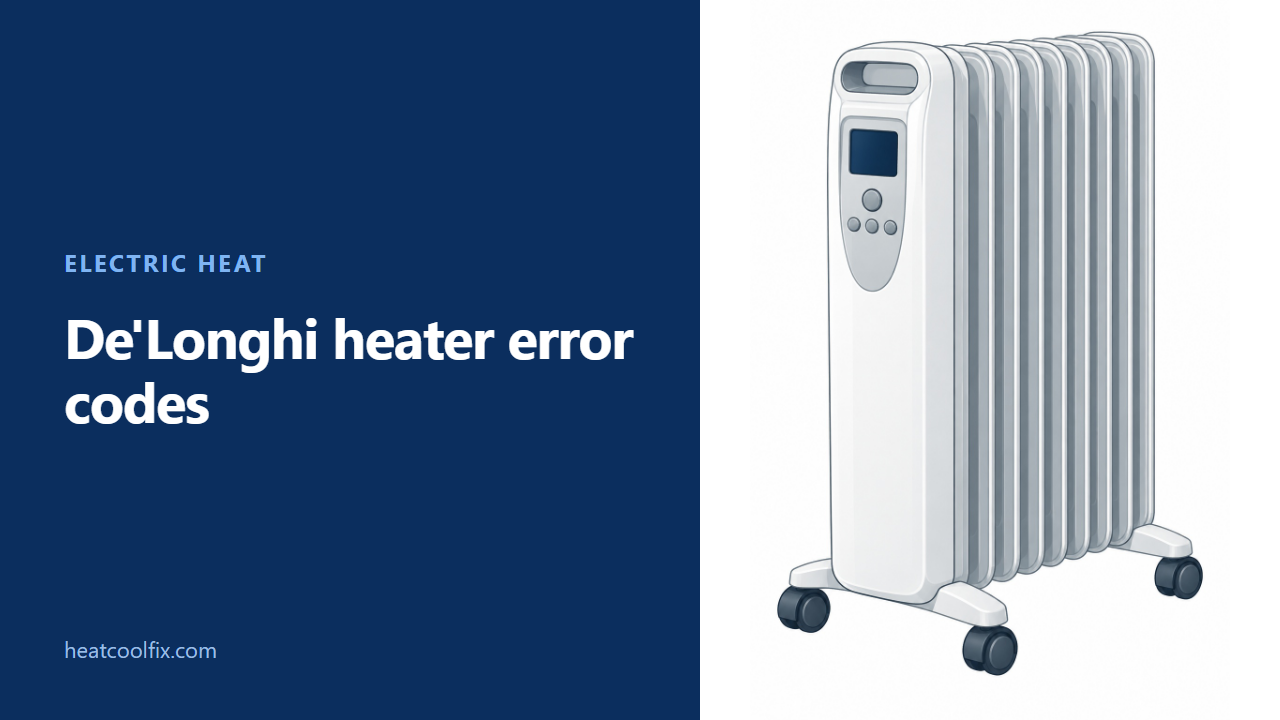
De'Longhi's US TRD40615E Dragon manual identifies Ht as high internal temperature and PF as probe failure. Ht calls for checking that the radiator is not covered or obstructed. PF stops operation and needs customer service. The manual also treats an overheating safety shutdown separately.
De’Longhi heater error codes Ht and PF have specific meanings in the US Dragon TRD40615E manual: high internal temperature and probe failure. They call for different responses, so read the letters carefully before looking for a reset button.
This guide follows the TRD40615E instructions linked from De’Longhi’s US support pages. It covers the oil-filled radiator’s display and alarms. A ceramic tower needs its own instructions, even if a search result shows the same letters.
For a heater that simply fails to warm the room without an alarm, start with the broader space heater troubleshooting guide.
Before you start
What to carry: a torch, your phone and the model information. Capture the whole display, including any lock or timer symbol. Keep a note of whether the message flashes or stays on, and whether the radiator still produces heat.
Gas or electric? The TRD40615E instructions describe a 120-volt electric radiator. The oil is contained inside the appliance; this is not a fuel burner to relight.
Renting? If the heater belongs to the property, send the model and display to the maintenance contact before arranging replacement or repair.
De’Longhi says not to operate this heater with a damaged cord or plug, after damage, or if it leaks oil. Stop using a leaking unit and contact its service center.
The manual requires a direct connection to a suitable outlet, without an extension cord or outlet strip. De’Longhi also says to insert the plug fully and check it periodically for overheating or deformation. An excessively hot or deformed plug or cord can point to an outlet problem; a defective outlet must be replaced before the heater is used again.
To switch the appliance off completely, De’Longhi says to press ON/OFF and then unplug it. Let the radiator cool before cleaning or moving it, and keep bare skin off hot surfaces. De’Longhi says to use the handle when moving it. Its repair warning directs malfunctions to customer service rather than opening the heater yourself.
Two alarms, two different responses
| Dragon display | De’Longhi’s explanation | Direction in the manual |
|---|---|---|
| Ht | Internal temperature is too high; heating power reduces automatically | Check for covering or obstruction |
| PF | Probe failure; the appliance does not operate | Contact De’Longhi customer service |
Ht: look for something trapping the heat
De’Longhi says Ht appears intermittently while the internal temperature is high. The heater progressively reduces its power until the temperature drops. Its troubleshooting table names a covered or obstructed unit as the cause to check.
With the heater switched off and unplugged, look for clothing, a curtain or another object covering the appliance. Do not handle hot surfaces to pull something free. Let it cool and restore the clear space required by the instructions before considering further use.
For this Dragon manual, flammable materials must stay at least three feet from the front and top, and avoid contact with the sides and back. The manual also prohibits blocking its air openings or using it on a soft surface where openings could become blocked.
De’Longhi says the Ht alarm disappears as the internal temperature decreases. If the heater remains in trouble after the obstruction is removed and it cools, its troubleshooting section directs you to customer service.
PF and the separate overheating safety device
PF: arrange service for the probe fault
The Dragon manual calls PF probe failure and says the appliance does not operate with that alarm. Its prescribed next step is De’Longhi customer service, rather than an owner sensor replacement or button sequence.
Send the display photograph and model information with the request.
Do not confuse an Ht warning with a safety shutdown
De’Longhi describes its overheating safety device separately from Ht. That device switches the heater off, and the instructions say to call customer service.
The distinction matters: the Ht paragraph describes automatic power reduction, while the safety-device paragraph describes a shutdown. The manual does not give the owner an internal thermal reset procedure.
For this model, clearing space around an Ht radiator should not become repeated attempts to restart a heater that has shut down on its safety device.
A lock, timer or dim screen can be normal
Check the control indication when no alarm is showing
De’Longhi’s key lock prevents accidental operation. On this TRD40615E control, holding plus and minus together for at least three seconds activates it; the same action deactivates it. A lock symbol and double beep confirm activation.
The manual also describes a delayed start and a delayed stop. With a timed stop set, the radiator switches off at the end of the selected period. Pressing the timer button twice cancels timer operation, and its symbol disappears.
A screen that dims after you stop pressing buttons is another documented behavior. De’Longhi says its display drops from the brighter keypress setting to the operating brightness after a few seconds. That change alone is not Ht or PF.
If the complaint is ticking or crackling rather than a display message, the heater noise guide covers that separate symptom.
What each one takes
| Finding | Work involved |
|---|---|
| Ht with a covering or obstruction | Safe shutdown, cooling and restoring clear space |
| PF | De’Longhi customer service and probe-fault diagnosis |
| Overheating safety shutdown | Manufacturer guidance before further use |
| Key lock or timer indication | Changing the intended front panel setting |
| Damaged plug, cord or oil leak | Stop use; outlet or appliance service as appropriate |
Questions people ask
Where is the US Dragon error-code manual?
De’Longhi links the TRD40615E instructions from its US support listing. The alarms and troubleshooting chart are on printed page 7, PDF page 8 in this file.
Does HE mean the same thing as Ht?
The Dragon manual used here defines Ht and PF; it does not define HE. Compare the photographed characters with your model’s alarm illustration before describing the fault to support.
What does error 3.1 mean?
This TRD40615E alarm list does not contain 3.1. Keep the exact display and model together rather than treating that number as a Dragon sensor code.
Why did it stay off after I unplugged it?
De’Longhi says this unit returns to off after a power interruption or unplugging. Pressing ON/OFF restores the previously selected operating conditions. That describes normal power recovery, not permission to restart a damaged heater.
Is ECO an error message?
No. De’Longhi describes ECO as a function that automatically selects heating power. Its available cycle includes off, so a pause in heating can be part of the selected operating mode.
The other electric heating guides: space heater shutdowns, space heater noises and baseboard heating faults.
Sources: De'Longhi TRD40615E Instructions for Use, document 5711010611/05.13_00, printed page 1 and pages 4 to 7; US model support and English (United States) manual listing:
Read next
 Electric heat
Honeywell Heater Error Codes: E1, Beeps and Shut Offs
On a Honeywell space heater, E1 is about the tip-over switch. The HZ-960, HZ-970 and HZ-980 manual says the heater is tipped
 Electric heat
Pelonis Heater Error Codes: E1, E2, E3, FF and P4
On Pelonis digital space heaters, E1 or E2 means the temperature sensor has a short or open circuit. FF is the over
 Electric heat
Dreo Heater Error Codes: E1, E2, FF, F2, P4 and PP
Dreo heaters show a code on the LED display, and Dreo's own product pages explain them. FF or F2 is overheat protection:
 Electric heat
Heat Storm Heater Error Codes: EE, EO, E1 and UH
On Heat Storm's HS-1500-PHXG-WI V2 manual, EE is a temperature-probe error, EO is a program-setup failure and E1 is a tip-over error.