Space Heater Making Noise? Ticking, Clicking or a Loud Fan
 By Ray Bennett · Updated 2 October 2026 · 10 min read · Checked against the sources at the end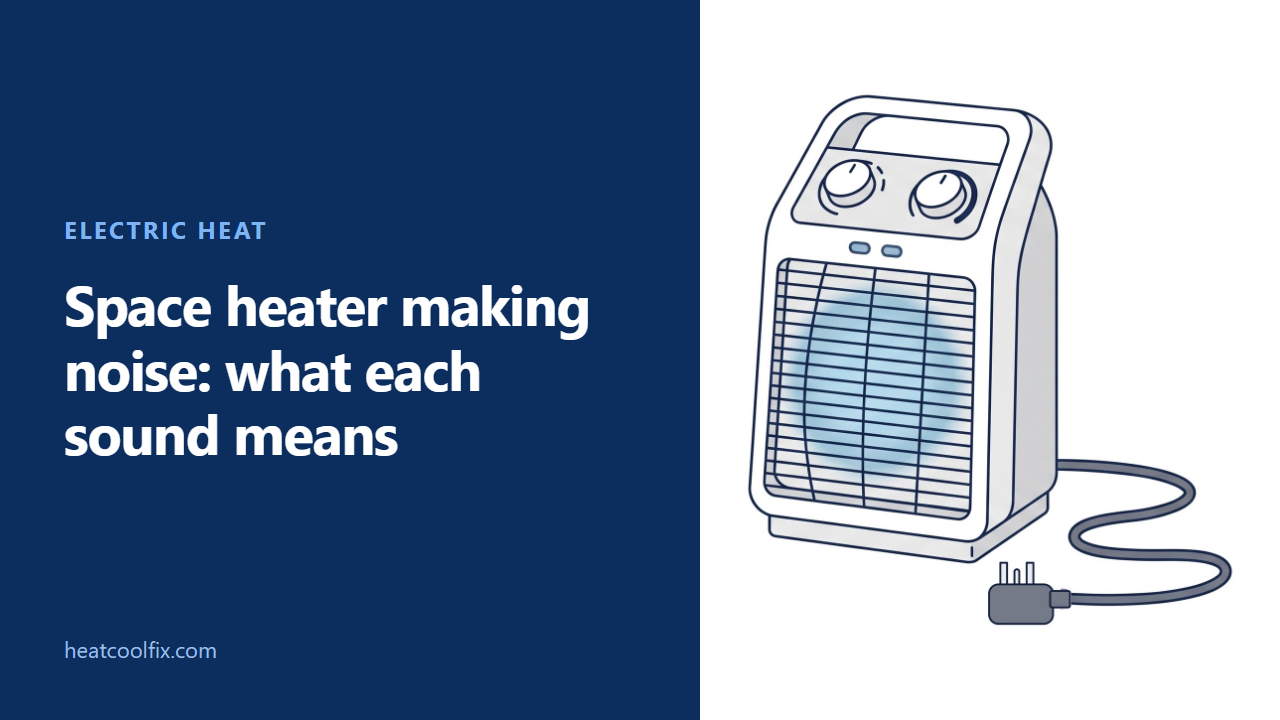
Ticking from an oil-filled radiator as it warms is the oil expanding, Honeywell says, and De'Longhi calls crackling normal the first time it runs or when it has not been used for a while. A fan heater that has got louder may need its grille, inlets or filter cleaned. Sparks, or a plug or outlet that feels hot, mean turn it off and unplug it now.
The sounds on this page come from three places: the oil or metal warming up, the fan, and the electrics. The makers say which of the first two are normal. The third is the one to take seriously, so it comes first, in the warning below.
This page is about plug-in electric heaters: oil-filled radiators, ceramic towers and fan heaters.
Before you start
What to carry: a torch and a vacuum cleaner with a brush attachment.
Gas or electric? Everything here is about electric heaters that plug into the wall. A kerosene or propane heater burns fuel and is a different machine; CPSC says never to refuel one while it is in use. If your heater has stopped altogether, see a space heater not working.
Which kind you have. An oil-filled radiator looks like a row of fins on wheels, with the oil sealed inside, and De’Longhi says some of its models also have a turbo fan. A ceramic tower or a fan heater has a fan that pulls air in through inlets or a filter and pushes it out through a grille.
Off and unplugged before you clean or move it. Vornado and Honeywell both say to turn the heater off with its own controls first and then pull it out by the plug, never by the cord, and Honeywell says to let it cool. On Honeywell’s ceramic tower, let it finish its short cool-down after you press off before you unplug it.
Never open it up. Honeywell says not to open the motor housing yourself, because it can void the warranty and cause damage or injury, and its tower heater does not come apart. A heater that has been dropped, damaged or has started to malfunction should be thrown away or checked by an authorized service facility, Honeywell and Vornado say.
What the sound tells you
An oil-filled radiator that ticks or crackles
Why it happens. As the heater warms, the oil inside the fins can expand. Honeywell says that can make a slight ticking sound that stops once the oil reaches its working temperature, and that its radiators can take up to several minutes to get there. De’Longhi says crackling is normal the first time a heater is switched on, or when it has not been used for a while.
A squeak on day one. De’Longhi also says a squeaking noise is normal when a new radiator is first turned on.
Keep it upright. De’Longhi says to use its radiators in the vertical position only. If one has been lying on its side, stand it up properly before you switch it on.
Oil on the floor. That is not a noise to wait out. If oil leaks, De’Longhi says to contact the maker or an authorized service center, and only they may open the radiator.
It turns itself off and on
The thermostat at work. Honeywell says its ceramic tower runs either continuously or on a thermostat setting, where it cycles on and off to hold the temperature you chose. If the room is already warmer than your setting, it stays off until the room cools. If it shuts off while the room is still colder than your setting, that is not the thermostat: Honeywell says a safety feature may have acted to prevent overheating, so go to check 5.
A click from an oil-filled radiator. On a De’Longhi radiator, the thermostat gives a click at the point where it switches the heat off, and its instructions use that click to set the temperature.
Metal settling. Dimplex says a slight clicking or pinging sound is normal as its heaters’ metal parts expand and contract.
The fan. On a Vornado set to Auto, the fan adjusts higher or lower with the heat to hold the set temperature. On Honeywell’s ceramic tower, the heater counts down 6 seconds after you press off, to cool the parts inside, before it shuts off.
A fan that has got louder
Why. A fan heater pulls a lot of air through it, and Vornado says dust, hair and debris can build up inside as it runs. Dimplex says that if its heater’s noise becomes loud or persistent, check that it is secure and that nothing is obstructing it.
Vornado’s cleaning. Unplug it first. Vacuum the dust off the front grille and the air inlets on the sides with the brush attachment, then wipe the heater with a soft, dry cloth. Vornado recommends cleaning the outside every week, and blowing the heater out with compressed air now and then to keep the element and motor clear.
Honeywell’s filter. On its ceramic towers with a filter, Honeywell says to switch off, unplug, let the heater cool, take the filter cover off and clean or vacuum the filter. It recommends cleaning the heater at least once a month and before you put it away for the summer, with a dry cloth only and no water, wax or polish.
A turbo radiator. On De’Longhi radiators with a turbo fan, a safety device switches the heater off if dust builds up on the air intake and output grills. Unplug it, let it cool, vacuum the grills, then plug it back in.
Something caught in it. Vornado says an object that stops the fan blade turning can make the heater overheat and cut its own power. Honeywell says that if you find an obstruction, turn the heater off and unplug it, let it cool completely, then remove it.
A rattle, or a noise that will not settle
Where it stands. Honeywell says to place its heaters on a firm, level, open surface, never on bedding or deep carpet, and that their rubber feet hold them firmly in place. Vornado says not to use a heater on an uneven or unstable surface, or up on a shelf or desk: only on the floor, standing upright.
Room around it. Keep it at least three feet from anything that can burn, such as curtains, furniture or bedding, CPSC says. Honeywell gives the same three feet from any wall or anything combustible.
If the noise stays. If it still rattles after cleaning, on a firm, level floor, do not take it apart. Stop using it, unplug it and contact the maker: Vornado says a heater that needs repair should be unplugged and not used, and Honeywell says to contact it first.
It clicks off and stays off
Or just the settings. Honeywell says the heater may simply be off because the room has reached your temperature setting or the timer has run out. Check those first.
A safety switch. Vornado’s MVH cuts its own power if it tips more than 10 degrees, or if the airflow is blocked and it starts to overheat. Honeywell’s heaters have a tip-over switch too. Stand it back upright. Before you clear anything blocking it, turn it off and unplug it, as Vornado and Honeywell say, and Honeywell says to let it cool completely first.
Getting it going again. Each maker resets its heater a little differently, and the steps are in a space heater not working.
If it will not come back on. Honeywell says its heaters also have a thermal cut-off fuse that shuts the heater down for good if it runs hotter than normal, and on the HCE200 the heater then has to be replaced. De’Longhi says the overheat safety device on its radiators is reset by an authorized service center, not at home.
When to unplug it and stop
At the plug or the outlet. Sparks when you plug it in or while it runs, a warm outlet cover plate, or lights that flicker or dim: Vornado says to turn the heater off and unplug it at once, and have an electrician find the cause before you use it again. A plug that feels warm is normal, Honeywell says, but a loose fit between the outlet and the plug can overheat and distort it. If the plug or outlet is hot, or the plug sits loose, Vornado says to stop using the heater until an electrician has replaced the outlet. NFPA says to call a qualified electrician or your landlord for warm or discolored outlets, sparks from an outlet, or a burning or rubbery smell from an appliance.
Straight into the wall. CPSC says to always plug a space heater directly into a wall outlet, never into an extension cord or a power strip, so it does not overload them and start a fire. NFPA says to plug only one heat-producing appliance, such as a space heater, into an outlet at a time, and Honeywell says not to put the heater on a circuit that already has other appliances working.
Grinding, or a smell of burning. Honeywell and Vornado say not to run a heater after it malfunctions, so if the fan grinds or scrapes, or a burning smell keeps coming back, stop using it and contact the maker. For smells, see an electric heater that smells like burning.
What each one takes
| What you notice | What it takes |
|---|---|
| Ticking from an oil-filled radiator as it warms, or crackling at first use | Nothing, it is normal |
| The heat going off and on, the fan changing speed | Nothing, it is normal |
| A louder fan | Cleaning the grille, inlets and filter |
| A rattle | A firm, level spot on the floor |
| It switches off and stays off | A reset after it cools; if it will not reset, the maker’s service or a new heater |
| Grinding, or a noise that stays after cleaning | The maker’s service, or a new heater |
| Sparks, a hot plug or outlet, or a warm outlet cover | Unplug it, and an electrician for the outlet |
Questions people ask
Is it normal for a space heater to make noise?
Some, yes. Honeywell says ticking from an oil-filled radiator as it warms is normal, and De’Longhi says crackling is normal the first time it runs or when it has not been used for a while. Dimplex says a slight clicking or pinging as its heaters’ metal parts expand is normal. A fan heater also makes the sound of its fan.
Why does my oil heater tick or crackle?
As it heats, the oil inside can expand and tick, Honeywell says, and the ticking stops once the oil reaches its working temperature, which can take up to several minutes. De’Longhi says crackling is normal the first time it runs or when it has not been used for a while.
Why does my space heater keep turning off and on?
On a thermostat setting it cycles on and off to hold the temperature you chose, Honeywell says. If it switches off and stays off, Honeywell says the room may have reached your setting or the timer may have run out; if not, a tip-over or overheat safety switch may have cut the power.
Why is my space heater fan so loud?
Vornado says dust, hair and debris can build up inside a fan heater as it moves air, and Dimplex says to check that a heater whose noise gets loud is secure and free from obstructions. Turn it off, unplug it and let it cool, then vacuum the grille, the inlets and any filter, and stand it on a firm, level floor. If it grinds, or the noise stays, stop using it and contact the maker.
Is it normal for a space heater plug to feel warm?
Honeywell says it is normal for the plug to feel warm to the touch. A plug or outlet that is hot is not: Vornado says to stop using the heater and have an electrician replace the outlet, and to turn it off and unplug it at once for sparks or a warm outlet cover plate.
The other electric heat guides: a space heater not working, an electric heater that smells like burning, a baseboard heater making noise and a wall heater making noise.
Sources: Honeywell HZ-789 oil-filled radiator, HCE300 ceramic tower, HCE200 and HZ-0360 heater manuals, De'Longhi oil-filled radiator instructions (GB 5708014700 and Australia GB-5786002700), Vornado MVH and AVH2 whole room heater owner's guides, Dimplex heater FAQ, CPSC release 25-101 (January 2025), and NFPA electrical safety tips
Read next
 Electric heat
Baseboard Heater Won’t Turn Off? Thermostat, Size or Wiring
On a single pole baseboard thermostat, Dimplex says there is no off position and power is continuous to the heater, and Qmark
Electric heat
Baseboard Heater Won’t Turn Off? Thermostat, Size or Wiring
On a single pole baseboard thermostat, Dimplex says there is no off position and power is continuous to the heater, and Qmark
 Electric heat
Wall Heater Making Noise? Fan, Ticking, Clicks and Clunks
A steady fan sound is normal: Cadet says wall heaters are generally quieter than a regular refrigerator. On a Williams gas wall
Electric heat
Wall Heater Making Noise? Fan, Ticking, Clicks and Clunks
A steady fan sound is normal: Cadet says wall heaters are generally quieter than a regular refrigerator. On a Williams gas wall
 Electric heat
Electric Heater Smells Like Burning? Dust, Plug or Wiring
A burning smell the first time an electric heater runs, or after it has sat unused, is usually factory oil or dust
Electric heat
Electric Heater Smells Like Burning? Dust, Plug or Wiring
A burning smell the first time an electric heater runs, or after it has sat unused, is usually factory oil or dust
 Electric heat
Baseboard Heater Making Noise? Clicking, Popping, Buzzing
Popping, crackling or clicking as an electric baseboard heater warms up or cools down is the metal expanding and contracting, which Dimplex
Electric heat
Baseboard Heater Making Noise? Clicking, Popping, Buzzing
Popping, crackling or clicking as an electric baseboard heater warms up or cools down is the metal expanding and contracting, which Dimplex