Swamp Cooler Smells Bad? Musty, Fishy or New Pad Smell
 By Ray Bennett · Updated 2 October 2026 · 10 min read · Checked against the maker’s manual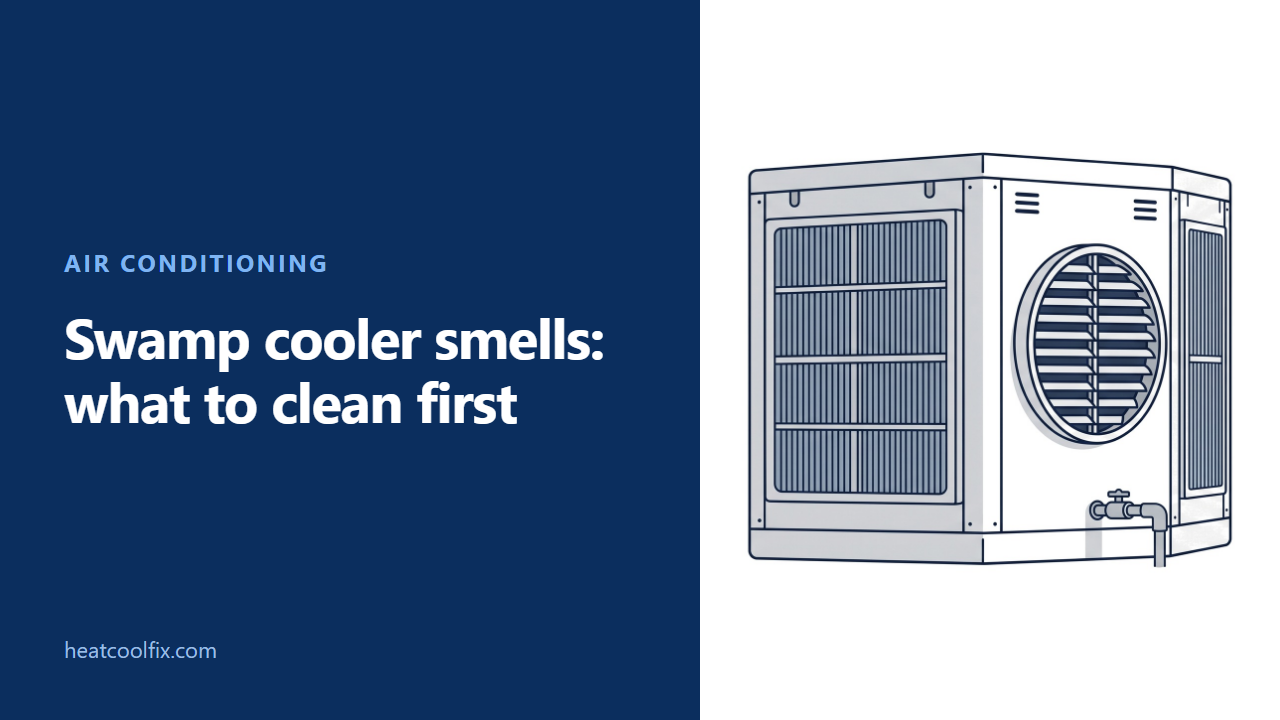
Phoenix's and Portacool's troubleshooting charts both blame a musty or unpleasant smell from a swamp cooler on stale water in the pan or tank and on mildewed or clogged pads. Turn the power off, drain, flush and clean the water, and clean or replace the pads. Then turn the pump off about 15 minutes before the fan each day so the pads dry out, as Portacool says.
A swamp cooler, an evaporative cooler, blows outdoor air through wet pads, so it smells of whatever is growing in its water and pads. Phoenix’s troubleshooting chart, written for its industrial and commercial coolers, and Portacool’s chart for its portable coolers give the same two causes for a musty or unpleasant odor: stale or stagnant water, and pads that are mildewed or clogged. New pads can smell for a while too.
The manuals we read do not name a fishy smell. Unless it smells burning or rubbery, start with the water and the pads.
Before you start
What to carry: a torch, a bucket, a soft brush and a cloth, and new pads if the old ones are mildewed.
Gas or electric? A swamp cooler runs on electricity and water only: a fan motor and a water pump, with no gas and no refrigerant. A central air conditioner that smells is covered in an air conditioner that smells.
Which kind. DOE says most home evaporative coolers sit on the roof, some are on the ground or in a window, and portable ones on wheels give only a slight cooling effect. The water sits in a pan at the bottom of a fixed cooler and in a tank in a portable one.
Drain it safely. Phoenix says to drain its coolers with the water supply and the power turned off, and never onto a roof. DOE’s Building America guide says standing water can breed mosquitoes and bacteria, including Legionella, the cause of Legionnaires’ disease.
Mind the roof. Seeley’s Breezair TBQ/TBS manual says climbing onto the roof can be hazardous and could injure you and damage your property, and suggests a Seeley dealer or service agent do the maintenance on a roof cooler. DOE says routine maintenance on a roof cooler may require a ladder.
No chemicals your maker does not allow. Phoenix says not to use cooler cleaners, treatments, anodes or other chemical additives in its industrial and commercial coolers, and that they void the warranty. Munters, writing about commercial pad walls, says never to use a chemical that is not labeled for evaporative coolers.
Where the smell comes from
Drain, flush and clean the water
Why. Phoenix’s and Portacool’s charts list stale or stagnant water as the first cause of a musty or unpleasant odor, and both say to drain, flush and clean the reservoir or tank. Hessaire says stagnant water can develop odors.
A portable cooler. Portacool says to shut the cooler down, disconnect the power and drain the tank once a week by removing the drain cap. With the tank drained and the power off, the media can come out so the tank can be cleaned, where dust may collect over time. Put the media back facing the way its label shows: Portacool says not to run the cooler unless all the media is securely in place. Hessaire says to unplug the unit first, drain and clean the tank at least weekly, and clean it with mild soap and water monthly.
Before it sits unused. Hessaire says to drain it completely and let it dry. Portacool says to store it with the tank wiped clean, the media and tank dry, and the cooler covered.
A roof or window cooler. DOE says to check the pads, filters, reservoir and pump at least once a month in hot climates where the cooler runs often, and its Building America guide says regular maintenance keeps the reservoir clean and odor-free. The guide also says to empty the pan whenever the cooler will sit idle for more than a few days, and in winter to shut off the water line, drain and clean the pan, and fit a cover.
How to drain it. Phoenix says to drain its coolers with the water supply and the power off, through a drain hose, and never onto a roof. Phoenix says never to wash the cooler cabinet with a garden hose, because water may harm the motor and pump or seep into the ductwork, and Portacool says to keep water out of the motor and electrical system when cleaning. Seeley’s Breezair TBQ and TBS coolers have Manual Drain, Drain and Dry and Autoclean settings on their MagIQtouch controller that drain the tank for you.
Clean or replace mildewed pads
Why. Phoenix’s and Portacool’s charts list pads that are clogged or mildewed as the second cause of an odor. Hessaire says a musty smell usually means mold or mildew on the cooling pads.
The fix. Portacool’s fix is to replace the media, and Phoenix’s is to check the bleed-off and clean or replace the pads. DOE says some paper and synthetic pads can be cleaned with soap and water or a weak acid, following the maker’s instructions. Hessaire says to replace pads that still smell after cleaning, and generally at least once a cooling season. DOE’s Building America guide says to replace torn, worn or mildewed pads.
Fitting new pads. On a downdraft metal cooler, Hessaire says new pads must sit at the very top of the panels, because pads fitted too low let water leak into the ductwork and the ceiling.
How often. DOE says to replace the pads at least twice a cooling season, or as often as once a month if the cooler runs all the time. Seeley says its honeycomb Chillcel pads last longer than other kinds, and to expect to change them every 7 or 8 years. Seeley warns that pads kept past their useful life can let water carry over into the ductwork and electrics.
Let the pads dry out every day
Pump off first. Portacool says to turn the pump off about 15 minutes before the fan at the end of the day, so the media dries. It says dry media at the end of the day lasts longer and helps control mildew, mold, bacteria and other odor-causing growth. Hessaire says to run the cooler in fan-only mode after use to dry out the pads. Seeley’s Drain and Dry setting on its TBQ and TBS coolers drains the tank and runs the fan for an hour at a time you choose each day.
Pads wet before the fan. Phoenix’s chart lists pads that are not completely wet before the cooler starts as a cause of odor, and its fix is to turn the pump on for several minutes before starting the cooler.
What stops algae. Munters, writing about large commercial pad walls, says algae needs light, moisture and nutrients, and cannot live when the pad is bone dry. It says to let the pads dry completely once every 24 hours, to turn the pumps on last and off first, and to cover the sump to keep out dirt and light. It also says not to use phosphate scale control agents or detergents in the pads, because they break down into food for algae, and to clean old algae and rotted pads out of the system.
New pads: give them time
A new cooler or new pads. Seeley says its Chillcel pads are a bit smelly when a new cooler is first turned on, and the smell does not last long. Portacool says new media may give off a slight smell that lessens in time, and that it does not let harmful chemicals into the air.
Speeding it up. Seeley’s fix for odor from new pads is the Pad Flush setting on its MagIQtouch controller, or draining the tank now and then during the running-in period so fresh water flushes the pads.
Look for smells pulled in from outside
Why. A swamp cooler blows outdoor air into the house, so it brings in whatever is near it. Phoenix says not to place its industrial and commercial coolers near vent pipes or kitchen exhaust, because odors or fumes may be drawn into them, and to install them where only fresh outside air can enter.
Let the air out. Seeley says the air a cooler blows in collects moisture and impurities and must leave the building, so keep doors or windows open. More on that in a swamp cooler not cooling.
Water treatments and cleaners
Follow your own maker. Phoenix says not to use any cooler cleaners, treatments or additives in its industrial and commercial coolers other than the bleed-off it supplies, because they void the warranty and may shorten the cooler’s life. Portacool sells its own Hard Water Treatment for hard water, and Hessaire says some cooler-safe water treatments can prevent odor.
What Munters says. Munters, writing about commercial pad walls, says continuous use of algae chemicals is not recommended and is potentially harmful, and that they will not control algae without regular cleaning and flushing. It says oxidizing chemicals such as bleach, used continuously or too strong, can destroy wood, cellulose and metals, and that overdosing is easy.
Vinegar. DOE’s Building America guide says to clean the water nozzles with vinegar to remove mineral scale.
A burning or electrical smell
Power off. A burning, rubbery or hot electrical smell is not a water or pad smell. Switch the cooler off at the service panel and at every disconnect that feeds it, or unplug it, and do not run it again until it is checked. Portacool says not to keep running a cooler that is damaged or malfunctions.
Call an electrician. NFPA says to call a qualified electrician or your landlord for a burning or rubbery smell coming from an appliance, or a tingling feeling when you touch one.
The pump cord. Phoenix says its pump cords clip into retainers so they do not touch the water, and Portacool says never to run a cooler with a damaged cord.
What each one costs
| The step | Cost |
|---|---|
| Draining and cleaning the pan or tank | Nothing |
| Drying the pads every day | Nothing |
| New pads | The price of the pads |
| Checking for vent pipes or kitchen exhaust nearby | Nothing |
| Maintenance on a roof cooler | A dealer or service agent, if you would rather not climb |
| A burning or electrical smell | An electrician |
Questions people ask
Why does my swamp cooler smell like fish?
The manuals we read do not name a fishy smell. The causes Phoenix’s and Portacool’s charts give for a musty or unpleasant odor are stale water and mildewed or clogged pads, so drain, flush and clean the water and clean or replace the pads first. If it smells burning or electrical, turn it off and call an electrician.
Why does my swamp cooler smell musty?
Phoenix’s industrial cooler chart and Portacool’s portable cooler chart list stale or stagnant water and mildewed or clogged pads. Hessaire says a musty smell usually means mold or mildew on the pads.
How do I stop my swamp cooler from smelling?
Unplug a portable cooler and drain and clean its tank weekly, as Portacool and Hessaire say, and turn the pump off about 15 minutes before the fan each day so the pads dry, Portacool says. Empty a roof cooler’s pan whenever it will sit idle for more than a few days, DOE’s Building America guide says. Replace pads that still smell after cleaning.
Is it normal for new swamp cooler pads to smell?
Yes, for a while. Seeley says its new Chillcel pads are a bit smelly at first and the smell does not last long, and Portacool says the slight smell from new media lessens in time.
Can I put bleach or vinegar in my swamp cooler?
Check your own manual first. Phoenix says not to use cooler cleaners, treatments or other chemical additives in its industrial and commercial coolers. Munters, writing about commercial pad walls, says bleach used continuously or too strong can destroy wood, cellulose and metals, and that overdosing is easy. DOE’s Building America guide says to clean the water nozzles with vinegar.
Sources: Phoenix Manufacturing AeroCool industrial/commercial evaporative cooler owner's guide 1-999-2469, Portacool Classic portable evaporative cooler owner's manual (2017), Seeley International Breezair TBQ/TBS owner's manual and Seeley FAQ, Hessaire mobile cooler troubleshooting page, Munters engineering bulletins MB-ACP-205 on preventing algae in evaporative cooling pads and MB-ACC-205 on common algae treatment chemicals, DOE Energy Saver "Evaporative Coolers", DOE Building America Solution Center (PNNL) "Evaporative Cooling Systems" guide, and NFPA electrical safety tips
Read next
 Air conditioning
Swamp Cooler Not Cooling? Windows, Pads, Water and Pump
A swamp cooler only cools when its pads are soaking wet, the outdoor air is dry enough, and the air it blows
Air conditioning
Swamp Cooler Not Cooling? Windows, Pads, Water and Pump
A swamp cooler only cools when its pads are soaking wet, the outdoor air is dry enough, and the air it blows
 Air conditioning
What Size Dehumidifier Do I Need? Pints by Dampness
ENERGY STAR sizes a portable dehumidifier by how damp the space is: 20 to 30 pints a day for a damp room
Air conditioning
What Size Dehumidifier Do I Need? Pints by Dampness
ENERGY STAR sizes a portable dehumidifier by how damp the space is: 20 to 30 pints a day for a damp room
 Air conditioning
What Size Window Air Conditioner Do I Need? BTU Chart
Measure the floor area and read ENERGY STAR's chart: 5,000 BTU for 100 to 150 square feet, 6,000 up to 250, 8,000
Air conditioning
What Size Window Air Conditioner Do I Need? BTU Chart
Measure the floor area and read ENERGY STAR's chart: 5,000 BTU for 100 to 150 square feet, 6,000 up to 250, 8,000
 Air conditioning
Ceiling Fan Direction in Winter and Summer, Explained
Counterclockwise in summer, clockwise at low speed in winter. ENERGY STAR says the summer direction makes a breeze and a wind chill,
Air conditioning
Ceiling Fan Direction in Winter and Summer, Explained
Counterclockwise in summer, clockwise at low speed in winter. ENERGY STAR says the summer direction makes a breeze and a wind chill,