Wall Heater Making Noise? Fan, Ticking, Clicks and Clunks
 By Ray Bennett · Updated 2 October 2026 · 10 min read · Checked against the sources at the end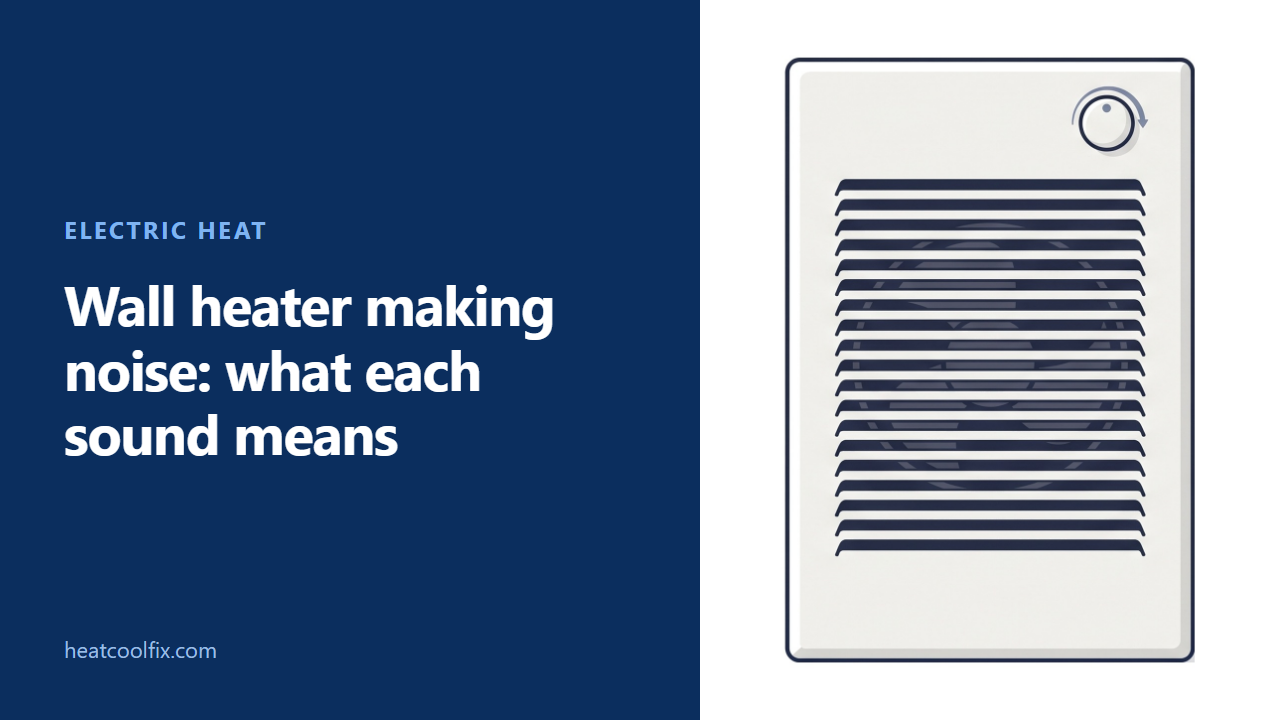
A steady fan sound is normal: Cadet says wall heaters are generally quieter than a regular refrigerator. On a Williams gas wall furnace, a noisy blower can be a dirty blower, cleaned with the power off, or a rattling housing or bent wheel, which a technician fixes. On a Rinnai, sharp clicks at ignition are the heat exchanger expanding and a clunk is the gas valves.
A wall heater makes three kinds of noise: its fan, and on a gas wall furnace, the heat exchanger expanding and the gas valves and burner. The makers say which of those are normal and which mean switch it off.
This page covers electric wall heaters, the fan heaters with a grill set into the wall, and gas wall heaters, also called wall furnaces.
Before you start
What to carry: a torch, a screwdriver, a hair dryer or a vacuum that can blow, and a voltage detector, which is on King’s list of tools for cleaning its heaters.
Gas or electric? An electric wall heater is wired into the house and has no pipes. A gas wall heater has a gas line and a vent, either a pipe going up or a vent through the wall. For a gas heater that will not light or stay lit, see a gas wall heater not working.
Power off, and check it is off. King says to turn off the circuit for the heater and then test it with a voltage detector. Cadet warns that breakers are often not marked correctly, and says to lock or tag the panel door so nobody turns the power back on. Williams says to let its Monterey Plus gas wall heater cool and to shut off both the electricity and the gas when working on it. Rinnai says to turn its furnace off with the ON/OFF button, and never to unplug it while it runs or while its fan is on.
Sparks, smoke or unusual noise. Cadet and King say not to run an electric heater after it malfunctions: turn the power off at the panel and have a qualified electrician inspect it first. Williams says that if sparking, odors or unusual noises happen when its gas wall heater starts up, shut off the electric power at once and recheck for wiring faults or obstructions near the fan motor. If the furnace overheats or will not shut off, Williams says to close the manual gas valve before turning off the power to the fan.
What the noise tells you
Sounds the makers call normal
The fan. Cadet says its fan-forced wall heaters are generally quieter than a regular refrigerator.
A fan that slows down or runs on. Cadet says its Energy Plus heater has a variable speed blower, and that a slower fan and lower heat output are normal once the room is at the set temperature. In its Night/Away mode, the fan runs at a low level for 5 to 10 minutes until the heater cools down.
A motor that runs slowly. On other wall heaters, Cadet says to make sure the supply voltage matches the heater’s rating and that the heater is clean. If it still runs slowly, the motor or heater may need servicing or replacing.
On a Rinnai gas wall furnace. Rinnai says its fan starts after a short delay once the burner lights, to let the heat exchanger warm up and avoid cold drafts, and keeps running after you turn the heater off until the heat exchanger cools. It says sharp clicking at ignition, or when the heater turns down or goes out, is expansion noise from the heat exchanger, and a clunk when the thermostat operates is the gas valves opening and closing.
An electric wall heater: clean the fan
Why. King says to clean an electric heater at least twice a year, and more often with pets or a lot of dust. Cadet says to clean its Com-Pak heaters as needed, or every six months at least, and its Energy Plus heaters at least every six months. Marley says owners of its Smart Series wall heater should only vacuum and wipe the outside and the grille openings, and leave cleaning inside to qualified service personnel.
King’s steps. Turn off the circuit and test it with a voltage detector. Take the thermostat knob off carefully before the grill, because forcing it can damage the thermostat. Blow the dust out with compressed air, or a low-velocity blower or vacuum, but never canned air, which King says can hold a flammable propellant. Keep the fan blades from spinning while you blow, because that can damage the motor.
Cadet’s Com-Pak steps. Cadet’s Com-Pak guide says to make sure the power is off and the element is cool, take the grill off and wash it in hot soapy water, then dry it. Hold the fan so it is not damaged or bent while you blow debris through the element with a hair dryer or a vacuum on blow, and vacuum the fan area without touching the elements.
Then listen. King says to put the grill back only when it is completely dry, turn the power back on, run the heater for a few minutes and listen that it sounds like it is running smoothly.
Do not oil it. Cadet says not to lubricate the motor, and King says its fan motor does not need lubrication.
An electric fan that will not spin
Stop using it. Cadet and King say not to run any heater after it malfunctions: turn the power off at the panel and have a qualified electrician inspect it before using it again.
What Cadet lists. Cadet’s Com-Pak chart says that if the element heats for a moment without the fan turning and then stops heating, the cause is a defective motor or internal connection, or a fan or motor that is jammed. For a defective motor or connection, the heater or fan motor needs replacing. For a jam, turn the power off at the breaker, let the element cool, remove the obstruction and reset the heater as its instructions describe; if it still does not run, it needs repair or replacement.
On an Energy Plus. Cadet’s chart says a fan or motor that does not spin is a defective motor or one out of alignment, and the fix is a new motor. Cadet says any service other than cleaning should be done by an authorized service representative.
When it keeps shutting off. King’s WHF manual says that if its thermal protector shuts the heater off again, turn it off at the breaker at once and look for a failed fan motor or dirt and lint on the element. If it keeps cycling the heater off, King says to disconnect the power and have a qualified electrician check and repair it. Cadet says a Com-Pak whose limit trips more than once a day must be replaced.
Check for a recall. CPSC says the fan on some Cadet Apex72 high wall heaters can fail to turn on, so the heater overheats and can catch fire inside, and that some old Cadet and Encore in-wall heaters could send flames, sparks or molten particles through the grill. See the Cadet recalls to check.
A Williams gas wall furnace: a noisy blower
Cleaning. Williams says to let the furnace cool and to shut off the electricity and the gas before working on it. Its care section for the Monterey Plus says that if it has the optional blower, clean any lint or dirt from the fan blades, the fan motor and the air passages you can see.
What else Williams lists. Its troubleshooting chart, which it marks as for qualified service technicians, gives three causes of a noisy blower: a rattling housing, a dirty blower and a bent blower wheel. The fixes are to tighten the blower screws, clean the blower wheel, or straighten or replace it.
Once a year. Williams recommends that a qualified service technician check the furnace at the start of each heating season.
On a Rinnai. Rinnai says all maintenance and service on its direct vent furnaces is for a qualified service technician.
A gas wall furnace: ticking as it heats
Normal clicks on a Rinnai. Rinnai says sharp clicks at ignition and when the heater turns down or goes out are the heat exchanger expanding.
When the casing is distorted. Williams’ chart lists expansion noise and ticking under abnormal operation. Its fix is to check the installation: the casing may be distorted by being fastened to an uneven opening or jammed under the header, and a restricted vent may create expansion noise. Williams says to make sure no part of the vent is blocked or rusted, and to clean or replace it before using the furnace.
The legs. Williams says the legs must sit flat on the floor plate, and never to raise the furnace up to meet the vent pipe.
On a Rinnai EX38C. Rinnai’s EX38C manual says not to cut the intake hose attached to the heater, because cutting it may result in noise.
Noises that mean call someone
A noisy ignition on a Rinnai. Rinnai’s EX38C chart gives two causes: a blocked flue terminal outside, which it says to clear, and a flue manifold that is not connected, which can also smell of gas and needs a service call.
A gas flame that is not right. Williams lists delayed ignition, with a pilot flame that may be too low, under abnormal operation. It says a flame that blows off noisy burner ports means too much gas pressure, and if the flame looks abnormal, to contact the gas company or a qualified service technician immediately.
A whistle on propane. Rinnai says its RHFE-1004FA can sometimes whistle on propane because of varying gas composition, most of all with a new tank, and its fix is a gas pressure and air shutter adjustment in its service manual: a job for a service technician.
A beep and a red light. Marley says its Smart Series wall heater beeps, lights a red warning light and shows a code when its overheat control trips. If nothing blocks it, Marley recommends an inspection by an electrician or repair service, and says not to keep using a heater that keeps tripping.
A gas smell. Do not touch any electrical switch or use any phone in the building, and call the gas supplier from a neighbor’s phone, as Williams and Rinnai say.
What each one costs
| The step | Cost |
|---|---|
| Fan sound, Rinnai’s clicks at ignition, a valve clunk | Nothing, they are normal |
| Cleaning an electric heater’s fan | Nothing |
| Cleaning a Williams gas wall furnace’s blower | Nothing; on a Rinnai, a service technician |
| A new fan motor, or a new heater | A service visit, or a new heater |
| Blower, casing, vent or flame faults on a gas wall furnace | A service technician |
| A recalled Apex72 | A free new heater, installed, CPSC says |
Questions people ask
Why does my wall heater make noise?
A steady fan sound is normal: Cadet says wall heaters are generally quieter than a regular refrigerator. On a Williams gas wall furnace, a noisy blower can be a rattling housing, a dirty blower or a bent blower wheel. On a Rinnai, sharp clicks are the heat exchanger and a clunk is the gas valves.
Is it normal for a wall heater to click?
On a Rinnai gas wall furnace, yes: Rinnai says sharp clicking at ignition and when it turns down or goes out is expansion noise. Williams lists ticking under abnormal operation and says the casing may be distorted or the vent restricted, which its chart sends to a technician.
Why is my wall heater fan loud or rattling?
On an electric heater, clean the fan with the breaker off and the heater cool, as King and Cadet describe, holding it still so it does not spin. On a Williams gas wall furnace, its chart lists a rattling housing, a dirty blower or a bent blower wheel.
Should I oil an electric wall heater fan motor?
No. Cadet says not to lubricate the motor, and King says its fan motor does not need lubrication.
Why does my gas wall heater clunk?
Rinnai says a clunk when the thermostat operates is the sound of the gas valves opening and closing, which is normal.
The other electric heat guides: an electric wall heater not working, a baseboard heater making noise, an electric heater that smells like burning, a space heater not working and a space heater making noise.
Sources: Cadet technical troubleshooting and FAQ page, Com-Pak and Com-Pak Twin owner's guide and Energy Plus owner's guide, CPSC recalls 00-070 (Cadet and Encore in-wall heaters, 2000) and 24-360 (Cadet Apex72, 2024), King Electrical FAQ and WHF Series instructions, Marley Smart Series wall heater instructions 5200-11074, Rinnai direct vent wall furnace service manual and EX38C (RHFE-1005FTA) installation and operation manual, and Williams Monterey Plus top vent gas wall heater manual
Read next
 Electric heat
Space Heater Making Noise? Ticking, Clicking or a Loud Fan
Ticking from an oil-filled radiator as it warms is the oil expanding, Honeywell says, and De'Longhi calls crackling normal the first time
Electric heat
Space Heater Making Noise? Ticking, Clicking or a Loud Fan
Ticking from an oil-filled radiator as it warms is the oil expanding, Honeywell says, and De'Longhi calls crackling normal the first time
 Electric heat
Baseboard Heater Won’t Turn Off? Thermostat, Size or Wiring
On a single pole baseboard thermostat, Dimplex says there is no off position and power is continuous to the heater, and Qmark
Electric heat
Baseboard Heater Won’t Turn Off? Thermostat, Size or Wiring
On a single pole baseboard thermostat, Dimplex says there is no off position and power is continuous to the heater, and Qmark
 Electric heat
Electric Heater Smells Like Burning? Dust, Plug or Wiring
A burning smell the first time an electric heater runs, or after it has sat unused, is usually factory oil or dust
Electric heat
Electric Heater Smells Like Burning? Dust, Plug or Wiring
A burning smell the first time an electric heater runs, or after it has sat unused, is usually factory oil or dust
 Electric heat
Baseboard Heater Making Noise? Clicking, Popping, Buzzing
Popping, crackling or clicking as an electric baseboard heater warms up or cools down is the metal expanding and contracting, which Dimplex
Electric heat
Baseboard Heater Making Noise? Clicking, Popping, Buzzing
Popping, crackling or clicking as an electric baseboard heater warms up or cools down is the metal expanding and contracting, which Dimplex