Williams Wall Furnace Troubleshooting: Pilot and Heat
 By Ray Bennett · Updated 22 October 2026 · 7 min read · Checked against the maker’s manual
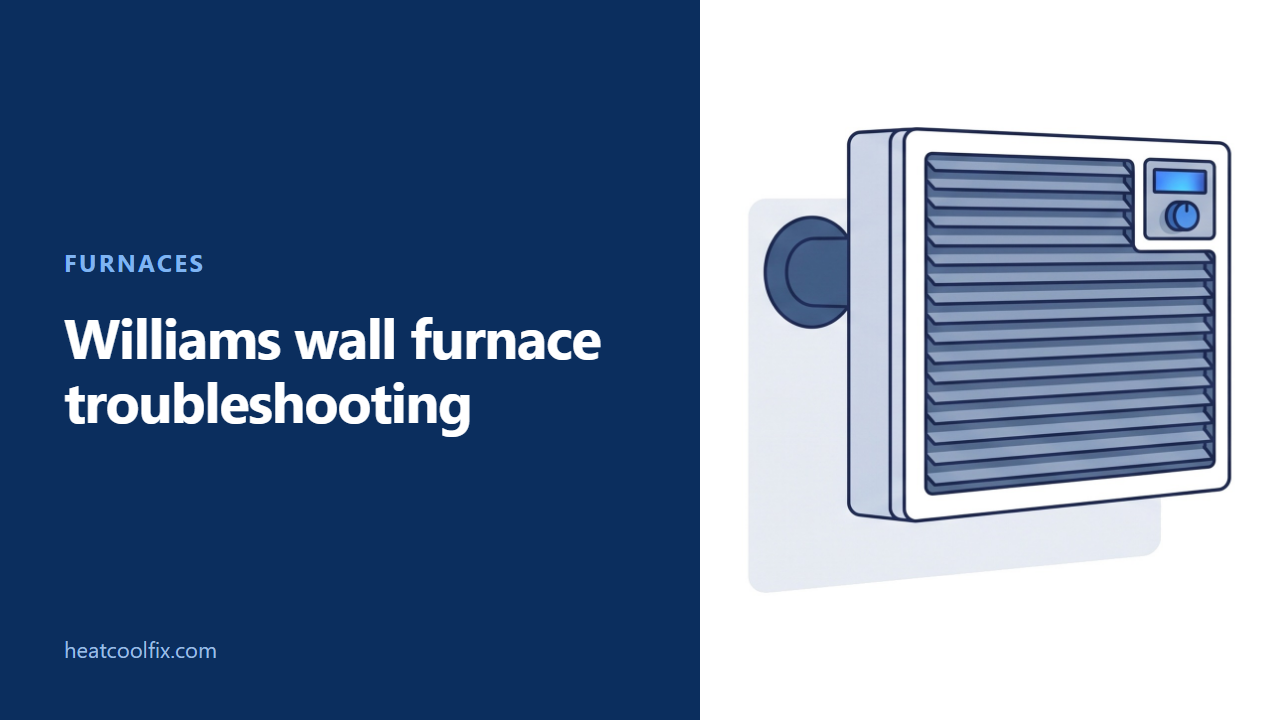
On Williams 1403822 and 2203822 direct vent wall furnaces, separate a pilot that goes out from a pilot that stays lit with no main burner. Williams lists the pilot generator, its connections and thermostat wiring among the checks. The pilot observation door must close properly; millivolt and gas valve tests belong to a technician.
Williams wall furnace troubleshooting starts with what the pilot does when you release the control knob. Williams gives separate checks for a pilot that will not stay lit and a pilot that burns while the main burner stays off.
This guide follows Williams’ direct vent manual P322101 for the natural gas 1403822 and 2203822. The pilot observation door, generator circuit and thermostat checks here belong to those models. A Forsaire counterflow furnace or another Williams model needs its own instructions.
Before you start
What to carry: a torch and the furnace’s lighting instructions. For a service report, keep the model number and a description of when the flame stops.
Gas or electric? These two models burn natural gas. Williams says their heating system needs no electric supply unless an optional blower is fitted. Its propane models have different model numbers; this page does not change the specified fuel.
Renting? Tell your landlord or maintenance contact whether the pilot is out, the main burner will not start, or the room never reaches the setting.
The general furnace pilot guide helps identify ignition types. Here the important extra detail is the closed observation door on Williams’ sealed combustion system.
If you smell gas, Williams says not to light an appliance, touch electrical switches or use a phone inside. Leave and immediately call the gas supplier from a neighbor’s phone. Follow its instructions; if it cannot be reached, call the fire department.
Williams forbids operation with a broken or missing pilot observation door. Use only your hand on the gas control knob; if it will not move, do not force it or use tools. If the knob does not pop up after release, Williams says to stop and immediately call your service technician or gas supplier.
Williams says not to use the furnace if any part has been under water; immediately call a qualified technician to inspect it and replace affected controls. Williams requires qualified installation and repair. Before work, let the furnace cool and shut off gas and electricity. If an accessory blower is fitted, isolate its electrical supply before removing access doors or service panels.
Which flame is missing?
Separate the pilot, main burner and optional blower
Williams’ operating sequence starts the main burner when the thermostat calls for heat. If a blower is fitted, heat building in the furnace starts it; after the burner stops, the fan runs until the remaining heat is removed.
So a stopped fan is not enough to identify a failed pilot. Use the flame behavior you observed during normal lighting, and check whether the thermostat is set to request heat.
If the pilot was successfully lit, Williams’ operating instructions finish with the gas control in ON and the thermostat at the desired setting. A control still in PILOT or a thermostat set too low appears in its no-main-burner fault list.
The pilot will not stay lit
Check the lighting sequence before blaming the generator
Use the complete lighting label on the furnace, or pages 14 and 15 of the matching Williams manual. Do not substitute the general pilot sequence from another heater for this sealed combustion model.
For an Empire GWT-50W-2, use the Empire wall furnace guide instead.
Williams’ procedure includes turning the thermostat to its lowest setting, switching off electrical power if applicable, and moving the gas control to OFF. It then requires a five minute wait and another gas odor check, including near the floor, before lighting.
Williams requires the knob in PILOT for lighting and warns never to light the pilot with it in ON. Protect your eyes against an ignition flash. After the pilot lights, Williams says to keep the control knob fully pressed for about one minute. The pilot should stay lit when the knob is released. If it will not stay lit after several tries, Williams says to turn the knob to OFF and contact service.
Once lighting succeeds, Williams requires the observation door closed and its wing nut tightened if fitted, before turning the gas control to ON. Close the control access panel, restore applicable electrical power and return the thermostat to the desired setting.
These are the points to compare with an attempt you have already made. If the label is missing or you cannot follow the whole procedure safely, arrange help instead of improvising a way to light it.
What the generator and millivolt checks tell you
Keep the test conditions with the reading
For a pilot that goes out, Williams lists insufficient generator output, a defective generator, loose or dirty generator connections, a grounded thermostat wire and a defective gas valve.
The manual first has the technician check that the pilot flame reaches the generator, the generator is fully seated in its bracket and the pilot lighting door closes tightly. It does not begin by ordering a new gas valve.
Williams specifies 140 millivolts or more at the valve’s generator terminals with the pilot burning and thermostat contacts closed. That is a test under stated conditions, not a number to compare with any loose-wire reading.
Leave those measurements and connection checks to the technician. Ask whether the reading was taken under Williams’ specified conditions and whether the technician checked the flame, connections and thermostat circuit before recommending a replacement.
The pilot stays lit but the main burner does not start
Check the heat request, then let service separate the circuit
After those owner checks, Williams’ remaining list includes a plugged burner orifice, broken or incorrectly wired thermostat leads, a defective thermostat, insufficient generator output and a defective valve.
A burning pilot therefore does not establish that the generator can open the main valve. Williams includes the generator in both symptom lists.
The service chart uses a temporary jumper at the valve’s thermostat terminals to help separate a thermostat circuit problem from other causes. That is a technician’s diagnostic step, not a wire to install and leave in place. Do not bypass the thermostat yourself.
Tell the technician about recent thermostat replacement or cable work. Williams specifically checks for grounded or damaged thermostat wiring, including contact with nails or staples.
The furnace lights, then stops before the room is warm
Look at the thermostat's surroundings
Williams lists thermostat location when the furnace shuts off before reaching room temperature. Its examples include the furnace’s warm air stream, a nearby lamp, or a television or stereo below the thermostat.
You can identify those surroundings without moving wires. Report them and the room’s behavior; relocation or thermostat testing is a service task.
For a burner that comes on and then stops without an apparent reason, Williams also checks vent and inlet tube installation and excessive gas input. For later pilot outages, its list includes flame problems and damaged or missing door gaskets. If the flame looks abnormal, Williams says to contact the gas company or a qualified service technician immediately.
What each one takes
| Finding | Work involved |
|---|---|
| Incorrect setting after successful lighting | Owner operating check using the furnace label |
| Pilot will not hold after the correct sequence | Service checks of the flame, generator and connections |
| Pilot stays lit but burner remains off | Thermostat circuit and valve diagnosis before buying parts |
| Damaged observation door or gasket | Repair and safe reassembly before further use |
| Heat stops early or remains inadequate | Assessment of thermostat location, venting, gas input or sizing as appropriate |
Questions people ask
Where is the Williams wall furnace troubleshooting PDF?
The source is Williams owner manual P322101, February 2014, saved from Gemaire. Pages 25 and 26 contain its troubleshooting table; pages 14 and 15 cover lighting.
Can this furnace heat during a power cut?
Williams says these direct vent furnaces do not need electric power unless an optional blower is fitted. A blower’s power requirement is separate from the basic gas heating operation described in this manual.
Should I clean the pilot opening with a needle?
Do not improvise a cleaning or adjustment method. Williams reserves repair for a qualified person and warns against tampering with the regulator or burner orifices. Ask service to check the pilot flame and opening.
Can I run it with the little observation door open?
No. Williams’ lighting procedure closes and secures that door before normal operation. Its fault chart also checks door closure when the pilot will not stay lit.
Does this also cover Williams 3507022?
No. This guide follows the direct vent 1403822 and 2203822 manual. Use the 3507022’s own lighting and service instructions instead of carrying over the generator threshold or door arrangement.
The other furnace guides: identifying a furnace pilot, Rinnai wall heater codes and furnace flame sensing.
Sources: Williams Furnace Company Direct-Vent Wall Furnace Owner's Manual P322101 (February 2014), models 1403822 and 2203822, pages 1, 4, 5, 14 to 17, 25 and 26; maker-authored PDF saved from Gemaire.
Read next
 Furnaces
Honeywell S8610U Error Codes: Green LED Flash Codes
The Honeywell S8610U shows its error codes as flashes of a green status LED. 2 flashes is a 5 minute retry delay
 Furnaces
Coleman Furnace Error Codes: DGAA and DGAH Flash Guide
For Coleman DGAA/DGAH furnaces covered by manual 5165697-BUM-C-0818, one green flash is ignition failure, three flashes mean the pressure switch failed to
 Furnaces
AprilAire Humidifier Error Codes: E1, E2 and E3
AprilAire's Model 60/62 operating guide says to record E1, E2 or E3 with a flashing red Call Dealer light and contact your
 Furnaces
Monitor Heater Error Codes: M2400 and M2200 E13, E14
Monitor's M2400/M2200 service chart calls E13 no ignition and E14 flame failure. E14 alone does not prove an empty tank: the M2400