Water Heater Thermostat: How to Test It and Reset It
 By Ray Bennett · Updated 2 October 2026 · 7 min read · General guidance, always check your own manual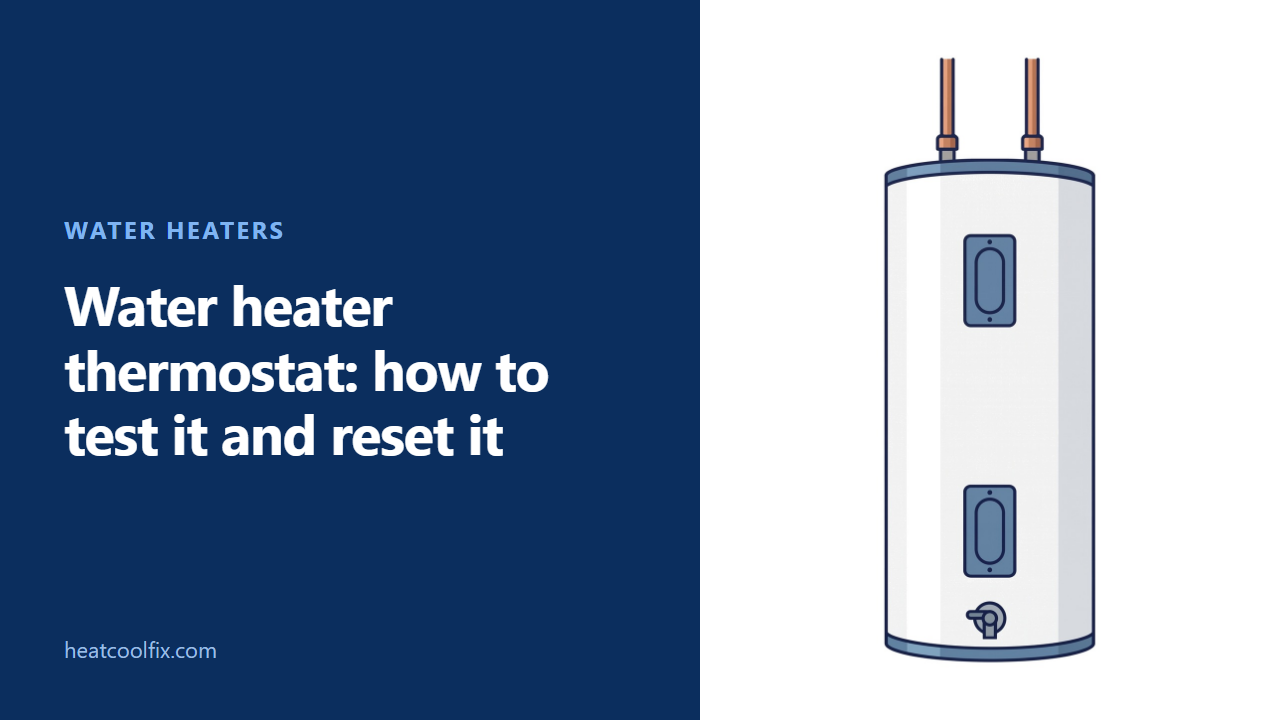
Cut the power, then read across the thermostat terminals with a meter on ohms. Turn the dial up and it should close, turn it down and it should open. No change either way means it is dead. The red button is the safety cutout, and one that keeps popping means something is overheating the water.
A water heater thermostat is a cheap part, and an electric tank carries two of them, one behind each access panel. The upper one is in charge. If it fails, nothing heats at all, no matter how good the elements are.
The little red button between its terminals is the other half of the story. That is the safety cutout, and when it pops, something made the water too hot.
Before you go down there
Is your heater electric? If the heater has a gas pipe and a burner underneath it, it has no thermostat like the one on this page. Its temperature dial is part of the gas valve on the front, and it is a different repair. Electric heaters have a cable going into the top and one or two metal panels on the side.
What to carry down: a flat screwdriver, a Phillips screwdriver, a multimeter, a non-contact voltage tester if you own one, and your phone for a photo of the wiring. Testing takes ten minutes. Changing a thermostat takes about twenty, and no water comes out.
Cut the power, and prove it is off
Switch off the double breaker marked water heater, take the upper panel off, fold the insulation back, and check the wires behind the plastic cover with a non-contact tester or a meter set to volts. Zero, or no beep, before your hands go near anything.
If no breaker is labelled, switch off the main breaker for the whole house rather than guessing. Then test at the thermostat itself, because that is the only place that proves it.
How the two thermostats share the work
They do not run together. The upper thermostat reads the top of the tank and decides everything: while the top is cold, it sends all the power to the upper element and the lower element gets nothing. Once the top is hot, it hands the power down to the lower thermostat, which then heats the bottom of the tank.
Small heaters, the ones under about thirty gallons, often have one panel, one thermostat and one element. Everything on this page still applies, you just have one of each and no upper and lower to tell apart.
That order explains most of the complaints people have:
No hot water at all. The upper thermostat, its reset button, or the upper element. The lower one cannot heat anything on its own.
A few minutes of hot water, then cold. The bottom of the tank is not heating: the lower thermostat or the lower element.
Water far too hot, or the tap scalds. A thermostat stuck closed. It is still feeding the element after the water is up to temperature.
The red button keeps popping. Something is overheating the water, and that is usually a stuck thermostat or an element shorted to the tank.
The red reset button
Push it firmly until it clicks. If the heater runs again and never trips, the cause was a one off, a long hot shower or a power blip.
If it trips again in a day or two, do not keep pressing it. Something is holding the element on after the water is hot, and pressing the button just lets the tank cook again. Test the thermostat below, then test the element for a short to the tank.
Test the thermostat with a meter
The ohms setting, the one with the horseshoe symbol. The power stays off for all of this.
Check the safety cutout itself
Put a probe on each of the two top terminals of the upper thermostat, the ones the incoming wires land on. A cutout that has been reset reads close to zero ohms. A reading of OL, or nothing at all, means it is still open. Press the button and read it again.
Make it switch
Turn the dial all the way up with a flat screwdriver and read across the two element terminals. It should close, near zero ohms. Now turn the dial all the way down. The reading should jump to OL as it opens, often with a faint click.
No change either way and the thermostat is finished. This is the test that catches a thermostat that looks fine.
Turn the dial back to 120 before you finish. A dial left on maximum sends out scalding water the moment the power goes back on.
Check it sits flat on the tank
The thermostat reads the tank through its own back, with no sensor and no probe. It has to be pressed flat against the bare steel by its bracket.
If it is loose, bent away, or somebody left insulation behind it, it reads cold water when the water is hot and runs the element far too long. Push it flat and clip the bracket properly before you buy anything.
If both thermostats pass all three tests, the thermostat is not your fault. The element is next, and that is a different test with the meter: how to test a water heater element.
What temperature to set it to
Whirlpool, A.O. Smith and Rheem ship their heaters set at 120 degrees, and Rheem’s scald chart shows why: at 120 a serious burn takes more than 5 minutes, at 140 less than 5 seconds.
| Setting | What it means |
|---|---|
| 120 F | The makers’ factory setting, and what most people should use. Cheaper to run. |
| 130 F | A choice for a big household that keeps running out. Rheem’s chart gives about 30 seconds to a serious burn. |
| 140 F | Scalds fast and costs more every month. A.O. Smith says it also kills the bacteria behind smelly water. Fit a mixing valve if you store water this hot. |
| Under 120 F | Not advised. Rheem warns that bacteria can grow in a tank that is not kept hot enough. |
Both thermostats go to the same number, and the dials are rough, so check the water at a tap with a thermometer after a few hours rather than trusting the marks.
Changing one
There is no draining for this job. The thermostat sits outside the tank, under the insulation, so the water stays where it is.
1. Photograph the wiring. Two screws on top, two on the side, and it matters which wire goes where. A photo takes five seconds and saves an hour.
2. Pull the old one out of its bracket. It is held by a spring clip, not by screws into the tank. Lift it straight out.
3. Push the new one in until it sits flat. Flat against the tank metal, no insulation behind it, clip holding it firmly.
4. Wire it back exactly as the photo shows, tighten the screws properly, put the insulation and the cover back, and switch the breaker on.
5. Press the reset button once and give it time. A.O. Smith says an electric tank takes 60 to 90 minutes to heat up fully, so do not judge it after ten.
What to buy. Search for an “upper water heater thermostat with high limit” for the top position and a “lower water heater thermostat” for the bottom. The upper one has the reset button built into it and the lower one does not, which is why they are not the same part. Camco, Apcom, Robertshaw and Therm-O-Disc all fit the standard bracket and are cheap.
If you are already in there and the heater is older than about six years, change both thermostats and both elements while the panels are off. The parts are cheap and the job is the same one twice.
Questions people ask
My heater is gas. Where is the thermostat?
It is part of the gas valve on the front, the round dial with the temperature marks. It is one sealed part with the burner control, it costs a lot more than an electric thermostat, and it is not a test you do with a meter.
Can I fit any thermostat?
Almost. Electric tank thermostats are close to standard, but buy the upper one for an upper position because it has the safety cutout built in, and the lower one for the lower. They are not the same part.
The reset button will not stay in.
The tank is still too hot, or the cutout itself has failed. Let the water cool for an hour and try once. If it pops straight back out, replace the thermostat and check the element for a short to the tank.
Do I need to drain the tank?
No. Thermostats sit outside the tank. Only elements need the water out.
Thermostat or element, which do I test first?
Thermostat. It is the cheaper part, the easier test, and the one that fails in the way people describe as “no hot water at all”.
Read next
 Water heaters
How Long Does a Water Heater Take to Heat Up? By Type
A.O. Smith says a typical 40 to 50 gallon gas tank heats back up in about 30 to 40 minutes and an
Water heaters
How Long Does a Water Heater Take to Heat Up? By Type
A.O. Smith says a typical 40 to 50 gallon gas tank heats back up in about 30 to 40 minutes and an
 Water heaters
Tankless vs Tank Water Heater: What Each Does Better
A tank keeps a store of water hot, so hot water comes at once, the upfront cost is low and upkeep is
Water heaters
Tankless vs Tank Water Heater: What Each Does Better
A tank keeps a store of water hot, so hot water comes at once, the upfront cost is low and upkeep is
 Water heaters
What Size Water Heater Do I Need? Size by the Busiest Hour
Size a tank water heater by your busiest hour of hot water, not by the number of bedrooms. A.O. Smith counts about
Water heaters
What Size Water Heater Do I Need? Size by the Busiest Hour
Size a tank water heater by your busiest hour of hot water, not by the number of bedrooms. A.O. Smith counts about
 Water heaters
How Old Is My Water Heater? Read the Serial Number
The date is in the serial number, on the rating label on the side of the tank. Bradford White uses two letters,
Water heaters
How Old Is My Water Heater? Read the Serial Number
The date is in the serial number, on the rating label on the side of the tank. Bradford White uses two letters,