No Hot Water in the House: Find It in Ten Minutes
 By Ray Bennett · Updated 2 October 2026 · 7 min read · Checked against the sources at the end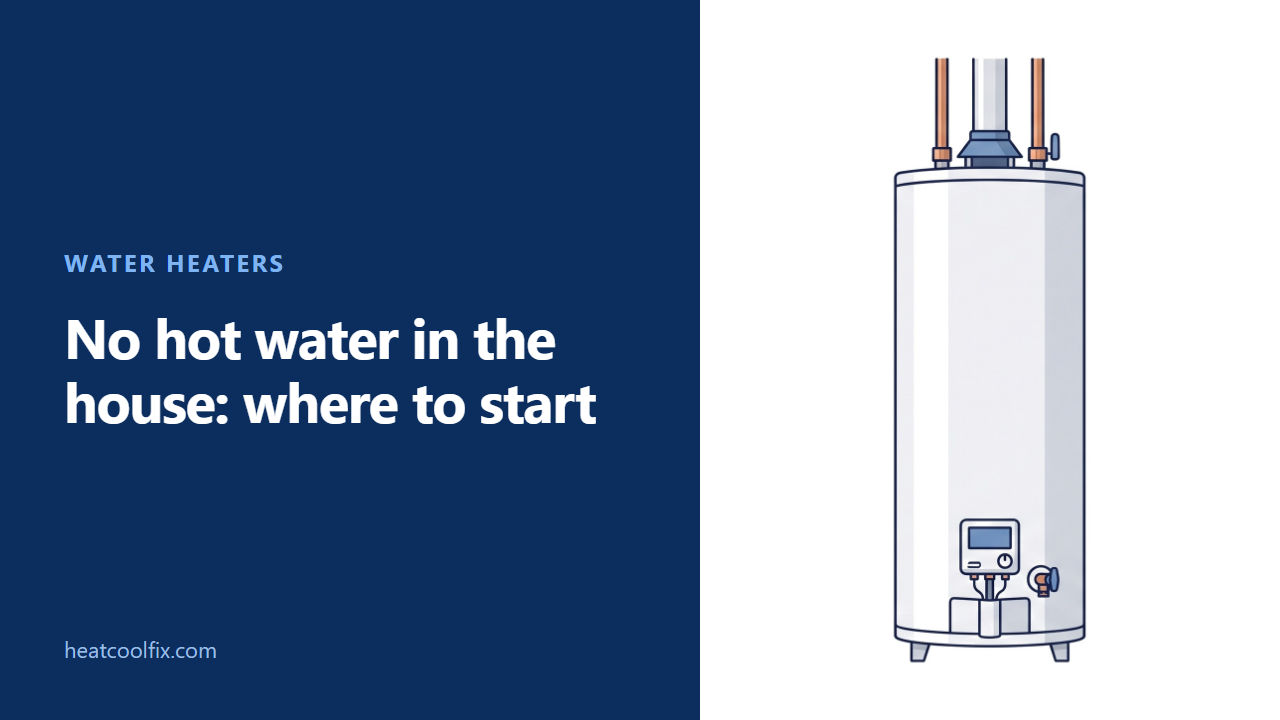
No hot water in the house is not always the water heater. Run the hot tap at three different taps first. All three cold points at the tank or the supply into it, one cold tap is that tap's own fault, and lukewarm everywhere is usually a mixing valve or a thermostat rather than a dead heater.
No hot water in the house is worth two minutes of checking before you go anywhere near the tank. Plenty of water heaters get replaced for a fault that was a valve, a frozen pipe or a cheap cartridge in one tap.
So the first question is not what is wrong with the heater. It is whether the heater is involved at all.
Before you start
What to carry: a torch. Ten minutes, and nothing needs taking apart yet.
Is there cold water everywhere? If the cold is weak or missing as well, this is the supply into the house and not the heater.
Gas or electric? A gas heater has a gas pipe into a control box on the front, a flue out of the top and a small window near the floor. An electric one has a thick cable into the top and a metal panel or two on the side. If yours is gas, light a gas ring on the stove first. If that lights, gas is reaching the house, so the supply is not the problem.
How long has it been cold? Cold since a long shower and back in an hour is a small tank rather than a fault. Cold since yesterday is a fault.
If you smell gas anywhere near the heater, do not light anything and do not touch a switch. Out of the house first, then the gas company from outside.
Two minutes that save an hour
Run the hot tap fully at the kitchen sink, at a basin upstairs and at the shower or bath. Give each one a full minute, because a long pipe run holds a lot of cold water.
All three cold. Now it is the heater, or the cold water getting into it. Keep reading.
One cold, the others fine. That is the tap. Its own shutoff under the basin has been knocked closed, or the cartridge inside it has failed and is letting cold across. Nothing at the tank will fix it.
Warm but never hot, everywhere. That is rarely a dead heater. It is a mixing valve or a thermostat setting, and there is a section on it below.
Three faults that are not the heater
A shutoff valve that somebody closed
Look at the pipe going into the top of the tank. There is a valve on it, usually a lever or a round handle, and it has to be fully open.
A closed one lets the hot taps run briefly and then gives nothing, often with spitting and banging from the taps as air comes through. Decorators, plumbers finishing another job and anybody tidying a basement all close these and forget.
Open it slowly and give the tank half an hour.
A frozen pipe, if it turned cold last night
The clue is that nothing comes out at all rather than cold water coming out. The Red Cross says pipes freeze most in crawl spaces, garages and outside walls with little or no insulation.
Open the tap so there is somewhere for the thaw to go, then warm the pipe with a hairdryer on low, starting at the tap end and working back. Never leave it running unattended.
Know where the main stop is before you start. A pipe that has already split only shows it when the ice melts.
A mixing valve that has stuck or been turned down
Newer installs, and a lot of local codes, put a small valve on the hot pipe just off the top of the tank. It blends a little cold in so a tap cannot scald, and it has a dial on it.
When its cartridge sticks, it sends almost all cold to the whole house while the tank behind it is full of hot water.
Test it by hand. With the heater on, carefully feel the pipe leaving the top of the tank and then the pipe after that little valve. Hot going in and cool coming out is your fault, and the tank is fine.
If it really is the heater
Now the tank is worth opening up, and the order is different for the two kinds.
Electric. The double breaker marked water heater first. A tripped one often does not look off, it sits limply in the middle, so push it firmly all the way off and back on. Then the red reset button behind the upper access panel. Neither costs anything, so they come first.
Gas. Look through the little window low down on the tank with the room light off. A small steady blue flame means the pilot is alive and the fault is further on. Nothing at all means you have found it, and relighting it properly is a fifteen minute job, most of it waiting.
The full order for both, with the meter tests when the free checks run out, is on the page that works a dead water heater through in order.
Warm, but never properly hot
This is a different complaint from no hot water, and it has its own short list.
Somebody turned it down. A.O. Smith says both thermostats on an electric heater should be at the same number, and they leave the factory at about 120. A dial moved during decorating, or a holiday setting left on, does exactly this.
The lower element has gone. The top of the tank heats and the bottom does not, so you get a few minutes of hot and then warm. The test is ten minutes with a meter: the thermostat first, because the upper one runs the whole heater.
The tank is full of scale. A heater that rumbles while it works is heating through a crust and never quite catches up: what each noise means and how to flush it.
A recirculation pump has died. You still get hot water, it just takes a long run of the tap to arrive. That is a pump, not a heater.
A flat, or a shared building
If the hot water is made somewhere else in the building, almost none of the above is yours to fix.
Check with a neighbour first, because a building boiler that has locked out takes the whole block with it. If your flat has its own small tank in a cupboard, treat it like any other heater. If there is a heat interface unit instead, a flat plate box with several pipes into it, that is the building’s system and it needs the managing agent rather than a screwdriver.
Questions people ask
The cold works fine everywhere, so it has to be the heater.
Not quite. It rules out the incoming supply, and it leaves the heater, the valve on its inlet and a mixing valve on its outlet. All three give the same symptom at the tap.
How long should I wait after fixing something?
A.O. Smith gives 60 to 90 minutes for a 40 to 50 gallon electric tank, and 30 to 40 minutes for a gas one. Judging it after ten minutes is why people think a good repair failed.
It came back on its own and then went again.
That is not the red reset button: Rheem says it stays off until someone presses it. Rheem’s list for not enough hot water starts with use that outran the tank, then the breaker, the thermostat setting and the wiring.
I have a tankless unit and nothing happens at all.
A tankless heater needs a decent flow before it will fire, so a partly closed valve or a blocked inlet filter stops it starting. Read the code on its panel against the label inside its own cover.
The heating works but there is no hot water, and both come off the same boiler.
Then the boiler is alive, and the fault is the part that sends heat to the cylinder rather than to the radiators. That is a zone valve or the cylinder thermostat, and it is a different job from a tank heater.
Should I just replace the heater?
Not before the checks above. Past about twelve years, and with a real fault in the tank itself, replacing it is fair. For a cheap part on a younger heater, fix it.
Sources: A.O. Smith residential electric use and care guide 100264218 (no hot water, not hot enough, mixing valves, lower element), A.O. Smith's thermostat setting instructions and "How Long Does It Take a Water Heater to Heat Up?", Rheem electric use and care manual AP23124 (troubleshooting, ECO), Navien NPE-2 user's information manual (minimum flow), and the American Red Cross "Preventing and Thawing Frozen Pipes"
Read next
 Water heaters
How Long Does a Water Heater Take to Heat Up? By Type
A.O. Smith says a typical 40 to 50 gallon gas tank heats back up in about 30 to 40 minutes and an
Water heaters
How Long Does a Water Heater Take to Heat Up? By Type
A.O. Smith says a typical 40 to 50 gallon gas tank heats back up in about 30 to 40 minutes and an
 Water heaters
Tankless vs Tank Water Heater: What Each Does Better
A tank keeps a store of water hot, so hot water comes at once, the upfront cost is low and upkeep is
Water heaters
Tankless vs Tank Water Heater: What Each Does Better
A tank keeps a store of water hot, so hot water comes at once, the upfront cost is low and upkeep is
 Water heaters
What Size Water Heater Do I Need? Size by the Busiest Hour
Size a tank water heater by your busiest hour of hot water, not by the number of bedrooms. A.O. Smith counts about
Water heaters
What Size Water Heater Do I Need? Size by the Busiest Hour
Size a tank water heater by your busiest hour of hot water, not by the number of bedrooms. A.O. Smith counts about
 Water heaters
How Old Is My Water Heater? Read the Serial Number
The date is in the serial number, on the rating label on the side of the tank. Bradford White uses two letters,
Water heaters
How Old Is My Water Heater? Read the Serial Number
The date is in the serial number, on the rating label on the side of the tank. Bradford White uses two letters,