Baseboard Heater Making Noise? Clicking, Popping, Buzzing
 By Ray Bennett · Updated 2 October 2026 · 9 min read · Checked against the maker’s manual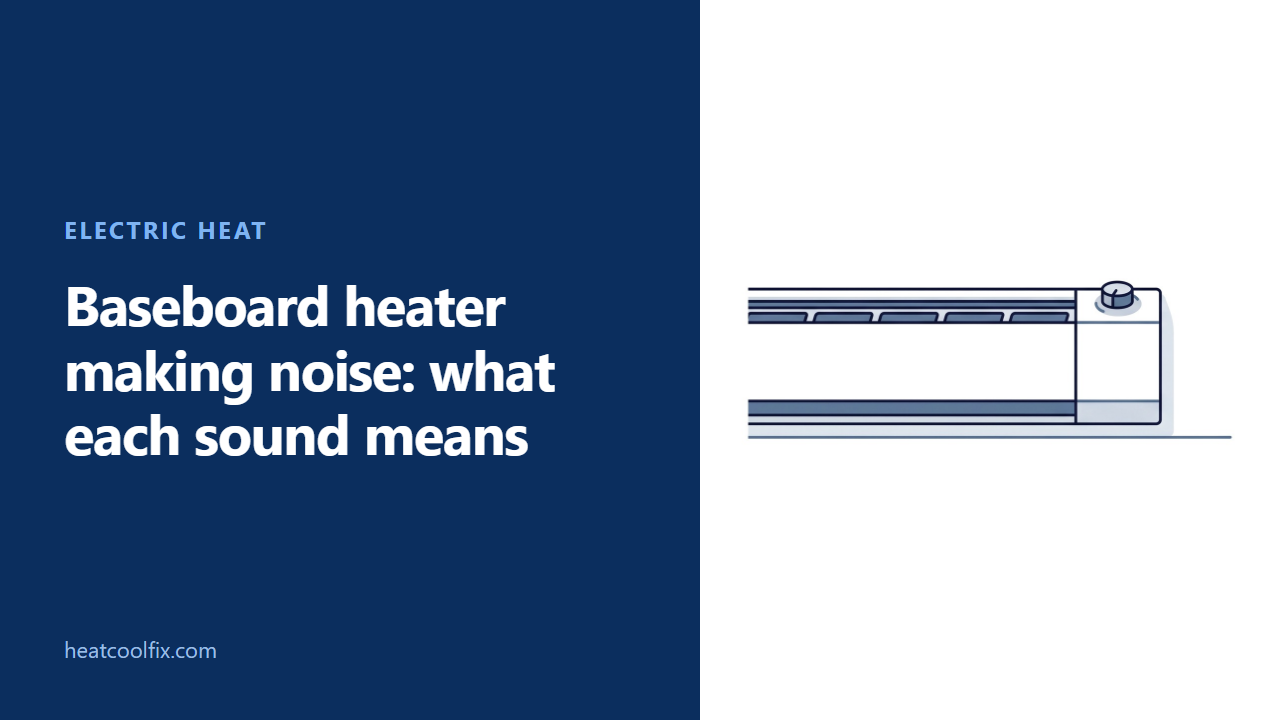
Popping, crackling or clicking as an electric baseboard heater warms up or cools down is the metal expanding and contracting, which Dimplex and Ouellet call normal. Cracking is often mounting screws that are too tight, Stelpro says. A buzz or hum is usually the element pinched by an uneven wall, Cadet says, once the voltage on its label is checked.
The usual popping and clicking from an electric baseboard heater is its metal expanding as it heats and contracting as it cools. Dimplex and Ouellet call a slight amount of that normal, and Stelpro gives the same cause. Cracking, a buzz, a click or a sizzle each point somewhere different, and the makers and ESFI say where.
Most of the fixes need only a screwdriver and the breaker off. Anything in the wiring is an electrician’s job.
Before you start
What to carry: a torch and a screwdriver. A few minutes of work, plus 15 minutes of running the heater first if you follow Cadet’s steps for a hum.
Gas, oil or electric? This page is about electric baseboard heaters: a long metal box along the wall with no pipes, wired straight into the house. If your baseboard has water pipes and runs off a boiler, it is hot water baseboard, and its noises are further down this page.
Read the label. The label on the heater gives its maker, model and voltage. The makers give slightly different screw instructions, so follow the one for your heater. If the label is behind the front cover, as on Dimplex’s LPC smart baseboard, where it sits below the right side of the element, turn the breaker off and let the element cool before the cover comes off.
Mind the heat. Cadet warns that after the heater has been running, the element will probably still be hot to the touch. Cadet and Stelpro both say not to let bare skin touch hot surfaces.
A sizzle, a hot insulation smell, or the wrong voltage. ESFI lists sizzles and buzzes from the electrical system, an odor of hot insulation, and switch plates that are hot or discolored among the signs of a wiring hazard, and says to call a licensed electrician. Cadet says a 120 volt heater on a 240 volt supply can hum, and to turn the breaker off and replace the heater right away.
What the sound tells you
Popping or clicking as it heats or cools
Why. Ouellet says the metal reacts to rapid temperature changes, expanding when the heater comes on and contracting when it cools down, and that this causes the crackling and popping. Stelpro gives the same reason for clicking sounds, and Dimplex says a slight clicking or pinging sound is normal.
When it is too much. Dimplex says that if the noise becomes loud or persistent, check that the heater is mounted securely and nothing blocks it. Cadet’s and Dimplex’s troubleshooting charts say a heater making creaking, popping or humming noises may need a slight adjustment to its cabinet, and to call their technical support.
A quieter thermostat. Ouellet says electronic thermostats virtually eliminate the noise from expansion and contraction, and Stelpro says they greatly reduce it. Dimplex says heaters and their controls should be installed by a licensed electrician.
Loosen the mounting screws a little
Why. Stelpro says screws that hold a baseboard to the wall too tightly are often the cause of cracking noises, and to simply loosen them slightly.
How far. With the breaker off, loosen them a little. Stelpro’s ABA and SBB baseboard guides say to loosen the mounting screws half a turn after the heater is tightened to the wall, and King’s installation instructions say at least a quarter turn. Ouellet says loosening them a quarter turn will greatly reduce the noise. If your heater’s manual gives a number, use that one.
On a Dimplex. Dimplex’s smart baseboard guide says the owner should do cleaning only and leave all other servicing to qualified service personnel, and its T Series chart sends a noisy cabinet to Dimplex technical support.
Room to move. Stelpro also suggests considering a slight space between the heater and any decorative wood molding next to it.
While the cover is off. Stelpro says to clean a baseboard at least once a year, with the power off at the breaker and the element cooled before the front panel comes off. Vacuum the fins with the small round brush of a vacuum cleaner without bending them, and mind your hands: King warns the fins are sharp and may cause cuts. Put the front panel back with its screws before the power goes back on. Ouellet says never to remove the grill on its heaters: vacuum the front of the grill instead.
A buzz or hum: check the voltage first
Why first. Cadet says it is always good to start troubleshooting by checking the voltage, because hooking a 120 volt baseboard to a 240 volt supply can cause a humming noise among other problems. If you have the wrong voltage heater, Cadet says to turn the breaker off and replace it right away.
How to tell. Cadet says 120 volt heaters run on a single pole breaker and 240 volt heaters on a double pole breaker, and that a heater on a higher voltage than its rating label will be destroyed and could start a fire. If a heater glows red or keeps getting unusually hot and shutting off, Cadet says to turn its breaker off immediately. Leave it off and call an electrician.
A buzz or hum: let the element settle
Why. Cadet says its heaters are built with the element square to the back of the cabinet. If the cabinet back is slightly warped when it is mounted on an uneven wall, it pinches the element, and Cadet says that more often than not causes the hum. Cadet’s page gives the same cause for a slight popping noise, and its technician says the pinched element can also ping.
Cadet’s steps. Once the voltage is right, run the heater for 15 minutes, then shut off its breaker at the panel. Loosen, but do not remove, the screws holding it to the wall; Cadet says there should be at least two. Then loosen the grounding screw near the middle, which you can see by looking down into the vent on the top front.
Then settle it. Bump the cabinet a little with your palm so the element comes to a natural resting position. Tighten the mounting screws first, then the screw on the element. Turn the breaker back on: Cadet says the heater should be much quieter.
A click from the thermostat
One click. Honeywell’s CT62 line voltage thermostat instructions say to listen for a click as its switch makes contact and the heater starts, and another as it breaks contact and the heater shuts off. Cadet’s instructions for a dial thermostat likewise say to turn the knob to the left just until it clicks and the heater turns off.
Clicking off and on while the room stays cold. Dimplex’s smart baseboard guide says restricted airflow may make its thermal overload protector cycle it on and off, and a cycling heater will not give the room enough heat. Dimplex’s FAQ adds dust around the grille as a cause: turn the power off, clean the heater and let it cool before restarting.
If it keeps cycling. Stelpro says thermal protection that activates means the heater has had abnormal operating conditions, and if it activates and deactivates repeatedly, it recommends a qualified electrician or a certified repair centre examine it. More in a baseboard heater not working or not getting hot.
Sounds that need an electrician
Sizzling and buzzing in the wiring. ESFI lists sizzles and buzzes from the electrical system among the signs of a home wiring hazard, along with breakers that trip often, dim or flickering lights, sparks, and switch plates that are hot or discolored. It says to contact a qualified electrician immediately.
A breaker that keeps tripping. For a heater breaker that will not stay on, see a breaker that keeps tripping.
Hot water baseboard noises
Which kind. Hot water baseboard looks like the electric kind, but it has a copper pipe with fins inside, heated by water from a boiler.
Squeaks or scraping as it warms. Slant/Fin’s installation instructions say all piping expands when heated. They say the holes where the pipes rise through the floor should be half an inch larger than the pipe so it can move, and that the element’s cradles must be centered over their brackets so it expands smoothly without scraping noises. Its riser rings, an accessory that slips around the pipes at the floor, absorb expansion squeaks and vibration noises.
Air in the pipes. Slant/Fin says air has to be vented from the system to prevent noise or air pockets blocking the flow. Bleeding it out is covered in hot water radiators and baseboard, and the other noises, gurgling included, in a boiler making noise.
What each one costs
| The step | Cost |
|---|---|
| Popping as it heats and cools | Nothing, it is normal |
| Loosening the mounting screws | Nothing |
| Cadet’s settle and retighten fix | Nothing |
| An electronic thermostat | The thermostat, and an electrician to fit it |
| A heater on the wrong voltage | A new heater and an electrician |
| Sizzling or buzzing wiring | An electrician |
Questions people ask
Is it normal for a baseboard heater to make noise?
A little, yes. Dimplex says a slight clicking or pinging sound is normal as the metal expands and contracts, and Ouellet says the same of crackling and popping when the heater comes back on. If it becomes loud or persistent, Dimplex says to check the heater is mounted securely and nothing blocks it.
Why is my baseboard heater clicking?
Usually the metal expanding and contracting, Dimplex and Stelpro say. A single click as it starts or stops is the thermostat’s switch, Honeywell says. Clicking off and on while the room stays cold can be the safety cutout cycling because something blocks the airflow, Dimplex says; if it keeps cycling, Stelpro recommends having the heater examined.
Why is my baseboard heater buzzing or humming?
Cadet says to check the voltage first: a 120 volt heater on a 240 volt supply can hum, so turn the breaker off and call an electrician. Otherwise it is most often the element pinched by an uneven wall, fixed by loosening and retightening its screws with the breaker off. A sizzle or buzz from the wiring is different: ESFI lists it as a sign of a wiring hazard.
How do I stop my baseboard heater from making noise?
On an electric baseboard, with the breaker off, loosen the mounting screws slightly: half a turn on a Stelpro ABA or SBB, a quarter turn on an Ouellet. For a hum, check the voltage, then follow Cadet’s loosen, bump and retighten steps. On a Dimplex, call its technical support. Ouellet and Stelpro say an electronic thermostat cuts expansion noise.
Why does my hot water baseboard tick or gurgle?
Slant/Fin says all piping expands when heated and needs room to move in its floor holes and on its brackets, or it can scrape and squeak. It also says air has to be vented from the system to prevent noise, which is done at the vents.
The other electric heat guides: an electric baseboard heater not working, an electric wall heater not working, a space heater not working, a space heater making noise and an electric heater that smells like burning.
Sources: Cadet "Fix a buzzing baseboard heater sound in 5 easy steps" and owner's guide 720001, Dimplex heater FAQ and support page, T Series owner's guide and LPC smart baseboard guide, Ouellet FAQ, Stelpro FAQ, "Maintenance of your heating units" and ABA and SBB baseboard user's guides, King K Series baseboard installation instructions, Honeywell CT62 line voltage thermostat instructions, Slant/Fin baseboard installation instructions, and ESFI home wiring and home electrical fire safety tips
Read next
 Electric heat
Space Heater Making Noise? Ticking, Clicking or a Loud Fan
Ticking from an oil-filled radiator as it warms is the oil expanding, Honeywell says, and De'Longhi calls crackling normal the first time
Electric heat
Space Heater Making Noise? Ticking, Clicking or a Loud Fan
Ticking from an oil-filled radiator as it warms is the oil expanding, Honeywell says, and De'Longhi calls crackling normal the first time
 Electric heat
Baseboard Heater Won’t Turn Off? Thermostat, Size or Wiring
On a single pole baseboard thermostat, Dimplex says there is no off position and power is continuous to the heater, and Qmark
Electric heat
Baseboard Heater Won’t Turn Off? Thermostat, Size or Wiring
On a single pole baseboard thermostat, Dimplex says there is no off position and power is continuous to the heater, and Qmark
 Electric heat
Wall Heater Making Noise? Fan, Ticking, Clicks and Clunks
A steady fan sound is normal: Cadet says wall heaters are generally quieter than a regular refrigerator. On a Williams gas wall
Electric heat
Wall Heater Making Noise? Fan, Ticking, Clicks and Clunks
A steady fan sound is normal: Cadet says wall heaters are generally quieter than a regular refrigerator. On a Williams gas wall
 Electric heat
Electric Heater Smells Like Burning? Dust, Plug or Wiring
A burning smell the first time an electric heater runs, or after it has sat unused, is usually factory oil or dust
Electric heat
Electric Heater Smells Like Burning? Dust, Plug or Wiring
A burning smell the first time an electric heater runs, or after it has sat unused, is usually factory oil or dust