Air Handler Not Working: What It Is, What Goes Wrong
 By Ray Bennett · Updated 2 October 2026 · 6 min read · Checked against the sources at the end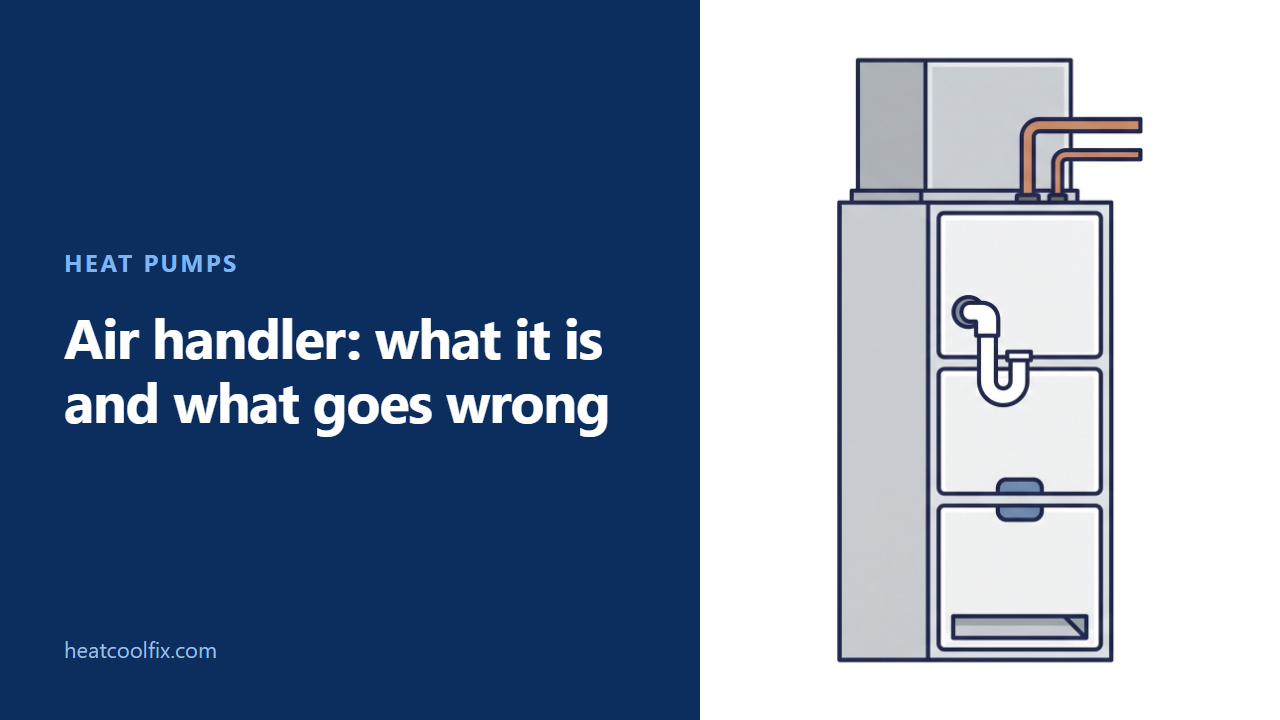
An air handler is the indoor box on a system with no gas furnace: a blower, a coil, a drain pan, a filter and usually electric heat strips. Nothing at all is one of several breakers, a panel switch on some units, or the small fuse on the board. A fuse that keeps blowing is a shorted wire, and a new fuse on its own fixes nothing.
An air handler not working is the same complaint as a furnace not working, except that a lot of people are not sure which one they have. There is no flame in an air handler, no gas pipe and no flue.
It is the indoor half of a heat pump or an air conditioning system, and it has its own short list of faults.
Do you have one?
What to carry: a torch, a screwdriver and a new filter. Twenty minutes.
Gas or electric? This is the whole question here. A gas furnace has a gas pipe going into it and a metal flue coming out of the top. An air handler has neither, just a thick cable, and usually two or three large breakers rather than one.
Where it lives. A loft, a cupboard, a garage or a crawl space, with ducts out of the top and a small copper pair running out to the unit outside.
Switch every one of them off before a panel comes off, not just the one you think feeds it. The heat strips are fed separately from the control side, so a unit can be dead to the touch and still have mains sitting on the strips.
If the smell is burning rather than musty, leave it off and get somebody out rather than looking for a reset.
What is inside it
The strips at the top are the electric backup heat, and on a heat pump they are what runs when the outdoor unit cannot keep up. The coil below them is cold in summer and warm in winter. The pan under that catches the water the coil makes. The blower pushes everything round the house, and the filter is very often the only filter in the whole system.
That is worth knowing because most of the faults below belong to one of those five.
Nothing happens at all
Breakers, the panel, then the little fuse
Check every breaker that feeds it, including the big ones for the heat strips. A tripped breaker often does not look off, it sits limply in the middle.
Then the access panel. Some units have a plunger switch behind it that kills the unit when the door is off, and the panel has to be clicked properly shut rather than leaning in place. This catches people who have just changed a filter.
Then the small blade fuse on the control board, three amps on a Goodman AVPTC and five on a Carrier FV4C, the same kind a car uses. A broken stripe through the little window means it has blown, and that is the next section.
If the thermostat is blank as well, the fuse is the most likely thing of the three: a dead thermostat and where its power comes from.
The fuse keeps blowing
Find the short before you fit another one
That fuse protects the 24 volt circuit, the one that runs the thermostat and everything the thermostat calls for. It blows when two of those wires touch.
Start at the thermostat, because that is where somebody touched it last. Take it off its plate and separate every bare wire end so none of them can touch each other or the wall plate. Fit a new fuse and switch on.
If it holds, the short is at the thermostat and it is usually a stray strand or a wire pushed too far into its terminal.
If it goes again immediately, the short is in the cable run or at the outdoor unit. A staple through a cable, a rodent, or a wire rubbed through where it passes a sharp edge.
Never fit a bigger fuse to make it hold. The size the maker specifies is chosen to protect the transformer and the wiring inside your walls, and a bigger one there simply lets the wire be the fuse instead.
The blower runs but there is no heat
On a heat pump the air is meant to feel cool, around 85 to 100 degrees, Carrier says, and people mistake that for a fault constantly: what temperature the air should actually be.
If it is genuinely cold, the question is whether the strips are coming on. They are brought in by sequencers, which are slow switches that bring one strip in at a time, and a failed one leaves you short of heat without anything looking broken.
Check the thermostat is asking for backup heat at all. Set it to Emergency Heat for a minute: if the air goes properly hot, the strips work and the fault is in how they are being called for.
Their own breakers are the other half of it. Strips on a tripped breaker are strips that will never run, and the rest of the system carries on as if nothing is wrong.
It is wet, or it is sweating
Tell water inside it from water on it
Water under the unit and in the pan is the drain, and that is a common wet fault: where the water is actually coming from.
Water on the outside of the cabinet is different. An air handler standing in a hot humid loft or garage runs cold inside and warm outside, and if the insulation inside the cabinet has come adrift or got wet, the metal sweats exactly like a cold glass.
The other cause of a sweating cabinet is air being drawn in where it should not be, usually at a badly sealed return joint. That pulls hot wet loft air straight onto cold metal.
Neither is dangerous on its own, and both of them drip onto something that will mind.
Questions people ask
Is an air handler the same as a furnace?
It does the same job indoors and it makes no heat of its own beyond the electric strips. No flame, no flue, no gas pipe.
Why does mine run all the time?
Usually the fan switch on the thermostat left on ON, which is a setting rather than a fault: what is still running, and why.
Can I change the fuse myself?
Yes, with the power off. The important part is finding what blew it, because otherwise you will be doing it again in a minute.
My electricity bill jumped in winter.
That is the heat strips doing the work instead of the heat pump, which Google says can cost about 2 to 5 times as much. It is worth knowing whether the outdoor unit is actually running.
There is ice on the coil inside.
Airflow or refrigerant, same as any coil, and it must be thawed before the cooling runs again: how to thaw it safely.
How often does it need a filter?
Every one to three months, and on an air handler it matters more than most because that filter is usually protecting the only coil you have.
Sources: Goodman AVPTC air handler installation and operating instructions IOA-4021 (3 amp 24 volt fuse, shorts in the low voltage wiring, return air filter, heat kits), Carrier FV4C fan coil installation instructions (5 amp automotive fuse, more than one disconnect switch, heater power), Trane outdoor unit owner's guide 22-5213 (more than one disconnect switch), Carrier "Heat Pump Not Heating? Troubleshooting Cold Air Issues" (85 to 100 degree supply air), and Google Nest Help "Heat Pump Balance" (aux heat cost)
Read next
 Heat pumps
Heat Pump vs Air Conditioner: How to Tell and Which to Buy
A heat pump is an air conditioner with a reversing valve, so it can run backwards and heat the house in winter.
Heat pumps
Heat Pump vs Air Conditioner: How to Tell and Which to Buy
A heat pump is an air conditioner with a reversing valve, so it can run backwards and heat the house in winter.
 Heat pumps
What Size Heat Pump Do I Need? Tons, Load and Backup Heat
Ask for a Manual J, which ENERGY STAR says your contractor should use. Square foot rules give odd answers for heat pumps:
Heat pumps
What Size Heat Pump Do I Need? Tons, Load and Backup Heat
Ask for a Manual J, which ENERGY STAR says your contractor should use. Square foot rules give odd answers for heat pumps:
 Heat pumps
Heat Pump Smells Like Burning or Musty: What Each Means
A burning dust smell on the first cold day is normal and fades on its own; Trane says in 10 to 15
Heat pumps
Heat Pump Smells Like Burning or Musty: What Each Means
A burning dust smell on the first cold day is normal and fades on its own; Trane says in 10 to 15
 Heat pumps
Heat Pump vs Furnace: Which Costs Less to Run?
It depends on your prices and your winters. A furnace burns fuel and only heats. A heat pump moves heat in on
Heat pumps
Heat Pump vs Furnace: Which Costs Less to Run?
It depends on your prices and your winters. A furnace burns fuel and only heats. A heat pump moves heat in on