Boiler Pressure Too Low or Too High: What the Gauge Means
 By Ray Bennett · Updated 2 October 2026 · 8 min read · Checked against the maker’s manual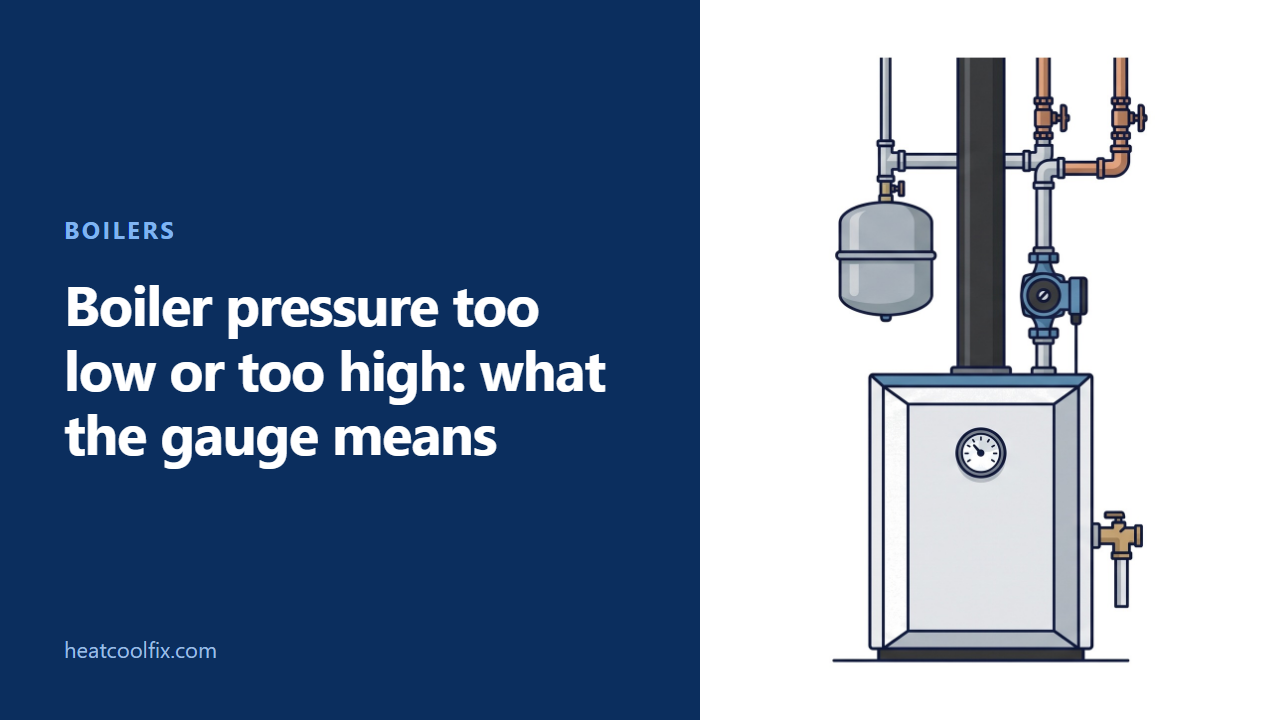
On a home hot water boiler the gauge should read about 12 psi cold, Weil-McLain and Navien say, and no more than 24 or 25 hot. Pressure that keeps dropping means water is leaving: a leak, or the relief valve letting go. Pressure that climbs too high as it heats points to the expansion tank, waterlogged or too small, or to the gauge itself. Never add water to a hot boiler.
Boiler pressure is the number on the round gauge on the front or on the pipe beside it, and it is one of the few things on a boiler a homeowner can read and act on. The makers give clear numbers for it.
This page covers hot water boilers. A steam boiler runs at only a few psi and follows different rules, which are at the end.
Before you start
What to carry: a torch, a towel, and your phone to note the gauge cold and again an hour after the heat has been on. Ten minutes, spread over the hour.
Gas, oil or electric? It makes no difference here. The pressure belongs to the water in the pipes, whatever heats it.
Find three things. The gauge, the expansion tank (a round tank on the pipes, often grey or blue), and the relief valve (a brass valve with a lever and a pipe running down towards the floor).
Never plug or cap the relief valve. Burnham says do not plug the relief valve discharge, and Navien says a dripping relief valve must be replaced, never plugged or removed.
A relief valve that has let go needs a professional. Watts says that when a boiler relief valve discharges, a licensed contractor must find and correct the cause right away.
What the gauge should say
Cold. Weil-McLain and Navien give 12 psi as the typical cold fill pressure for a home system. The fill valves that top the system up are set close to that: Taco’s 329 at 12 psi from the factory, and Watts’ 1156F and Caleffi’s 553 at about 15.
Hot. The pressure rises as the water heats, Weil-McLain says. Weil-McLain says no more than 24 psi on its cast iron boilers and 25 on its Ultra, Lochinvar says 24, Triangle Tube says 25, and Peerless says to stay at least 5 psi under the relief valve rating.
Some boilers need more. Burnham’s Alpine and Peerless’s PureFire need at least 14.5 psi. A tall house needs more too: Watts’ rule is the height in feet from the fill valve to the top of the highest radiator, times 0.43, plus 3 psi.
Pressure too low, or it keeps dropping
Look for where the water is going
The relief valve pipe. Burnham says its discharge pipe must end no more than 6 inches above the floor, so look for a wet floor or a mark under its end. If it has been letting water go, either the pressure is going too high when hot, which is the other half of this page, or the valve itself is leaking. Watts says either way a licensed contractor should find the cause.
Leaks on the boiler and pipes. Look along the pipes, under the radiators and baseboard, and at the valves. To find where a radiator itself leaks, see a radiator leaking. Weil-McLain says leaks must be fixed at once, because fresh make up water brings in minerals that overheat the metal and cause failure. Navien says the same.
A leaking zone valve. Honeywell says a V8043 zone valve should be serviced by a trained service technician, who drains the system and checks its O ring.
Refill it, cold, only as far as the makers say
Weil-McLain’s fix for low system pressure is to fill to the correct pressure and check for leaks. Many systems fill through a fill valve on the cold water pipe that tops the system up by itself, and Watts says its 1156F supplies make up water when the system leaks. Others have a manual fill valve, which only adds water when you open it.
If the boiler shut itself off for low water. Burnham says that is serious, and a qualified service technician must inspect the system before the boiler runs again.
Do it with the boiler cold, and watch the gauge the whole time. Watts says to always watch the gauge when using the fast fill lever, because with the purge valve closed it can push the pressure past the relief valve setting. Stop at about 12 psi, or the number your boiler needs.
Some combi boilers. Navien says its NCB-E refills itself: a sensor turns on the refill circuit when the system water falls too low. Others fill through a separate fill valve like any other boiler.
If it keeps needing water. That is a leak somewhere, even a slow one. Lochinvar says make up water should stay under 5 percent of the system volume a year, read on a meter in the fill line, and more than that could mean a leak.
Pressure too high when it is hot
Suspect the expansion tank first
How it should work. Bell and Gossett explains that the tank’s air cushion takes up the pressure rise as the water heats, keeping the system below the relief valve setting.
What goes wrong. Weil-McLain says a relief valve that weeps often may mean a waterlogged or undersized tank, Amtrol says a tank wrongly charged or too small, and Lochinvar says a pressure rise that goes too far points to the tank’s size or how it works. Bell and Gossett says a tank that is too small generally gives higher pressure than desired once the system is hot. DOE’s maintenance list includes checking the tank is filled with air, not water.
How it is checked. Weil-McLain says a diaphragm tank is checked off the system, and its charge is usually 12 psi for homes; a tank that will not hold pressure has a damaged membrane and must be replaced. Watts says a tire gauge only reads the tank’s air correctly once it is disconnected. Amtrol says a plumber should check the system, tank included, every year.
An Amtrol tank with an InSight cap. Amtrol says a discolored InSight cap means the tank needs replacing, and not to rely on the cap alone.
A closed valve. Navien says the expansion tank must never be shut off from the boiler while the system runs, or the relief valve may discharge.
Other causes. Weil-McLain says a high reading can also be the gauge itself. Watts lists checking the gauge, a fill valve letting water through, and water getting in from a leaking tankless hot water coil.
The relief valve
Test it once a year, and leave the rest to a plumber
The yearly test. Watts and Navien say the owner should operate the test lever at least once a year to keep the waterways clear. First check that the valve has a pipe running down to a safe place, because the water comes out hot and can scald, Watts and Navien warn. Weil-McLain says check the gauge shows pressure, lift the lever slightly so water runs through the valve and its pipe, and let it go. If it weeps after a second lift, Weil-McLain says call a technician.
If nothing comes out. Watts says the valve is not working. Lochinvar says the valve or its pipe may be blocked and the boiler should be shut down.
If it drips. Weil-McLain, Navien and Lochinvar all say to make sure the cause is the valve, and not over pressure from the expansion tank, before replacing it. Watts says that if it still drips once the pressure is back in range, lifting the lever quickly a few times may flush it, keeping clear of the hot water, and it must be replaced if the drip continues. Watts says its valves must be fitted by a licensed plumbing contractor.
Every three years. Watts, Weil-McLain, Navien and Lochinvar say a licensed plumbing contractor or inspection agency should reinspect the relief valve at least once every three years.
Steam boilers are different
A steam boiler runs at only a few psi. Peerless says its steam limit is usually set under 5 psi, and Weil-McLain says never above 10. The relief valve opens at 15. Weil-McLain says a reading above 15 psi means a gauge or limit control problem, and a job for a technician. On steam, the water level in the glass matters more than the pressure: the other boiler checks.
What each one costs
| The step | Cost |
|---|---|
| Reading the gauge, finding a leak | Nothing |
| Topping up through the fill valve, cold | Nothing |
| Testing the relief valve lever | Nothing, once a year |
| Expansion tank checked off the system | A service visit |
| Relief valve reinspected | A licensed plumber, every three years |
Questions people ask
What should my boiler pressure be?
About 12 psi cold on a home hot water system, Weil-McLain and Navien say. It rises as it heats, but Weil-McLain, Lochinvar and Triangle Tube say not above 24 or 25 psi hot. Some condensing boilers need at least 14.5 psi, and steam boilers run at only a few psi.
Why does my boiler keep losing pressure?
Water is leaving the system: a leak on the boiler, pipes, radiators or a zone valve, or the relief valve letting go when the pressure climbs too high as it heats. A system that keeps needing water has a leak somewhere, even a slow one.
Is it normal for the pressure to rise when the heat is on?
Yes. Weil-McLain says pressure rises as the water heats. It becomes a problem when it passes 24 or 25 psi, which Weil-McLain says may mean a problem with the expansion tank or the gauge.
Why is my boiler relief valve dripping?
Weil-McLain says a relief valve that weeps often may mean the expansion tank is waterlogged or too small. If it still drips once the pressure is right, Watts says flush it with the lever, keeping clear of the hot water, and have a plumber replace it if the drip continues.
Can I put water in my boiler myself?
Only cold, only to the right pressure, and watching the gauge, through the fill valve. Weil-McLain’s fix for low pressure is to fill to the correct pressure and check for leaks. Never add water to a hot boiler. On a steam boiler, go by the water in the glass, not the gauge.
Does antifreeze change anything?
Yes. Burnham says glycol antifreeze expands about 1.2 times as much as water, so its expansion tank should be at least 1.2 times bigger. Never add it yourself: Weil-McLain says never to use automotive or standard glycol antifreeze in its cast iron gas boiler systems.
Sources: Weil-McLain gas boilers user manual 550-100-226, CGa Series 3, Ultra Series 4 and ECO Tec Series 2 manuals, U.S. Boiler Company (Burnham) Series 2E, K2WT and Alpine instructions, Navien NCB-E user and installation manuals, Lochinvar Knight user and service manuals and Noble installation manual, Peerless PureFire manual, Triangle Tube Prestige user manual, Amtrol Extrol instructions, Watts ETX, 1156F and 174A instructions, Honeywell V8043 zone valve instructions, Taco 329 and Caleffi 553 fill valve sheets, Bell and Gossett HFT tank manual, Weil-McLain EG Series 7 boiler manual, Peerless Series 63/64 user manual, and DOE "Furnaces and Boilers"
Read next
 Boilers
Boiler or Radiator Smells? Gas, Burning, Oil or Sewage
Treat rotten eggs as gas: leave the house, then call 911 and the gas company from outside, as the gas companies say.
Boilers
Boiler or Radiator Smells? Gas, Burning, Oil or Sewage
Treat rotten eggs as gas: leave the house, then call 911 and the gas company from outside, as the gas companies say.
 Boilers
Radiator Leaking? Valve, Vent or the Radiator Itself
Dry the radiator, then watch where the water comes back: the valve stem, the joint where the valve meets the radiator, the
Boilers
Radiator Leaking? Valve, Vent or the Radiator Itself
Dry the radiator, then watch where the water comes back: the valve stem, the joint where the valve meets the radiator, the
 Boilers
Boiler Making Noise: Kettling, Banging, Gurgling, Whistling
Gurgling in hot water pipes is air: bleed the radiators, Weil-McLain says. Popping or rumbling inside the boiler points first to scale
Boilers
Boiler Making Noise: Kettling, Banging, Gurgling, Whistling
Gurgling in hot water pipes is air: bleed the radiators, Weil-McLain says. Popping or rumbling inside the boiler points first to scale
 Boilers
Radiator Not Heating Up: Hot Water and Steam Checks
On a hot water radiator, turn its valve fully up and feel the whole radiator. If part of it stays cold, bleed
Boilers
Radiator Not Heating Up: Hot Water and Steam Checks
On a hot water radiator, turn its valve fully up and feel the whole radiator. If part of it stays cold, bleed