How Old Is My Furnace or AC? Find the Date on the Label
 By Ray Bennett · Updated 2 October 2026 · 5 min read · Checked against the sources at the end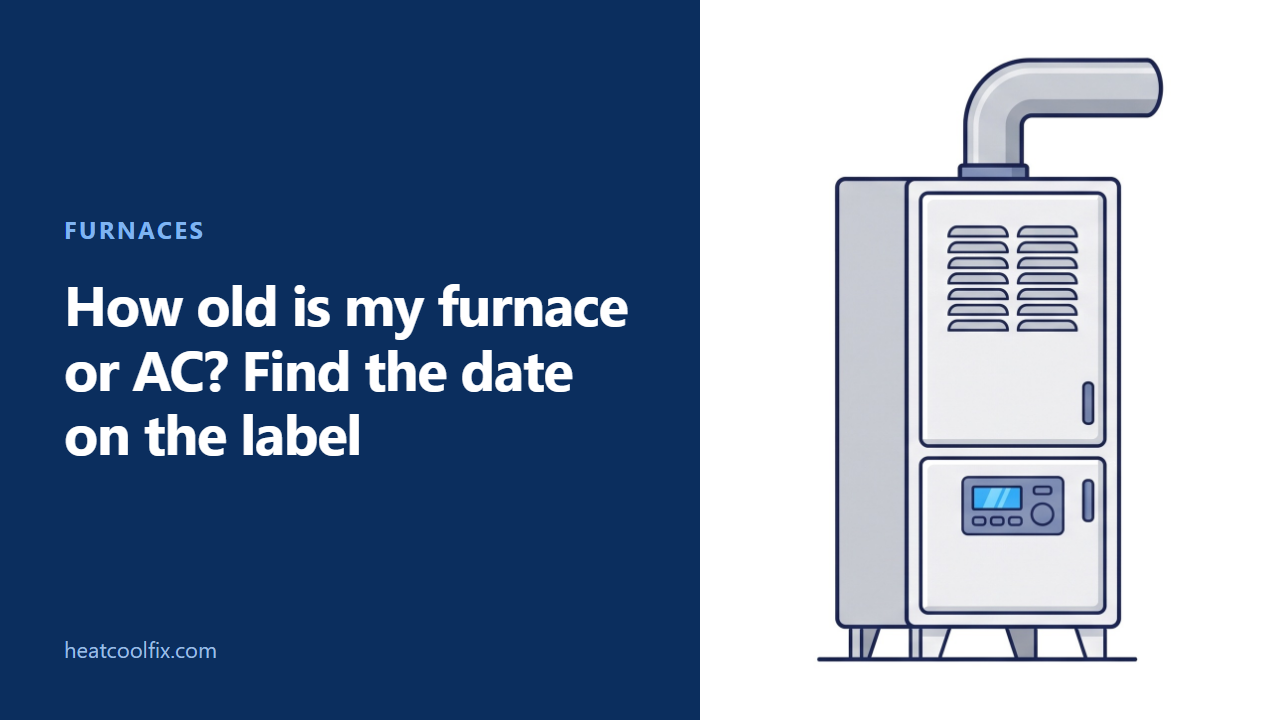
The age is on the rating plate. Trane says look for an MFG date first. If there is none, the serial number often holds it: Carrier's first four digits are the week and then the year, and Lennox's are the plant and then the year, followed by a letter for the month. The furnace and the outdoor unit each have their own plate, and they can be years apart.
How old is my furnace, and how old is the air conditioner? Both answers are printed on the equipment, on the rating plate that also carries the model and serial numbers. Some plates print the manufacture date outright. Others hide it in the serial number, and each maker codes it its own way.
This page shows where the plate is on each part of the system, how Carrier and Lennox code the date, and what the age means when you are weighing a repair.
Before you start
What to carry: a torch and your phone, to photograph each plate. Fifteen minutes.
Gas or electric? Either. A gas furnace, an electric furnace, an air handler and an outdoor unit all carry a plate, and it is read the same way.
Every piece has its own plate. Rheem says a split system has two model and serial tags, one on each piece, and asks for both. An outdoor unit replaced after a failure will not be the same age as the furnace.
If you smell gas. Lennox says stop and call your gas supplier from a neighbor’s phone. Do not open anything.
Outdoors, just read. The outdoor plate is on the outside of the cabinet. Carrier warns of a shock hazard inside and says only trained service people should do electrical troubleshooting.
Find the plate
Find every plate in the system
The outdoor unit. Trane says the label is on the top, right rear of an air conditioner or heat pump. Lennox says it is near the service panel, a sticker with black letters on white.
The furnace. Trane says on the right or left panel. Lennox says take off the top front service panel and look on the left side of the cabinet or on top of the blower deck, depending on the furnace.
The indoor coil or air handler. Trane says on the front panel.
The paperwork. Trane says to check the owner’s manual or the installation papers for the date first, if the last owner left them.
Read the date
Look for a printed date, then decode the serial
A printed date. Trane says look for MFG Date on the plate. That is the manufacturing date, and the furnace was likely installed the same year.
Carrier: week, then year. Carrier’s service manual for its air conditioners and heat pumps reads the first two digits as the week, the next two as the year, then a letter for the plant, E for Collierville, Tennessee or X for Monterrey, Mexico. Its example 0106E00001 was built in the first week of 2006.
Lennox: plant, year, month. Lennox’s numbering sheet reads two digits for the plant, two for the year, then a letter for the month, A for January through M for December with I skipped. Its example 5178M99989 was built in December 1978 at plant 51, Columbus.
Any other brand. Trane says that with no MFG date, note the brand, model number and serial number and look them up online. Carrier, Trane, Lennox and Goodman each have a warranty lookup on their own site.
What the model number adds
Read the size and the refrigerant too
The size. Model numbers often carry the capacity in thousands of BTU. Carrier’s manual reads 24 as 2 tons, 36 as 3 and 60 as 5. Lennox’s sheet reads HS19-311 as a condensing unit of about 31,000 BTU, two and a half tons.
The refrigerant. In the Carrier model numbers that manual covers, such as 24ABA336, the fifth character is A or B for Puron, which is R-410A, and R or S for R-22.
Why it matters. Trane says R-410A replaced R-22 in systems made after 2009, so a unit built before 2010 probably holds R-22: what the R-22 phase out means for it.
What the age means
Weigh the age against the repair
A furnace. Trane says an average furnace lasts 15 to 20 years. The right size, a good installation, a lighter workload and yearly maintenance all stretch it.
An air conditioner or heat pump. American Standard puts a typical lifespan at about 15 years, and Bryant says 15 to 20.
ENERGY STAR’s line. It suggests thinking about a replacement past 10 years for an air conditioner or heat pump and 15 for a furnace, especially alongside repeat or costly repairs: repair or replace.
A young system with a fault. Age does not decide it alone. Many furnace faults are one part, with a cause you can find first: a furnace that is not working.
Questions people ask
How can I tell how old my furnace is?
Look for an MFG date on the plate inside the furnace. With no date, the serial number often holds it. Trane says to check the owner’s manual and installation papers too.
How do I read a Carrier serial number?
The first two digits are the week and the next two the year. Carrier’s example 0106E00001 was built in the first week of 2006, at its Collierville plant.
How do I read a Lennox serial number?
Two digits for the plant, two for the year, then a letter for the month, A for January to M for December with I skipped.
Where is the serial number on my AC unit?
On the plate on the outdoor unit: Trane puts it top, right rear, and Lennox near the service panel. The indoor coil has its own plate on its front panel.
How long does a furnace last?
Trane says an average furnace lasts 15 to 20 years, longer with yearly maintenance and a good installation.
Is my air conditioner too old to fix?
ENERGY STAR suggests considering a replacement past 10 years, with repeat or costly repairs. A unit built before 2010 probably holds R-22, which now costs more to recharge.
Sources: Trane "Locating The Serial Numbers On Your New Products" and "How Long Should a Furnace Last?", Lennox support FAQs on model and serial numbers and its Model and Serial Numbering Systems sheet, Carrier service manual 24-25-9SM model and serial number nomenclature, Rheem "Locating the Model/Serial Numbers", the Lennox SL280UHV installation instructions, ENERGY STAR "When is it time to replace?", and the refrigerant pages of Bryant and American Standard
Read next
 Furnaces
What Size Furnace Do I Need? Why the Charts Disagree
Ask for a Manual J load calculation, and compare the furnace's output with it, not the input. Bryant's own chart puts a
Furnaces
What Size Furnace Do I Need? Why the Charts Disagree
Ask for a Manual J load calculation, and compare the furnace's output with it, not the input. Bryant's own chart puts a
 Furnaces
Should You Close Vents in Unused Rooms? What Tests Show
Probably not. A Lawrence Berkeley National Laboratory study found that closing registers raised energy use in the typical house it tested, because
Furnaces
Should You Close Vents in Unused Rooms? What Tests Show
Probably not. A Lawrence Berkeley National Laboratory study found that closing registers raised energy use in the typical house it tested, because
 Furnaces
MERV Rating Chart: MERV 8 vs 11 vs 13 for a Furnace Filter
A MERV rating says how well a furnace or AC filter catches particles from 0.3 to 10 microns, and higher catches more.
Furnaces
MERV Rating Chart: MERV 8 vs 11 vs 13 for a Furnace Filter
A MERV rating says how well a furnace or AC filter catches particles from 0.3 to 10 microns, and higher catches more.
 Furnaces
Turning the Heat On for the First Time: A Fall Checklist
Book the heating check-up in the fall: ENERGY STAR says contractors get busy once winter comes. Check the filter, and Trane says
Furnaces
Turning the Heat On for the First Time: A Fall Checklist
Book the heating check-up in the fall: ENERGY STAR says contractors get busy once winter comes. Check the filter, and Trane says