Swamp Cooler Not Cooling? Windows, Pads, Water and Pump
 By Ray Bennett · Updated 2 October 2026 · 9 min read · Checked against the maker’s manual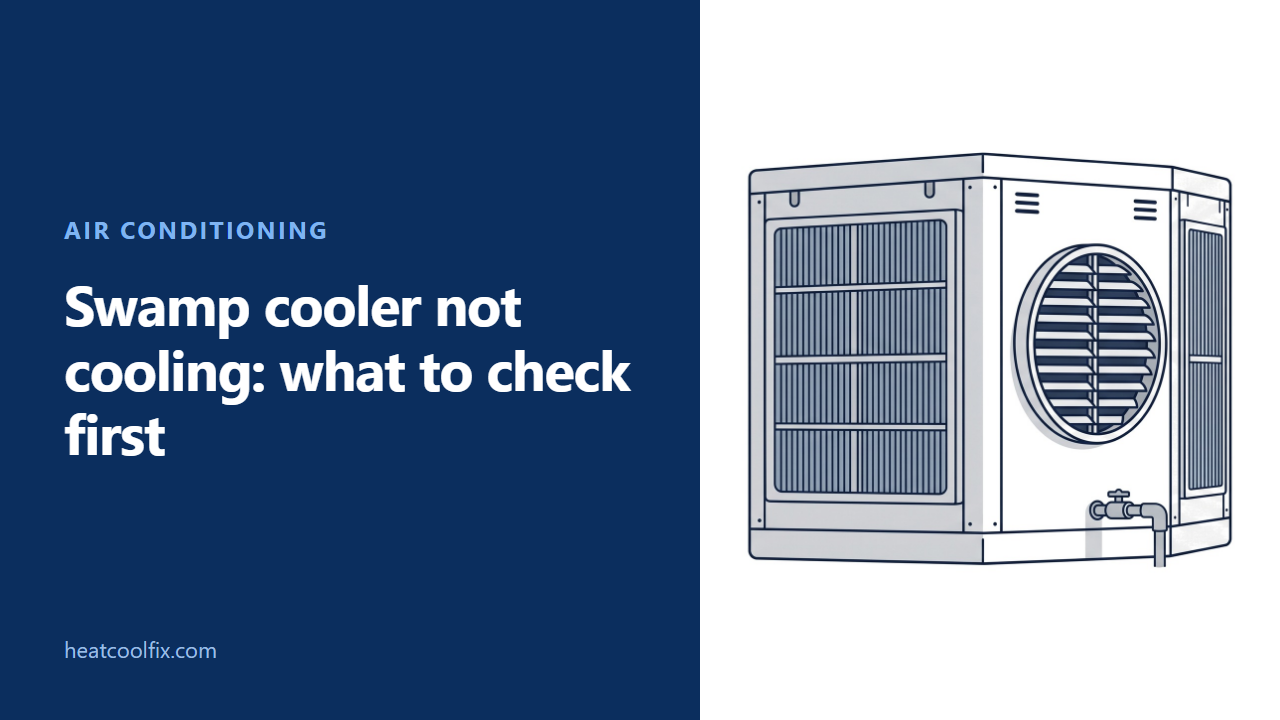
A swamp cooler only cools when its pads are soaking wet, the outdoor air is dry enough, and the air it blows in has a way out. Open windows on the far side of the house, check the pads are wet all over with no dry streaks, and clean or replace clogged pads. On a humid day it simply cannot cool as much: DOE says not to use one in humid climates.
A swamp cooler, an evaporative cooler, cools by blowing outdoor air through pads soaked in water. It needs three things to work: wet pads, dry outdoor air, and a way for the air to leave the house. The poor-cooling row of Phoenix’s troubleshooting chart, written for its industrial and commercial coolers, starts with the air leaving and also lists pads that are not wet, and DOE adds the weather.
Most of the checks cost nothing.
Before you start
What to carry: a torch, a stiff bristle brush (not a wire brush), a soft cloth, a bucket and a hose. Phoenix says to hose off a dirty pad, but never to wash the cooler cabinet with a garden hose, because water can harm the motor and pump. Half an hour, plus the time to let the pads soak.
Gas or electric? A swamp cooler runs on electricity and water only: a fan motor and a small water pump, with no gas and no refrigerant. If your air comes from a central air conditioner or heat pump instead, see an AC not blowing cold air.
Which kind. DOE says most home evaporative coolers sit on the roof and blow down into the house, some are on the ground or in a window, and portable ones on wheels give only a slight cooling effect.
Drain standing water. DOE’s Building America guide says to empty the pan whenever the cooler will sit idle for more than a few days, because standing water can breed mosquitoes and bacteria, including Legionella, the cause of Legionnaires’ disease. Phoenix says to drain it with the water supply and the power turned off, and never onto a roof.
On the roof. DOE notes that routine maintenance on a roof cooler may require a ladder and can wear the roof. If you are not comfortable on the roof, this is a job for a service company.
Why the air is not cool
Open windows on the far side
Why. DOE’s Building America guide says the air from an evaporative cooler is not recirculated: it blows through the house and must have a way out, and the cooler replaces all the air in the house every 2 to 3 minutes. Phoenix lists not enough exhaust from the building as the first cause of poor cooling.
How much to open. DOE says to open windows or vents on the side of the house away from the wind, about 1 to 2 square feet of opening for every 1,000 cfm of cooler. Too little and humidity builds up indoors; too much and hot air comes in. Open the windows in the rooms you want cool and close them in rooms you are not using.
If windows cannot be left open. DOE says up-ducts in the ceiling can let warm air out into the attic instead, and the attic then needs extra ventilation.
Make sure the pads are wet all over
What to look for. Phoenix’s inspection list asks whether there are any dry spots or streaks on the pads while the pump runs. Its chart lists clogged pads, plugged holes in the water distributor, a pump that is not working, loose water connections, too little water in the reservoir, and a clogged pump screen.
The fixes, from Phoenix’s chart. Clean the distributor holes, clean or replace the pump, clean the pump basket or screen, check the float valve, and fix any leaks in the water lines.
Before you open it. Phoenix says never to take off an access panel while the cooler is running, and never to run it with a panel off, because the blower motor can overload. Switch the power off before you open it and before you clean the pump. Phoenix says to unplug the pump cord before taking the pump out, not to let the pump fall over into the water, and to clip the cord so it does not touch the water.
A portable cooler. Portacool says to let the tank fill before turning the pump on, then use the water adjustment valve so the media is soaked but not flooded. If the air is not cool, its checks are that the water and power are connected, the media is damp, and there is water in the tank.
New portable media. Portacool says its new media needs a breaking-in period before it soaks up water readily, and can take up to a week to reach full efficiency.
Check the water supply and the float
The float. Phoenix’s start-up list includes checking that the water line is connected, turned on and not leaking, and that the float is set for the right water level. Water running out of the cooler points to the float: Phoenix’s fix is to adjust the float arm or replace the float valve, and to tighten the standpipe by hand.
A portable cooler leaking. Portacool lists a leaking float valve seat or a loose drain plug.
Clean or replace the pads
How often. DOE says to check the pads, filters, reservoir and pump at least once a month in hot climates, and to replace the pads at least twice a cooling season, or as often as once a month if the cooler runs all the time. Some paper and synthetic pads can be cleaned with soap and water or a weak acid, following the maker’s instructions.
What wears them out. DOE’s Building America guide says to replace torn, worn or mildewed pads, to check the water nozzles are aimed to soak the pads, and to clean them with vinegar to remove mineral scale. Phoenix lists inadequate bleed-off as one cause of clogged pads.
Hard water. DOE’s Building America guide says a bleed-off valve drains some water to cut mineral buildup, but can raise water use by 10 to 50 percent. It calls an auto-flush pump, which empties and refills the pan at set times such as every 8 to 12 hours of running, a more efficient alternative.
Portable media. Portacool says its KUUL media can last up to five years, depending on care and use.
Check the weather, not just the cooler
Humidity sets the limit. DOE says evaporative coolers lower the air 15 to 40°F in low humidity areas, and should not be used in humid climates because they add humidity to the home. DOE’s Building America guide gives an example for an aspen pad cooler: at 100°F and 10 percent humidity outdoors the air coming in is about 73°F, but at 95°F and 50 percent humidity it is about 84°F.
Where they work best. The same guide says they work best in dry climates where the summer design wet bulb temperature is below 70°F. Portacool says its portable coolers do best at 85°F or higher with humidity below 75 percent.
Too damp inside. Phoenix’s fix for too much humidity inside is to open relief vents and let more air out. For a house that feels damp generally: a house that is too humid.
It smells musty, or will not start
A musty smell. Phoenix and Portacool both list stale water in the tank and mildewed or clogged pads. Their fixes are to drain, flush and clean the reservoir and replace the pads. Phoenix also says to run the pump for several minutes before starting the fan, so the pads are wet first.
Stopping it coming back. Portacool says to turn the pump off about 15 minutes before the fan at the end of the day, so the media dries out, which it says helps control mildew, mold and bacteria. Every smell and its fix: a swamp cooler that smells.
A new cooler that smells. Portacool says new media can give off a slight smell that lessens in time.
No air at all. Phoenix lists a blown fuse, a tripped breaker, a loose or broken belt, or an overloaded motor. Portacool lists a tripped breaker or GFCI, an unplugged or damaged cord, or an overheated motor, and says to call an electrician if the breaker keeps tripping. Phoenix says to turn the blower wheel and the motor and pump shafts by hand before the first run each season, to make sure they turn freely; switch the power off first.
Water spitting into the air. Portacool lists too much water on the media and a leaking hose: turn the water adjustment valve down, check the media sits properly in its frames and the cooler is level, and tighten or replace the hose.
Spring start-up and winter shutdown
In spring. Undo the winter steps: take the cover off, open any dampers, and turn the water line back on. DOE’s Building America guide says to replace or clean the pads, check the belt tension, and clean and inspect the cabinet when the cooler first starts up. Phoenix says to adjust the belt only with all power off and the belt not moving.
The first run. Phoenix’s start-up order is the pump first, then check the pads are evenly wet, then open the windows, then start the blower.
In winter. It says to shut off the water line, drain and clean the pan, remove mineral deposits, and cover the cooler, closing the dampers on a ducted system. A window cooler should come out completely so the window can close.
What each one costs
| The step | Cost |
|---|---|
| Opening windows, checking the pads are wet | Nothing |
| Cleaning the distributor, pump screen and pan | Nothing |
| New pads | The price of the pads |
| A new float valve, pump or belt | The part, or a service visit |
| Motor or electrical faults | A service visit or an electrician |
Questions people ask
Why is my swamp cooler blowing warm air?
Phoenix’s chart starts with not enough air leaving the house, then air registers set wrong, then pads that are not wet: a pump, distributor, float or water supply problem, or clogged pads. On a humid day it also cannot cool as much, DOE says.
Do I need to open windows with a swamp cooler?
Yes. DOE says to open windows on the side away from the wind, about 1 to 2 square feet for every 1,000 cfm. Too little and humidity builds up; too much and hot air comes in.
How often should I change swamp cooler pads?
DOE says at least twice a cooling season, or as often as once a month if it runs all the time. Portacool says its KUUL media can last up to five years.
Why does my swamp cooler smell?
Phoenix and Portacool list stale water and mildewed pads. Drain, flush and clean the tank and replace the pads. Portacool also says to turn the pump off about 15 minutes before the fan so the pads dry out.
Does a swamp cooler work when it is humid?
Not well. DOE says not to use one in humid climates. Its Building America guide says the air coming in is about 84°F on a 95°F day at 50 percent humidity, against 73°F on a 100°F day at 10 percent.
Why is water dripping or spitting from my swamp cooler?
Phoenix points to the float arm, the float valve seat or a loose standpipe. Portacool adds too much water on the media or a leaking hose.
Sources: DOE Energy Saver "Evaporative Coolers", DOE Building America Solution Center (PNNL) "Evaporative Cooling Systems" guide, Phoenix Manufacturing AeroCool industrial/commercial evaporative cooler owner's guide 1-999-2469 and its troubleshooting chart, and Portacool Classic portable evaporative cooler owner's manual (2017)
Read next
 Air conditioning
Swamp Cooler Smells Bad? Musty, Fishy or New Pad Smell
Phoenix's and Portacool's troubleshooting charts both blame a musty or unpleasant smell from a swamp cooler on stale water in the pan
Air conditioning
Swamp Cooler Smells Bad? Musty, Fishy or New Pad Smell
Phoenix's and Portacool's troubleshooting charts both blame a musty or unpleasant smell from a swamp cooler on stale water in the pan
 Air conditioning
What Size Dehumidifier Do I Need? Pints by Dampness
ENERGY STAR sizes a portable dehumidifier by how damp the space is: 20 to 30 pints a day for a damp room
Air conditioning
What Size Dehumidifier Do I Need? Pints by Dampness
ENERGY STAR sizes a portable dehumidifier by how damp the space is: 20 to 30 pints a day for a damp room
 Air conditioning
What Size Window Air Conditioner Do I Need? BTU Chart
Measure the floor area and read ENERGY STAR's chart: 5,000 BTU for 100 to 150 square feet, 6,000 up to 250, 8,000
Air conditioning
What Size Window Air Conditioner Do I Need? BTU Chart
Measure the floor area and read ENERGY STAR's chart: 5,000 BTU for 100 to 150 square feet, 6,000 up to 250, 8,000
 Air conditioning
Ceiling Fan Direction in Winter and Summer, Explained
Counterclockwise in summer, clockwise at low speed in winter. ENERGY STAR says the summer direction makes a breeze and a wind chill,
Air conditioning
Ceiling Fan Direction in Winter and Summer, Explained
Counterclockwise in summer, clockwise at low speed in winter. ENERGY STAR says the summer direction makes a breeze and a wind chill,