Reset Button Keeps Tripping: Where It Is and Why
 By Ray Bennett · Updated 2 October 2026 · 6 min read · Checked against the sources at the end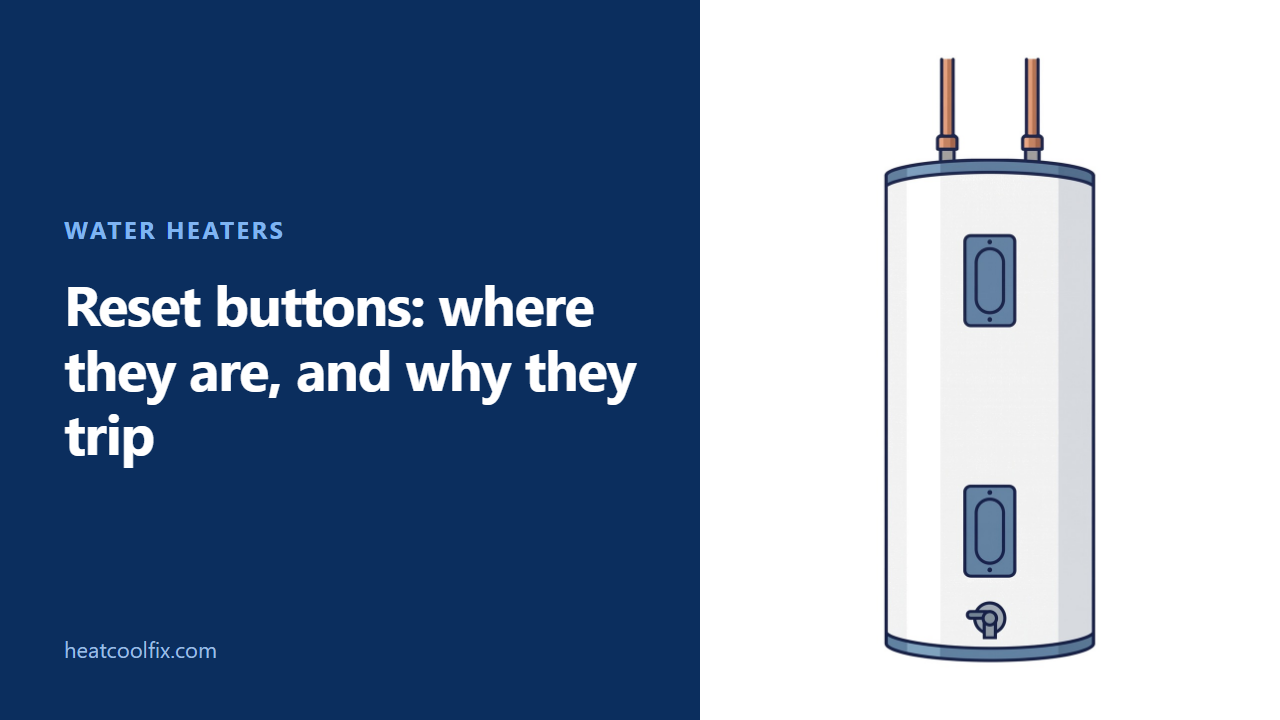
A reset button is a safety switch that has already done its job, so pressing it puts the machine back exactly where it was before something went wrong. Once is a test. Twice is a fault nobody has found. On an electric water heater it is the red button behind the upper panel, and on a heat pump there is no button at all.
A reset button keeps tripping for one reason. It is not a switch that turns the machine on, it is a safety device that already opened because something was wrong, and pressing it simply puts everything back where it was.
So the first press is a test. The second one is a fault that nobody has found yet.
Before you start
What to carry: a screwdriver and a torch. Ten minutes.
Gas or electric? It decides whether you have a button at all. An electric water heater has a famous red one. A gas furnace has no proper reset, only a rollout switch that should never be pressed casually. An air conditioner or heat pump has none.
Two different things get called the same name. A button on the appliance and a breaker in the panel are not the same fault, and the second half of this page separates them.
On an oil burner, once means once. Each press sends more unburnt oil into a chamber that already failed to light it, and that is genuinely dangerous rather than merely unwise.
The same goes for a rollout switch on a gas furnace. That one only trips when flame has come out of the burner box, and pressing it back in puts carbon monoxide in the house.
Where the button is, machine by machine
Electric water heater, the red button
Switch the breaker off first. Take the upper access panel off the side of the tank, fold the insulation back, and you will see a small red button sitting between the terminals of the upper thermostat.
Press it firmly until it clicks. Put the insulation and the panel back, switch on and give it 60 to 90 minutes, A.O. Smith’s time for an electric tank to heat up.
That button is a high limit, and it opens when the water goes above about 180 degrees. So if it has tripped, the water was far hotter than it should have been.
Gas furnace, which has no real reset
What people call a furnace reset is usually clearing a lockout. After three or four failed attempts to light, the board gives up for an hour, or three hours on some Carrier furnaces. Switch it off at the cabinet switch for thirty seconds, switch it back on and watch what it tries to do: which igniter you have and why it failed.
The actual button inside, near the front of the burners, is a rollout switch. It trips when flame escapes forwards, and that is a combustion fault. Do not press it and carry on.
Every way a furnace is reset, with the makers’ own timings: how to reset a furnace.
Air conditioner or heat pump, which has none
There is no user reset on an outdoor unit. What it has instead is a compressor overload buried inside, which opens when the compressor gets too hot and closes again on its own once it cools.
That is why a unit works in the morning and not in the afternoon and then works again the next day. It is not resetting itself out of politeness, it is telling you something.
Power is cut and restored at the breaker and at the pull out block on the wall: which fan has stopped, and the power path to it.
Step by step, with the waits that are not faults: how to reset an air conditioner and how to reset a heat pump.
Why a water heater reset keeps tripping
Three things trip it, and they are worth taking in order.
A stuck thermostat. A thermostat has welded itself closed and is calling for heat that nobody asked for, so the water climbs until the limit stops it. A.O. Smith says the lower thermostat does most of the work, so it is the likelier one to fail: how to test a water heater thermostat.
A shorted element. An element that has failed to earth draws current all the time whatever the thermostat says, with the same result. Bradford White says repeated trips of the limit usually come from a grounded element: how to test an element with a meter.
A loose or burnt connection. A wire that is not tight under its screw makes heat at that screw, and the limit sits right beside it. Look for browning round the terminals while the panel is off.
A button that trips once in five years after a power cut is a different matter and may well be nothing. One that trips every week is one of the three above.
When it is the breaker rather than a button
A breaker that trips is doing the same job for the same reason, one floor away.
Trips the moment you reset it. A dead short or a seized motor. Stop resetting. Flicking a breaker repeatedly at a genuine short is how a small fault becomes a fire.
Trips after a while, usually when it is hot. Something drawing more than it should as it warms up. On an air conditioner that is often a compressor struggling, and on a water heater it is usually an element on its way out.
Trips at the same time every day. Look at what else is on that circuit before blaming the appliance.
A breaker that trips with the appliance disconnected is the wiring or the breaker itself, and that is an electrician.
Questions people ask
How many times can I press it?
Once, then find out why. If it holds for months afterwards it was a one off. If it goes again within a week, stop pressing and start looking.
My water heater reset trips but the water is not hot.
That is normal, because the limit cuts the power completely. The water was too hot before it tripped and has since gone cold sitting there.
Where exactly is the button on a gas water heater?
Usually there is not one. Bradford White fits a resettable thermal switch on the inner door, and says to find the cause before pressing it. A gas heater otherwise has a thermocouple and a gas control, and if it has shut down the pilot is the place to look: lighting it and keeping it lit.
The furnace runs again after I switch it off and on.
That is clearing a lockout rather than fixing anything. It will lock out again, and the reason it locked out in the first place has not changed.
Is a tripping breaker dangerous?
The breaker is the safe part. It is what is making it trip that matters, and a breaker that keeps going is doing its job rather than failing at it.
My mini split has a reset button on the remote.
That one resets the remote itself. LG says it initializes the remote’s settings, which is a different thing from a safety reset.
Sources: Whirlpool Energy Smart use and care guide 318686-001 (ECO at 180°F, red reset button), A.O. Smith "Standard Electric - No Hot Water" flowchart (reset click, grounded element, welded thermostat) and "How Long Does It Take a Water Heater to Heat Up?" (60 to 90 minutes electric), Bradford White service manuals 238-51791-00D (grounded element and the high limit) and 238-51542-00E (resettable thermal switch on the inner door), Goodman *MSS9 installation instructions IOG-2009E and Carrier 58SC0A instructions (ignition lockout, manual reset rollout limits), Honeywell R7184 installation instructions 69-1459 and Beckett GeniSys 7505 manual (limited reset, unburned oil), and the LG Art Cool installation manual (remote reset)
Read next
 Water heaters
How Long Does a Water Heater Take to Heat Up? By Type
A.O. Smith says a typical 40 to 50 gallon gas tank heats back up in about 30 to 40 minutes and an
Water heaters
How Long Does a Water Heater Take to Heat Up? By Type
A.O. Smith says a typical 40 to 50 gallon gas tank heats back up in about 30 to 40 minutes and an
 Water heaters
Tankless vs Tank Water Heater: What Each Does Better
A tank keeps a store of water hot, so hot water comes at once, the upfront cost is low and upkeep is
Water heaters
Tankless vs Tank Water Heater: What Each Does Better
A tank keeps a store of water hot, so hot water comes at once, the upfront cost is low and upkeep is
 Water heaters
What Size Water Heater Do I Need? Size by the Busiest Hour
Size a tank water heater by your busiest hour of hot water, not by the number of bedrooms. A.O. Smith counts about
Water heaters
What Size Water Heater Do I Need? Size by the Busiest Hour
Size a tank water heater by your busiest hour of hot water, not by the number of bedrooms. A.O. Smith counts about
 Water heaters
How Old Is My Water Heater? Read the Serial Number
The date is in the serial number, on the rating label on the side of the tank. Bradford White uses two letters,
Water heaters
How Old Is My Water Heater? Read the Serial Number
The date is in the serial number, on the rating label on the side of the tank. Bradford White uses two letters,