AC Fan Not Spinning: Which One, and What to Do
 By Ray Bennett · Updated 2 October 2026 · 5 min read · Checked against the sources at the end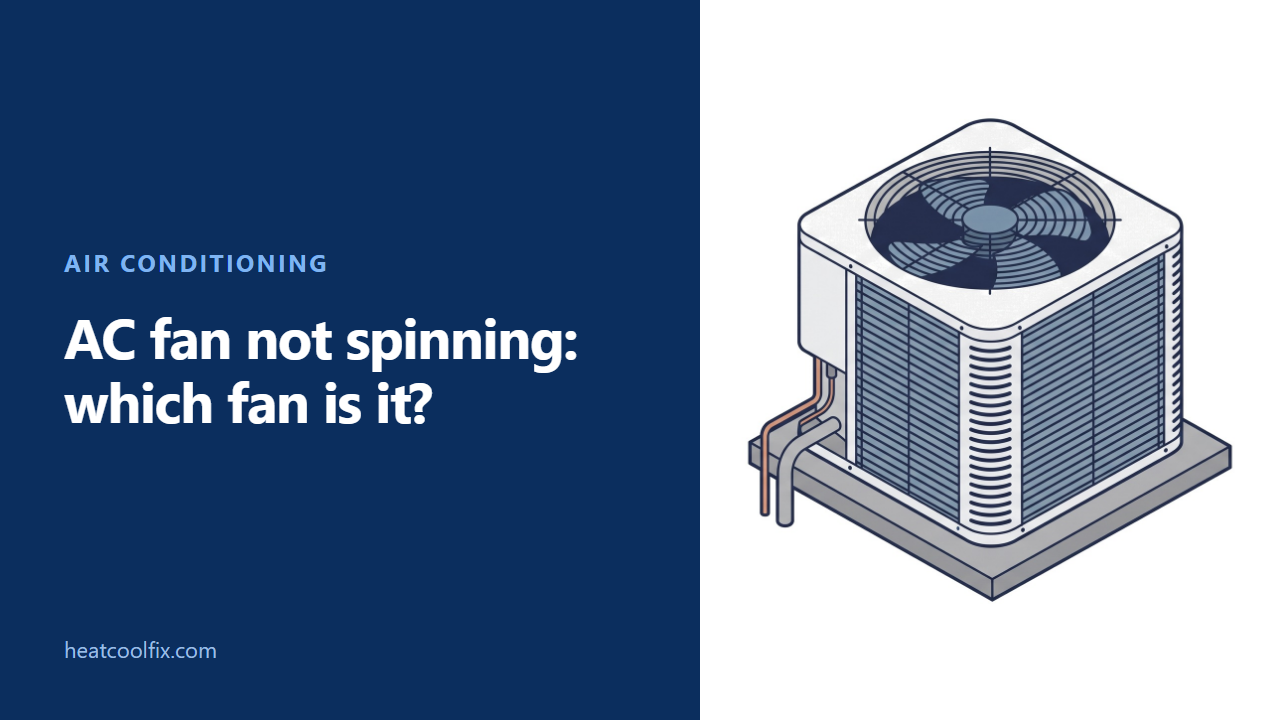
An air conditioner has two fans and they fail for different reasons. Air at the vents with nothing turning outside is the outdoor fan, and that is much the commonest. No air at the vents is the indoor blower, its door switch or the small fuse on the board. Running it with the outdoor fan stopped is what kills compressors.
An AC fan not spinning is two completely different faults, because an air conditioner has two fans. One sits indoors pushing air round the house and one sits outside throwing the heat away.
Thirty seconds of looking says which one you have lost, and after that the two lists have almost nothing in common.
Before you start
What to carry: a torch and a long stick or a wooden spoon. Ten minutes.
Gas or electric? Indoors the blower lives in a gas furnace or in an electric air handler, and the way it is switched on differs slightly. Outdoors it is the same box either way, and on a heat pump it is the same box again.
Set it up first. Thermostat to Cool, temperature pushed right down, fan on Auto. Then wait five minutes, because every system holds the outdoor unit off for a few minutes after any change and people diagnose a dead fan during that wait.
A compressor running with no outdoor fan. That fan is the only thing taking the heat away. Without it the compressor overheats within minutes, and the compressor is the part that ends a system rather than costing a repair.
Inside the outdoor unit there is also a capacitor that can hold a charge after the power is off, and mains on the contactor a few inches from it.
Which fan has stopped?
Stand at a vent, then go outside
With the system calling for cooling, hold a hand at a supply vent. Air moving means the indoor blower is running.
Then go outside. The big fan on top of the outdoor unit should be turning, with a deeper drone underneath it from the compressor.
Air indoors and nothing outside is a common case, and the next section is yours. No air indoors sends you further down. Neither one moving is usually power or a thermostat that is not calling at all.
The outdoor fan is not turning
The push test, with the power off
Switch the breaker off and pull the disconnect block out of the box on the wall beside the unit.
Reach through the grille on top with a long stick and give the fan blade a push. Note whether it spins freely and keeps going, or whether it is stiff and gritty.
Put the disconnect back, switch on and watch. A fan that runs after a push and would not start on its own points to the capacitor, and that is the cheap end: how to tell, and which one to buy.
A blade that would not turn freely by hand is a seized motor bearing, and that is a motor rather than a capacitor.
If it does not even hum, it is power
Silence rather than a hum means nothing is reaching the motor.
Two breakers in the main panel, one for the indoor unit and one for the condenser. Then the pull out disconnect block on the wall, which gets left out after a service or pushed back in upside down.
Then the contactor, the relay inside that switches the outdoor unit on. Pitted contacts and insects inside them are both ordinary failures.
The same order, in more detail, is on the outdoor unit page, because the box is the same on a heat pump.
The indoor fan is not turning
Four things, in this order
The fan switch on the thermostat. Put it to On rather than Auto. If the blower runs on On and never on Auto, the thermostat or its wiring is not calling for it.
The panel on the front of the indoor unit. There is a plunger switch behind it that cuts everything when the door is off, and the panel has to be properly clicked shut rather than leaning in place. This catches people who have just changed a filter.
The small fuse on the control board. Usually three amps and the same kind a car uses. A broken stripe through the window means it has blown.
Then the blower itself. Some have a capacitor, some have an electronic module, and either can fail. A blower that hums without turning gets switched off at the breaker for the same reason as the outdoor one.
If the thermostat is blank as well, start there instead: a dead thermostat and where its power comes from.
Both fans turn and it still is not cooling
Then the fans are not your problem. Two fans running with warm air at the vents points at the compressor not running, or at the system being low on refrigerant.
Measure the temperature drop across the indoor coil before anything else, because that one number separates the two: how to measure it, and what the number means.
Questions people ask
The outdoor fan runs but the compressor does not.
On a shared capacitor the compressor half can fail while the fan half is fine. Give it the five minute wait first, then look at the contactor and the capacitor.
It starts if I push the blade every time.
That is a capacitor telling you it is finished. It is not a way of running the system, because every hard start damages the motor a little more.
The fan spins the wrong way.
Usually a motor fitted or wired wrongly after a repair. An outdoor fan should pull air up and out through the top.
It ran all night and stopped in the afternoon.
Heat. A motor or a capacitor that is marginal fails when it is hottest, which is also when you need it. It will do it again.
Is it safe to run with just the indoor fan?
Yes. Running the blower on its own moves air round the house and cools nothing, and it does no harm at all. It is the opposite case, a compressor with no outdoor fan, that does the damage.
Mine is a mini split and the outdoor fan has stopped.
Same part and the same checks, in a smaller box: the rest of the mini split list.
Sources: Bryant "What to Do When Your Bryant AC Fan Is Not Spinning" (capacitor hum, contactor, fan motor, compressor overheating), Carrier service manual 24-25-9SM (5 minute cycle protector delay), Resideo (Honeywell) T6 Pro installation guide 33-00181EFS (five minute compressor protection), Carrier 58SC0A furnace instructions (blower door switch, 3-amp automotive fuse), and Carrier "Troubleshoot an Air Conditioner" (panel breaker and the disconnect by the unit)
Read next
 Air conditioning
Swamp Cooler Smells Bad? Musty, Fishy or New Pad Smell
Phoenix's and Portacool's troubleshooting charts both blame a musty or unpleasant smell from a swamp cooler on stale water in the pan
Air conditioning
Swamp Cooler Smells Bad? Musty, Fishy or New Pad Smell
Phoenix's and Portacool's troubleshooting charts both blame a musty or unpleasant smell from a swamp cooler on stale water in the pan
 Air conditioning
Swamp Cooler Not Cooling? Windows, Pads, Water and Pump
A swamp cooler only cools when its pads are soaking wet, the outdoor air is dry enough, and the air it blows
Air conditioning
Swamp Cooler Not Cooling? Windows, Pads, Water and Pump
A swamp cooler only cools when its pads are soaking wet, the outdoor air is dry enough, and the air it blows
 Air conditioning
What Size Dehumidifier Do I Need? Pints by Dampness
ENERGY STAR sizes a portable dehumidifier by how damp the space is: 20 to 30 pints a day for a damp room
Air conditioning
What Size Dehumidifier Do I Need? Pints by Dampness
ENERGY STAR sizes a portable dehumidifier by how damp the space is: 20 to 30 pints a day for a damp room
 Air conditioning
What Size Window Air Conditioner Do I Need? BTU Chart
Measure the floor area and read ENERGY STAR's chart: 5,000 BTU for 100 to 150 square feet, 6,000 up to 250, 8,000
Air conditioning
What Size Window Air Conditioner Do I Need? BTU Chart
Measure the floor area and read ENERGY STAR's chart: 5,000 BTU for 100 to 150 square feet, 6,000 up to 250, 8,000