Radiator Won’t Turn Off? Why It Stays Hot and What to Check
 By Ray Bennett · Updated 13 October 2026 · 13 min read · Checked against the sources at the end
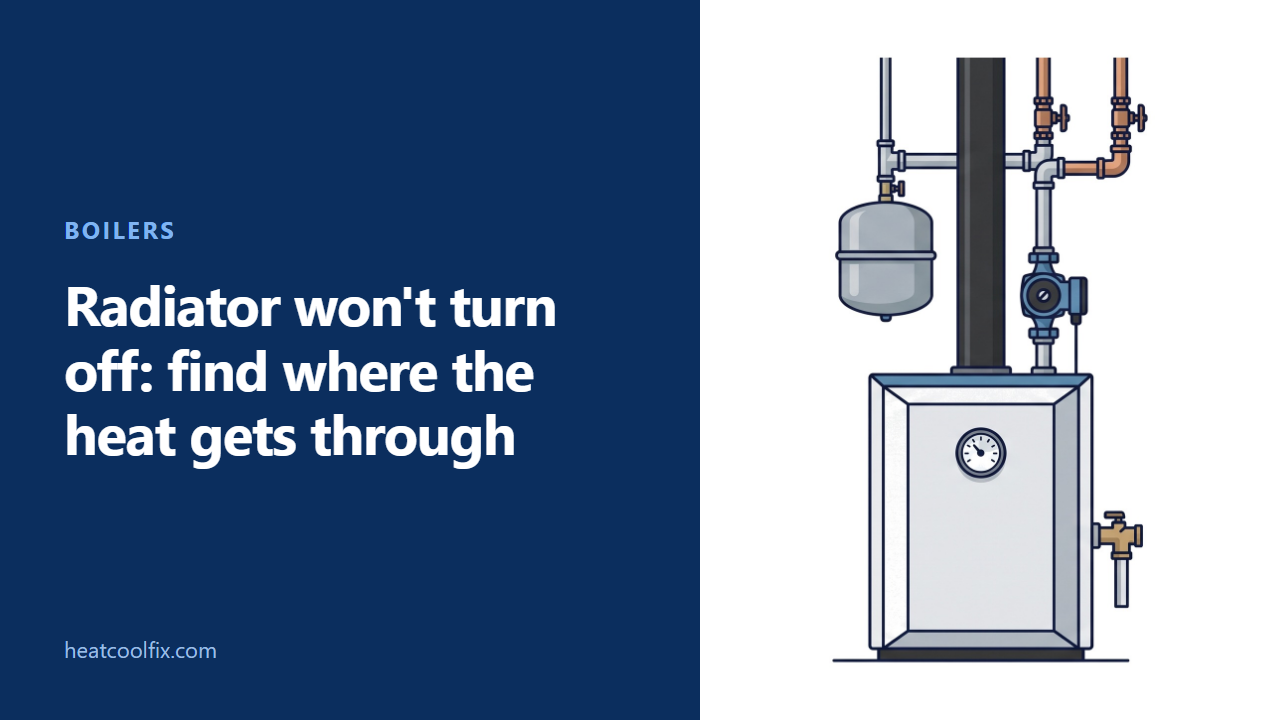
Count how many stay hot. One radiator points to its valve: the frost mark on a thermostatic valve is not off, and a stuck pin holds it open. One zone points to its zone valve, lever or pump relay. Every radiator points to the thermostat or the boiler. Warm with the heating off points to hot water rising where a flow check valve is missing, stuck or left open, or a combi's diverter valve.
A radiator that won’t turn off is still getting hot water or steam from somewhere, and the first step to finding where is to count how many are doing it. Stelrad, a radiator maker, says one radiator points to its own valve, and every radiator points to the boiler, the room thermostat or a control fault.
Some warmth is normal: Castrads says a thermostatic valve lets a little water through when the room is cold, against frost, and Google says hot water pipes stay hot for a while after the heating stops.
Before you start
What to carry: a torch, gloves, and an Allen key or pliers for a valve pin. Stelrad says freeing a stuck pin takes around ten minutes.
Gas, oil or electric? It makes no difference here. A plug-in electric oil-filled radiator is a different machine; plug-in heaters are under space heaters.
Hot water or steam? A hot water radiator has a pipe in and a pipe out, Castrads says, and a bleed screw at the top, Danfoss says. Castrads says a one-pipe steam radiator has one large pipe at the bottom and an air vent on the opposite side, and a two-pipe steam radiator has two pipes and no air vent. Both kinds of steam are check 3.
Renting? Viessmann says that beyond bleeding, work on a rented heating system is the landlord’s to arrange, so ask before you take a valve apart. In New York City, the housing agency takes 311 calls about defective radiators.
Never force it. Stelrad says forcing a seized pin risks snapping it or cracking the valve body, which turns a ten minute job into draining and replacing the valve. Burnham says never open a pipe fitting on its boilers until the water is cool and has no pressure.
A steam leak that will not stop. NYC’s inspection manual says that if closing a steam radiator’s valve does not stop a steam leak, the boiler is shut down and tagged so no one runs it until it is put right. Switch the boiler off and keep clear; if you rent, tell the owner at once.
Keep things away from it. The U.S. Fire Administration says to keep anything that can burn at least 3 feet from radiators.
Count how many stay hot
Turn the thermostat right down, give the radiators time to cool, then go round and hold a hand near each one before you touch it.
One radiator points to its own valve: checks 1 and 2 on hot water, check 3 on steam. Every radiator on one thermostat, such as one floor, points to the zone valve or pump that feeds them: check 4. Every radiator in the house points to the thermostat or the boiler: check 5. Warm with the heating off, or whenever hot water runs, points to hot water getting through with no call for heat: check 6.
Warmth that is normal
Caleffi says a room cannot cool the moment the thermostat is turned down, because the building and the heating system hold heat. Burnham’s controls can run the pump on after the call for heat ends to send out the boiler’s leftover heat.
One radiator
A thermostatic valve: the frost mark, then the pin
The frost mark is not off. Castrads says thermostatic valves pass a little water when the room is cold, against frost, and to shut one fully you fit the decorator’s cap made for it. The frost mark opens the valve at about 45 degrees on Caleffi and Oventrop heads and 45 to 50 on Danfoss’s RA2000. Resideo’s T104 and Macon’s EVO heads have a true off at 0, but Purmo says never shut one fully in a room that could freeze.
The test. Stelrad says turn the head to its lowest setting and wait: if the radiator cools, the valve works and the fault is elsewhere, and if it stays hot, the valve is the suspect. Danfoss, Oventrop and Macon say their dials can be limited or locked, so a dial that stops short may be set that way.
Check the pin. Stelrad says turn the head to its highest setting first, and that freeing a pin needs no draining. Danfoss says take the head off, by turning it counterclockwise or with an Allen key on older models, and push the pin with the flat end of the key: it should move in 2 to 3 mm and bounce back. On an older Danfoss RA valve with a large silver nut, Danfoss says the system should be off first.
Free a stuck pin. If it will not move and spring back, Danfoss says gently tap the side of the valve and move the pin in and out until it frees, then check for leaks and refit the head. Stelrad eases it with pliers, never strikes the pin itself, and stops if it will not move without heavy force. Set the head to 5 before refitting, as Caleffi and Oventrop say, and tighten it without excessive force.
Dirt or a failed head. Oventrop says a valve that cannot be shut off has dirt such as rust on its disc in most cases, which working the stem with the head off can often clear; a damaged disc means a new insert, a technician’s job. Oventrop also lists a defective head, and Macon a broken or kinked sensor tube, and both mean a new head, which Caleffi and Macon say goes on without draining.
Where the head sits. On hot water, Danfoss says check the head is seated properly, and that curtains over a head call for a remote sensor.
When to call. Stelrad says a valve that seizes again soon, or leaks once the head is back on, has reached the end of its life, and replacing it means isolating and draining that part of the system.
A hand valve, a lockshield, or no valve
A hand valve. Stelrad says many radiators have a manual valve that only closes when you turn it, and some older ones have no adjustable valve on the inlet at all, so they heat whenever the system runs.
The lockshield. Water leaves a hot water radiator through a second valve, the lockshield, which Castrads says balances the system. Stelrad says closing it is a temporary way to stop the radiator heating until the valve is fixed. Danfoss closes its RLV lockshield with a 6 mm Allen key under the cover and sets the flow by the turns it is open, from a quarter to four, so count the turns.
Not every cap is a shut-off. Danfoss says the cap on a new valve is not a shut-off and offers a separate shut-off device, Oventrop says its cap is not for a permanent one, and Caleffi’s 220 valves can be shut with their cap.
Hot water baseboard. On a series loop, where one pipe runs through each baseboard in turn, Slant/Fin’s room control is the damper on the cover, which blocks the warm air leaving the top when closed. Buderus says no thermostatic head can go on a series loop. On a one-pipe system with diverter tees, Slant/Fin says each baseboard usually has a shut-off valve at its tee.
A steam radiator: shut the supply valve all the way
One-pipe: shut it all the way. Hoffman says a one-pipe radiator’s supply valve can only turn it off completely or on fully. Peerless says a half-closed valve restricts the water draining out and causes hammer, and Castrads warns of hammer too.
Shut and still hot. HUD says worn valve seats let steam leak in, and DOE says a valve that will not fully open or shut may need replacing. NYC’s inspection manual checks that a closed valve holds with an infrared thermometer, and DOE notes bare riser pipes that heat a room with no radiator at all.
Turning it down instead. Castrads says one-pipe heat is controlled by the air leaving the radiator, so a thermostatic valve goes between the radiator and its air vent, with a vacuum breaker. Danfoss says not in the room whose thermostat runs the boiler, Macon not anywhere in that thermostat’s zone, and both say keep the pressure at about 2 psig or less; Danfoss says otherwise steam gets in anyway. DOE and HUD say a slower air vent cuts the heat to a room that overheats; Danfoss says take a vent off only with the heat off.
Two-pipe steam. Close the supply valve at the inlet: Hoffman says it may be a plain shut-off or a modulating valve, and an ordinary one takes several turns to open fully. DOE says a thermostatic valve on a two-pipe inlet can block steam entirely when it closes.
A zone, or the whole house
One zone: the zone valve, its lever, or the pump relay
What feeds a zone. HUD says each zone has its own thermostat, with a small pump or a zone valve in its loop. The installer checkout for the Honeywell V8043 is to turn the zone thermostat below room temperature: the valve should close and the equipment it switches should stop.
The manual lever. Zone valves from Taco, Honeywell, Caleffi and White-Rodgers have a lever or dial to open them by hand. On Taco’s 570, a lever pushed down holds the valve open until someone pushes it back up, and Taco says a lever that moves easily means the valve is open. The V8043’s lever returns to automatic the next time the valve is powered, and White-Rodgers says a valve left open by a power cut stays open until the power returns.
A valve that will not close. Taco lists three reasons a zone valve passes water unpowered: a pump strong enough to push it open, a manual lever left down, or a sticking piston. The V8043’s instructions say oxygen from frequent topping up wears out its rubber plug, Burnham says a dirty system can seize zone valves, and White-Rodgers says its 1311 and 1361 valves are allowed to leak a little when closed.
The lights. Taco says the red light on its SR switching relays comes on when the thermostat calls, sending power to that zone’s pump, so a light that stays on with the thermostat turned right down is for a technician to trace.
Leave the inside to a technician. The V8043’s instructions say a trained technician services it, Taco says never take a power head off while the thermostat is calling, and White-Rodgers says drain the system before its valve head is unlatched, or it can scald.
Every radiator: the thermostat and the boiler
A radiator valve does not switch the boiler. Castrads, Myson and Google say a radiator’s valve only changes the water into its own radiator. If every radiator stays hot, Stelrad says the usual causes are a thermostat set too high or faulty, a boiler stuck calling for heat, or a zone valve jammed open.
The thermostat’s own room. Viessmann says a thermostatic valve in the room with the thermostat must be fully open, and Bosch says not to fit one there. Google says a closed valve on the radiator nearest a Nest stops it sensing the temperature change, and DOE says a thermostat in a cooler spot keeps the boiler running and overheats other parts of the building.
Turn it to Off. If the boiler overheats or the gas will not shut off, Weil-McLain says keep the pump powered and shut the gas off outside the boiler. Otherwise, Stelrad’s first check is the thermostat’s settings and batteries. If the boiler and pump still run with the thermostat off, Google says switch the power off at the fuse box or system switch before touching the thermostat’s wires, then test the old thermostat if you replaced one. More in a thermostat not working.
The boiler side. U.S. Boiler warns that a factory jumper left across the thermostat terminals on its Megasteam makes a constant call for heat, and Resideo says its L7224U aquastat flags welded relay contacts near the end of the control’s life. Both are a technician’s find.
Hot with the heating off
Warm in summer or when hot water runs: gravity flow or a diverter
Why it happens. Taco says hot water in the supply pipe is lighter than the cooler water coming back, so it circulates on its own when the boiler is hot but the heating is not wanted, as when it is kept hot for tap water. Caleffi says that without a check valve this flow often pushes a room above the thermostat’s setting.
Ghost flow. With several pumped zones, Taco says water can bypass through a zone that is not calling while another zone’s pump runs, unless each zone has a flow check. Caleffi says a swing check cannot stop rising hot water, and many zone pumps now have a spring-loaded check built in.
The knob left open. Flow check valves have a knob or handle to open them by hand, and Bell and Gossett says one left open lets the radiators heat uncontrolled: return it to automatic after a power cut or bleeding. Taco’s knob goes fully clockwise for normal running and Bell and Gossett’s opens fully counterclockwise, but Caleffi’s 510 turns the other way, so follow your maker’s directions. Bell and Gossett warns that a corroded or leaking valve may be about to leak or rupture: keep clear and call a technician.
Stuck open. Taco says a flow check that lets water by typically has debris on its disc or seat, and Bell and Gossett says too much pipe dope can foul it. Cleaning one means the pressure at zero and the water below 100 degrees, Bell and Gossett says: a technician’s job, as is fitting one where there is none.
A combi or a steam boiler. Lochinvar says radiators that get hot during a hot water draw on its Noble combi point to its diverter valve. On its Independence steam boiler with a hot water tank, Burnham says a limit set above 180 degrees can make it steam with no call for heat.
After it is fixed
Leave thermostatic valves open over summer. Caleffi says set the head to 5 for the summer, and Stelrad says work each one open and shut a couple of times a year.
Turning rooms off. Google says you can close the valves in rooms you rarely use. DOE says keep cooler parts of the house above 50 degrees rather than shutting their heat off entirely, and Purmo says a radiator in a room that freezes can crack.
What each one takes
| Where the heat gets through | What it takes |
|---|---|
| The frost setting | Nothing, or the cap made to shut it where the room cannot freeze |
| A stuck pin | About ten minutes, gently, with the head off |
| Dirt on the seat, or a failed head | Working the stem or a new head; a technician for a new insert |
| No valve on the inlet | The lockshield for now, then a new valve |
| A steam valve that will not hold | A new valve, from a technician |
| A zone valve lever, a stuck valve or the relay | Putting the lever back, or a technician |
| The thermostat or its room | Opening that room’s valve, or a technician for the wiring |
| Gravity flow | Returning the flow check knob to normal, or a technician |
Questions people ask
Why is my radiator hot when the heating is off?
Hot water can rise into it on its own when the boiler is kept hot for tap water, if a flow check is missing, stuck or left open, Taco says.
Is the snowflake setting on a radiator valve off?
No. The frost mark opens the valve at about 45 to 50 degrees on Caleffi, Oventrop and Danfoss heads. Castrads’ decorator’s cap shuts one fully, but Purmo says never do that in a room that could freeze.
What happens if I take the thermostatic head off?
The valve opens: Danfoss, Caleffi and Macon say their valves stay open with no head on. Oventrop says wear gloves or switch the heating off first, and Danfoss says its older RA valves with a large silver nut need the system off.
How do I turn off one steam radiator?
On one-pipe steam, close its supply valve all the way: Hoffman says it is either fully off or fully on. On two-pipe, close the supply valve at the inlet.
Should I turn down the radiator in the room with the thermostat?
No. Viessmann says thermostatic valves in that room must be fully open, and Google says a closed valve on the radiator nearest a Nest stops it sensing the temperature change, so the boiler might run inefficiently.
The other radiator and boiler guides: a radiator not heating, a radiator leaking, a boiler that keeps turning off and a boiler not working.
Sources: Castrads thermostatic valve, hydronic, one-pipe and two-pipe steam pages, Stelrad radiator valve advice, Danfoss RA2000, RA-N, RLV and RA2000 1PS data sheets, RA2000 1PS installation instructions, its radiator thermostats guide, RA crossover guide, winter preparation page and hydronic support FAQ, Caleffi 220 and 200 series thermostatic valve instructions, 510 flow check instructions and idronics 5 and 36, Oventrop Uni XH and Uni LHB instructions, Resideo T104 specification and L7224U aquastat instructions, Honeywell V8043 zone valve instructions, Macon EVO, OPSK, NT series and TRV bulletins, Myson and Buderus radiator manuals, Purmo FAQ, Slant/Fin baseboard instructions and Base/Line 2000 specification, Hoffman steam manual TES-181A, Peerless one-pipe steam guide, Taco 570, SR501 and Flo-Chek literature and FAQ, White-Rodgers 1311 and 1361 zone valves, Bell and Gossett Flo-Control manual, Burnham Alpine, MPO-IQ and Independence instructions, Lochinvar Noble manual, U.S. Boiler Megasteam manual, Viessmann Vitodens instructions and bleeding page, Bosch Greenstar instructions, Google Nest help pages, Weil-McLain gas boilers user manual, DOE steam balancing guideline and Building America steam pages, HUD Rehab Guide, NYC HPD steam radiator pages and inspection manual and the U.S. Fire Administration
Read next
 Boilers
Lochinvar Noble Error Codes: Lockouts and Fault Messages
Lochinvar Noble error codes are words on the SMART SYSTEM display, such as Flame Fail: Ignition, Air Pressure Switch or LWCO. Faults
 Boilers
Weil-McLain ECO Tec Error Codes: Blower Fault and Lockouts
A Weil-McLain ECO Tec Series 2 names its faults on the touchscreen instead of using numbers. In a lockout the banner turns
 Boilers
Weil-McLain Evergreen Error Codes and Lockout Messages
A Weil-McLain Evergreen Pro shows its faults as words, not numbers: the display turns red and names the fault, such as IGNITION
 Boilers
Weil-McLain AquaBalance Error Codes: A01, F37 and A16
The Weil-McLain AquaBalance shows A or F with a number. A codes are hard lockouts: press RESET for 1 second once the