Portable Air Conditioner Not Cooling Your Room
 By Ray Bennett · Updated 2 October 2026 · 6 min read · Checked against the sources at the end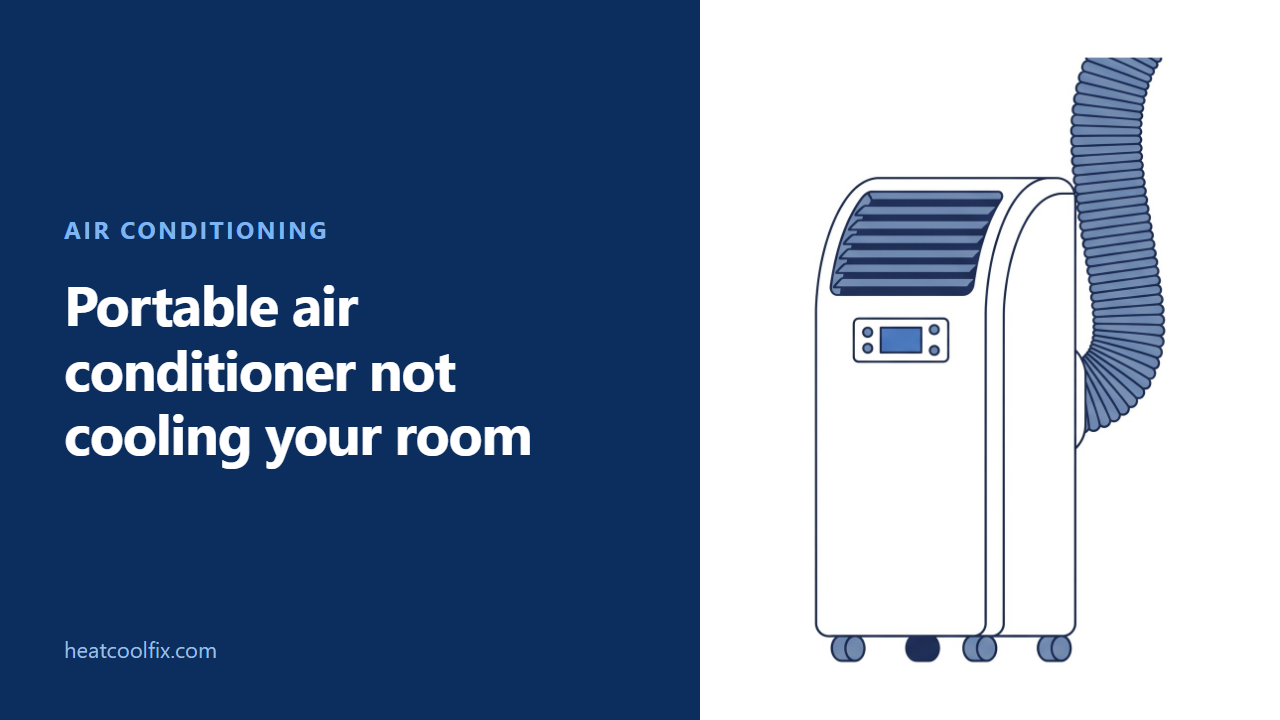
Count the hoses first. A single hose unit throws your cooled room air out of the window, and that air is replaced by hot air pulled in through every gap in the house, so it is working against itself all day. A twin hose one is not. After that it is the hose, which gets hot enough to heat the room it is standing in, and then the filters.
A portable air conditioner disappoints a lot of people, and most of the time nothing is broken. The design has a hole in it, and once you can see the hole the rest makes sense.
So the first thing to do is not open anything. It is to look at the back and count the hoses.
Before you start
What to carry: foam tape, a jug, and something to wash two filters in. Half an hour.
Gas or electric? Electric, and it plugs into a wall socket. Plug it straight into the wall rather than into an extension lead, because these pull a heavy surge every time the compressor starts.
Count the hoses at the back. One fat hose to the window, or two. That single fact decides most of what follows, and plenty of people have owned one for three summers without noticing.
Never extend the hose with extra ducting. A longer or narrower run raises the pressure the fan has to push against, the unit overheats, and it shuts itself down. The hose it came with is the length it was designed around.
Count the hoses
Work out which kind you have, then seal the window kit
One hose. The unit pulls air out of your room, runs it over the hot coil, and pushes it out of the window. That air has to be replaced, and it is replaced by outside air finding its way in under doors, round windows and down chimneys. So a single hose unit is quietly importing hot air the whole time it runs, and the hotter it is outside the worse the trade gets.
Two hoses. One brings outside air in for the hot coil, the other sends it straight back out. The room is not emptied and nothing is pulled in to replace it. This is why twin hose units cost more and cool better.
GE sells a dual hose conversion kit, the RAP02, for its own portables, so check whether your maker offers one. Otherwise, what you can do is stop losing anything else.
Seal the window kit. The plastic or foam panel that fills the gap in the sash usually leaves gaps at the ends and along the top. Foam tape round the whole thing is cheap, and it is one of the most worthwhile things you can do to a single hose unit.
The hose is a radiator
Short, straight, and wrapped
Short and straight. Put the unit as close to the window as the room allows. Every extra foot of hose is more hot surface sitting in the room you are trying to cool.
Feel it. Run the unit for ten minutes and put a hand on the hose. People are always surprised. That heat is going straight back into the room.
Wrap it. Pipe insulation or a purpose made sleeve, and it is one of the few cheap changes that makes a difference you can feel.
No sags and no loops. A dip in the hose collects condensate, which gurgles and eventually runs back into the machine.
Nothing crushing it. Behind a sofa or under a door, a squashed hose chokes the exhaust fan and the unit shuts down on its own overheat protection.
Filters, water and the settings
Two filters, one tank, four settings
The filters. There are usually two, front and back or top and bottom, and both slide out and wash under a tap. They clog within weeks because a portable sits on the floor where the dust is. Monthly through the season.
The tank, and the full light. Most modern portables are self evaporating: they fling the condensate onto the hot coil and it leaves with the exhaust. On a humid day they make more water than they can throw away, the tank fills, and the unit stops with a light on. Empty it, or better, if your manual allows one, fit a continuous drain hose and run it to a floor drain or a shallow tray.
Fan only. Air moves, nothing is cooled, and it is easy to leave it there by accident.
ECO or energy saver. The compressor cycles off and on and the unit goes quiet for long spells, which reads as a fault when it is not.
The restart delay. Three to five minutes before the compressor will start again. Pressing buttons restarts the wait.
Clearance. It needs open air all round the cabinet, so a unit wedged into a corner or against a curtain is being choked at the back.
What a portable can and cannot do
Portables are rated generously, and a single hose one delivers noticeably less than its label on the day you actually need it.
That matters because a common complaint about them is not a fault at all. It is a unit sold for a small bedroom being asked to cool an open plan living room, which it will never do however clean it is.
The honest expectation is a gap below the outdoor temperature rather than a number on a dial, which is true of every air conditioner: why a system holds a gap rather than a temperature. Shut the door of the room you are cooling, close blinds on the sunny side, and judge it on a normal day rather than the hottest afternoon of the year.
There are real faults too. If the fan runs and the exhaust hose never gets hot, the compressor is not starting. If there is ice on the coil behind the filter, treat it the same way as any other iced coil: thaw it first, then look at airflow. And if you want the same job done properly in one room, a window unit with the same label will beat a single hose portable every time: what to check on one of those.
Questions people ask
Why is the exhaust hose so hot?
Because everything the machine removes from the room is travelling through it, plus the heat of the motor itself. A hot hose means it is working. A hot hose lying across the room means some of that work is being undone.
Can I run the hose out of an open door instead?
You can, and it is much worse than a window. An open door lets the same hot air walk back in, so you get the exhaust out and the heat back through the gap in one move.
It says tank full every few hours.
Humidity. The unit is making more water than it can throw out with the exhaust. If your manual allows a continuous drain hose, run it to a drain or a tray and the message stops.
Is a twin hose really worth the extra money?
If you use it a lot, yes. It removes the whole problem at the top of this page rather than working around it.
Mine gurgles and sloshes while it runs.
Normal on a self evaporating unit, because it is flinging collected water onto the hot coil on purpose. A rattle rather than a slosh is something loose: which cooling noises matter.
Should I leave it running all day while I am out?
On a single hose unit, no. It spends the day pulling hot outside air into the whole house, so it costs you more than it gains. Switch it on when you are in the room.
Sources: GE Appliances support "Portable Air Conditioner - FAQs" (single and dual hose, FL, the RAP02 kit) and its exhaust vent hose articles (hose length, bends, venting outdoors, hot hose, clearance), and the Hisense AP0722CW1W portable air conditioner user manual (restart delay, filters, drain ports, clearance)
Read next
 Air conditioning
Swamp Cooler Smells Bad? Musty, Fishy or New Pad Smell
Phoenix's and Portacool's troubleshooting charts both blame a musty or unpleasant smell from a swamp cooler on stale water in the pan
Air conditioning
Swamp Cooler Smells Bad? Musty, Fishy or New Pad Smell
Phoenix's and Portacool's troubleshooting charts both blame a musty or unpleasant smell from a swamp cooler on stale water in the pan
 Air conditioning
Swamp Cooler Not Cooling? Windows, Pads, Water and Pump
A swamp cooler only cools when its pads are soaking wet, the outdoor air is dry enough, and the air it blows
Air conditioning
Swamp Cooler Not Cooling? Windows, Pads, Water and Pump
A swamp cooler only cools when its pads are soaking wet, the outdoor air is dry enough, and the air it blows
 Air conditioning
What Size Dehumidifier Do I Need? Pints by Dampness
ENERGY STAR sizes a portable dehumidifier by how damp the space is: 20 to 30 pints a day for a damp room
Air conditioning
What Size Dehumidifier Do I Need? Pints by Dampness
ENERGY STAR sizes a portable dehumidifier by how damp the space is: 20 to 30 pints a day for a damp room
 Air conditioning
What Size Window Air Conditioner Do I Need? BTU Chart
Measure the floor area and read ENERGY STAR's chart: 5,000 BTU for 100 to 150 square feet, 6,000 up to 250, 8,000
Air conditioning
What Size Window Air Conditioner Do I Need? BTU Chart
Measure the floor area and read ENERGY STAR's chart: 5,000 BTU for 100 to 150 square feet, 6,000 up to 250, 8,000