Does Your AC Need Freon? What a Leak Really Costs
 By Ray Bennett · Updated 2 October 2026 · 6 min read · Checked against the sources at the end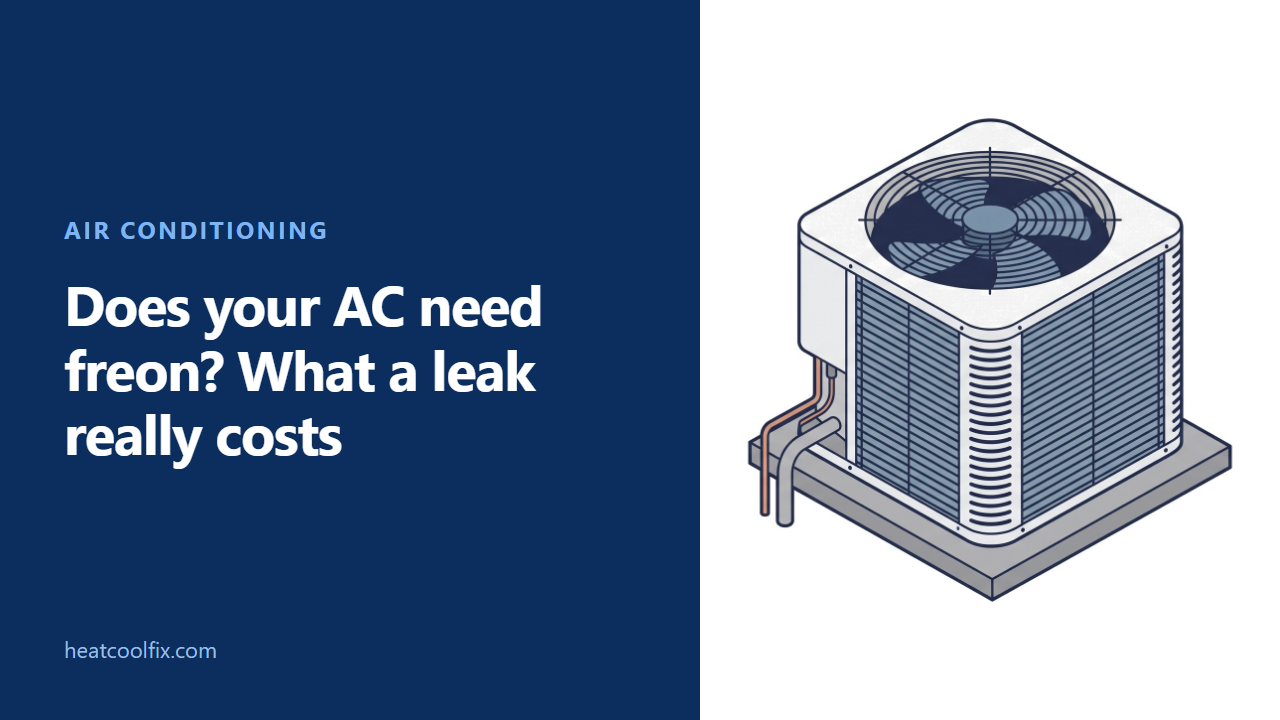
Refrigerant is not fuel and it does not get used up. A sealed system holds the same charge for twenty years, so if yours is low it is leaking, and topping it up every summer is paying rent on a hole. Here is how to spot one yourself and what the fix is actually worth.
There is one fact about refrigerant that changes how you read every quote you are ever given for it, and almost nobody is told it.
Refrigerant is not fuel. It is not burned, it is not consumed, and a healthy system never needs any. It goes round and round inside sealed copper for twenty years. So a system that is low is not hungry. It is leaking.
Before you start
What to carry: a torch and gloves. Ten minutes outside and five minutes indoors.
Nothing here involves gauges. You cannot buy the common refrigerants in the United States without a certification, and putting gauges on a system without knowing the target numbers does more harm than good. Everything on this page is done by looking and touching.
Same for a heat pump or a mini split. They are the same sealed circuit with the same failure, and a heat pump shows it in winter as weak heat rather than weak cooling.
And refrigerant is not something to play with. It comes out of a joint cold enough to burn skin on contact, it displaces the air in a basement, and venting it deliberately is against federal law. If a line is hissing, leave the room and ventilate it.
What being low actually looks like
Look for ice in the wrong place, and for oil
Frost on the copper lines. At the outdoor unit there are two copper lines. The fat one is wrapped in foam and should feel cold and sweaty in summer. The thin bare one should be warm to hot. Frost creeping back from where the fat one meets the unit is a low charge picture. Frost on the thin line is different: Goodman’s service manual says it marks a blockage in that line, which can look like a low charge on gauges.
Ice on the indoor coil. Same cause from the other end, and it is worth reading properly because a dirty filter does this too and is far more common: how to tell an airflow freeze from a refrigerant one.
An oily dirt patch. This is the good one. Oil travels round with the refrigerant, so wherever gas escapes, oil escapes with it and dust sticks to the damp patch. Look at every joint, at the flare nuts on a mini split, and under the service valves. A dark greasy smudge on clean copper is a leak with an address.
It cools, then stops cooling, then cools again after a night off. That is the coil icing over, blocking itself, and thawing while the system is off.
A hiss or a bubbling when it shuts down. Not proof on its own, because normal systems make noises settling: which air conditioner noises are meant to happen.
Where they actually leak
Find out which of the four you have
The service valve caps, outdoors. Those caps are not dust covers, they are the second seal. Missing caps let a system bleed down over years. It is the cheapest good news on this page.
The joints and the flare nuts. Anywhere the copper was cut, brazed or flared. On a mini split the flare nuts at both ends are a common leak, often from the day it was fitted.
The outdoor coil. Thin aluminium and copper out in the weather, and a strimmer, a dog or ten years of salty air will find it.
The indoor coil. The expensive one. Copper coils can develop tiny pinholes, which Carrier puts down to reactions between the copper and household chemicals such as hairspray, cleaning supplies and air fresheners, and a coil with one usually has more coming. It is not repairable in any way worth paying for.
Ask which one it is before you agree to anything. “It is low on refrigerant” is not a diagnosis. A leak search with electronic detection or dye is an hour, and the answer changes the decision completely.
Top it up, fix it, or replace it
Decide with three numbers, not with the weather
Topping up is renting. A pound or two every summer is a bill that never stops and gets worse, because the hole gets bigger and the compressor spends every year running on a low charge, which is what kills compressors.
The three numbers. How old is the system, what does the repair cost, and what does a new one cost. Under ten years old with a findable joint leak, fix it. Over fifteen with a leaking indoor coil, the coil alone runs into thousands, so price a new system alongside it.
Which refrigerant it holds changes the sum. Look at the plate on the outdoor unit. R22 has not been made or imported in the United States since 2020, so it now comes from reclaimed stock at a price that makes topping up an old system absurd. R410A is still available for servicing but is being phased down, and Trane says it will get more expensive as supplies shrink. Newer systems hold R454B or R32 and cannot be swapped between them. What EPA’s rules allow for each: the R-22 and R-410A phase out.
What a correct repair looks like. Find the leak, fix the leak, pull the system into a deep vacuum, then weigh in the exact charge from the plate. Not guess it in by pressure on a hot afternoon.
If it cools fine and you were told it is low, get a second opinion. A system that holds temperature on a hot day, with a normal temperature drop across the coil, is not short of refrigerant: how to measure that drop yourself.
Questions people ask
How often should it need topping up?
Never. That is the whole point of the page. A sealed system that is losing refrigerant has a hole in it, and the yearly top up is the symptom rather than the maintenance.
Can I add it myself with a can from the shop?
The cans on shelves are for car air conditioning, which is a different system with a different refrigerant and service ports that do not match. For a home system the refrigerants are restricted to certified buyers, and overcharging one damages the compressor as surely as running it low.
Is a leak dangerous to breathe?
In an open house a small leak is mostly a money problem. In a sealed basement or a small closet a large one displaces air, and some of the newer refrigerants are mildly flammable, so ventilate and stay out rather than investigating.
How long does a charge last if nothing is wrong?
The life of the system. Twenty years with the same gas in it is normal and expected.
They said it needs a pound and it will be fine.
It will be fine, until it is not. Ask where the refrigerant went. If nobody has looked, the same conversation happens next July at the same price.
My mini split lost its charge after a year.
Flare nuts. Either they were not made properly or they were not torqued, and that is a common fault on a newly fitted mini split. It is a warranty conversation with whoever fitted it.
Sources: Carrier "How to Fix a Refrigerant Leak in Your AC Unit" (closed loop, sealants, coil pinholes) and "What Is R-410A Refrigerant?" (certified buyers), Carrier's Application Guideline and Service Manual 24-25-9SM (valve caps as a seal), Goodman service instructions RS6200006 (restricted liquid line), Lennox "Refrigerant Lines", Trane "What To Do If the AC Evaporator Coil Is Frozen" and its R-410A page, and EPA's homeowner brochure "Phasing Out HCFC Refrigerants To Protect The Ozone Layer" (EPA-430-F-09-080)
Read next
 Air conditioning
Swamp Cooler Smells Bad? Musty, Fishy or New Pad Smell
Phoenix's and Portacool's troubleshooting charts both blame a musty or unpleasant smell from a swamp cooler on stale water in the pan
Air conditioning
Swamp Cooler Smells Bad? Musty, Fishy or New Pad Smell
Phoenix's and Portacool's troubleshooting charts both blame a musty or unpleasant smell from a swamp cooler on stale water in the pan
 Air conditioning
Swamp Cooler Not Cooling? Windows, Pads, Water and Pump
A swamp cooler only cools when its pads are soaking wet, the outdoor air is dry enough, and the air it blows
Air conditioning
Swamp Cooler Not Cooling? Windows, Pads, Water and Pump
A swamp cooler only cools when its pads are soaking wet, the outdoor air is dry enough, and the air it blows
 Air conditioning
What Size Dehumidifier Do I Need? Pints by Dampness
ENERGY STAR sizes a portable dehumidifier by how damp the space is: 20 to 30 pints a day for a damp room
Air conditioning
What Size Dehumidifier Do I Need? Pints by Dampness
ENERGY STAR sizes a portable dehumidifier by how damp the space is: 20 to 30 pints a day for a damp room
 Air conditioning
What Size Window Air Conditioner Do I Need? BTU Chart
Measure the floor area and read ENERGY STAR's chart: 5,000 BTU for 100 to 150 square feet, 6,000 up to 250, 8,000
Air conditioning
What Size Window Air Conditioner Do I Need? BTU Chart
Measure the floor area and read ENERGY STAR's chart: 5,000 BTU for 100 to 150 square feet, 6,000 up to 250, 8,000