How to Clean an AC Drain Line, and What to Pour In
 By Ray Bennett · Updated 2 October 2026 · 6 min read · Checked against the sources at the end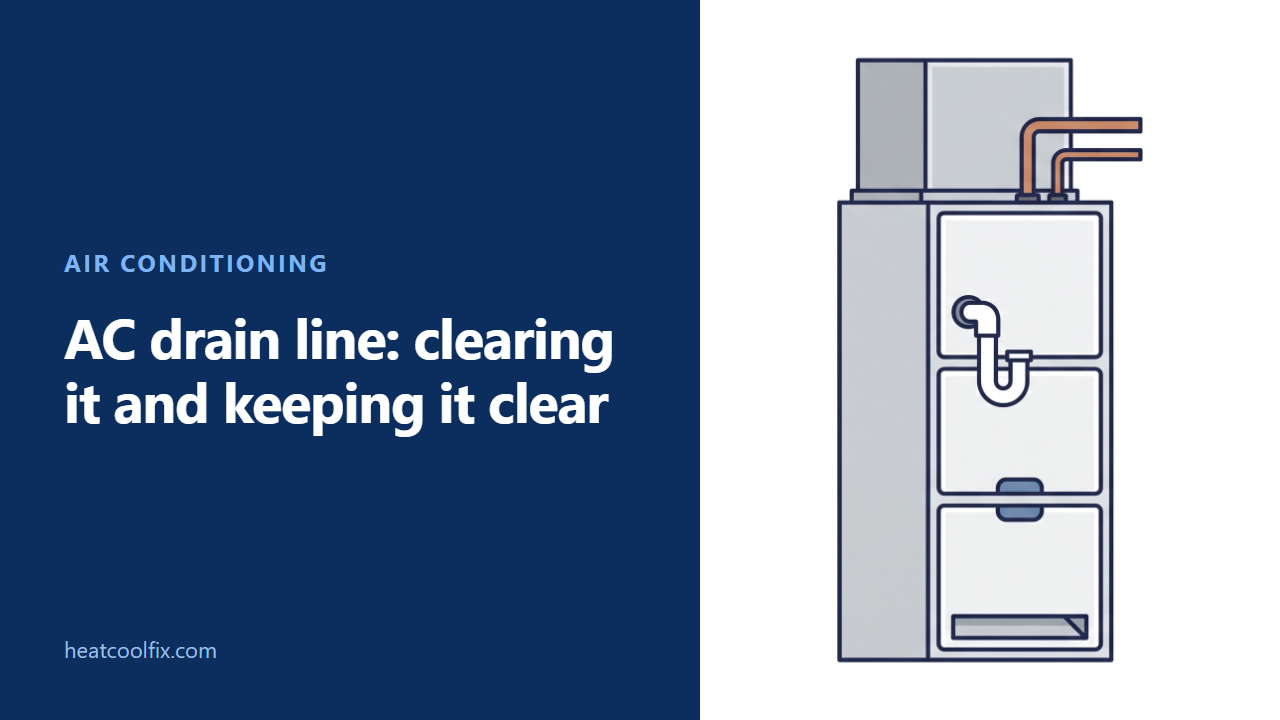
Suck the blockage out from the far end with a wet vacuum rather than pushing water in from the top, because pushing drives it further in. Then a cup of plain white vinegar down the access tee, left half an hour, and a flush. Fifteen minutes, twice a season, and it is the cheapest job on the whole system.
Learning how to clean an AC drain line is fifteen minutes that saves a ceiling. Cooling makes a surprising amount of water, and the small plastic pipe that carries it away is the part most likely to block on the whole system.
The method matters more than the liquid. Pull the blockage out from the far end rather than pushing water in from the top.
Before you start
What to carry: a wet and dry vacuum, a rag, a funnel and a bottle of plain white vinegar. Fifteen minutes.
Gas or electric? The indoor box differs and the drain does not. A gas furnace with a cooling coil on top and an electric air handler both make the same water and both drain it the same way. Switch the system off at the thermostat and at the breaker before you start either way.
Find both ends first. A white plastic pipe leaves the indoor unit, and somewhere near the unit there is a short upright stub with a cap on it. That cap is the access tee and it is where anything you pour goes in. The other end comes out through an outside wall, into a floor drain, or into a small condensate pump.
If the pipe runs uphill anywhere, there is a condensate pump doing the lifting. Do not pour anything into a pump reservoir except water, and unplug it before you touch it.
Where the water is supposed to go
Air moving across a cold coil sheds its moisture, and on a humid day a house system can make several gallons. That water runs off the coil into a shallow pan and away down the pipe.
The pipe is dark, permanently damp and full of dust from the air, which is a perfect home for slime. It builds slowly and then blocks all at once, usually in the hottest week of the year.
Many systems in an attic have a second pan underneath with its own drain, and that one is routed deliberately to somewhere you will see it, usually above a window. Water dripping from a pipe over a window is not a fault in that pipe. It is the second drain telling you the first one has blocked.
Clearing it
Wet vacuum on the outside end
Find the open end outside, or at the floor drain. Hold the vacuum hose over it and seal round the join with your hand or a rag so the suction goes down the pipe rather than round it.
Run it for two or three minutes. You will hear the note change when the clog lets go, and what comes into the vacuum is a grey slime that explains everything.
This is the step that does the work. A shop vacuum is worth borrowing for it.
Then a cup of vinegar down the access tee
Take the cap off the upright stub near the indoor unit. Pour in about a cup of plain white vinegar, undiluted, through a funnel.
Leave it half an hour. It kills the film that is left on the inside of the pipe, which is what would block it again in a month.
Why not bleach? Plenty of pages say to use it, and Bryant says not to spray undiluted bleach on AC parts. It corrodes the metal drain pan and anything metal in its path, and on some systems it will damage the coil. Vinegar does the job without that argument, so it is what this page recommends.
Flush it and watch the far end
Pour a jug of clean water down the access tee and go and look at the outside end.
Water running out freely means it is clear. Nothing coming out, or a trickle, means the blockage is still there and it is back to the vacuum.
Put the cap back on the tee when you are done. An open tee lets the system pull air in through the drain instead of pulling water out of the pan, and then the pan backs up with the pipe perfectly clear.
If it blocked badly enough to stop the cooling
Most systems have a small float switch sitting in the pan. When the pan fills, the float lifts and it cuts the cooling off to stop the water coming through the ceiling.
What you get is an indoor fan blowing away with no cold in the air, which looks exactly like a dead air conditioner and is not one: the full list for an AC that is not cooling.
Once the drain runs, the float drops and the cooling comes back on its own. Nothing needs resetting.
Keeping it clear
Twice a season in heavy use. Once at the start of the summer and once in the middle of it. In a humid climate with the system running daily, more.
Pan tablets. Small tablets that sit in the drain pan and slowly release something that stops the slime growing. They are cheap, and they can reduce how often you do this.
Check the fall. The pipe has to run downhill the whole way. A sagging run collects water and grows slime faster than a straight one, and a length of pipe with a dip in it will keep blocking however often you clean it.
Look at the pump. If yours has a condensate pump, it has its own small tank that silts up too, and its own float that sticks. It is usually a plug in unit and a look inside is worth it once a year.
Questions people ask
What is the best AC drain line cleaner?
Plain white vinegar, and a wet vacuum to do the actual clearing. There are proprietary gels and tablets and they are fine, but nothing beats sucking the blockage out first.
Can I just blow it out with a garden hose?
Pushing water in from the top drives the blockage deeper and can flood the pan over the ceiling. Pull it out from the far end instead.
How much water should come out on a hot day?
Several gallons over a day is normal in a humid climate. A drain that has never dripped in summer is a drain that is not draining.
My unit is in the attic and the pipe over the window is dripping.
That is the emergency drain doing its job, and the main line is blocked. Deal with it this week, because the next stage is the ceiling.
There is a musty smell when it runs.
Usually the same slime, in the pan or on the coil. Clearing the drain helps and a damp coil is the other half of it.
Does a mini split have one of these?
Yes, a small one running out through the wall behind the head, and it blocks the same way. On those the water simply runs out of the indoor unit and down the wall: the rest of the mini split list.
Sources: Carrier "How to Clean AC Drain Line" (wet vacuum at the outside end, a cup of distilled vinegar, float switch), Trane "AC Condensate Drain Line Clogged?", and Lennox "AC Drain Line Clogged? Here's What to Do" (30 minutes, the secondary drain over a door or window)
Read next
 Air conditioning
Swamp Cooler Smells Bad? Musty, Fishy or New Pad Smell
Phoenix's and Portacool's troubleshooting charts both blame a musty or unpleasant smell from a swamp cooler on stale water in the pan
Air conditioning
Swamp Cooler Smells Bad? Musty, Fishy or New Pad Smell
Phoenix's and Portacool's troubleshooting charts both blame a musty or unpleasant smell from a swamp cooler on stale water in the pan
 Air conditioning
Swamp Cooler Not Cooling? Windows, Pads, Water and Pump
A swamp cooler only cools when its pads are soaking wet, the outdoor air is dry enough, and the air it blows
Air conditioning
Swamp Cooler Not Cooling? Windows, Pads, Water and Pump
A swamp cooler only cools when its pads are soaking wet, the outdoor air is dry enough, and the air it blows
 Air conditioning
What Size Dehumidifier Do I Need? Pints by Dampness
ENERGY STAR sizes a portable dehumidifier by how damp the space is: 20 to 30 pints a day for a damp room
Air conditioning
What Size Dehumidifier Do I Need? Pints by Dampness
ENERGY STAR sizes a portable dehumidifier by how damp the space is: 20 to 30 pints a day for a damp room
 Air conditioning
What Size Window Air Conditioner Do I Need? BTU Chart
Measure the floor area and read ENERGY STAR's chart: 5,000 BTU for 100 to 150 square feet, 6,000 up to 250, 8,000
Air conditioning
What Size Window Air Conditioner Do I Need? BTU Chart
Measure the floor area and read ENERGY STAR's chart: 5,000 BTU for 100 to 150 square feet, 6,000 up to 250, 8,000