AC Leaking Water: Where It Is Coming From, in Order
 By Ray Bennett · Updated 2 October 2026 · 6 min read · Checked against the sources at the end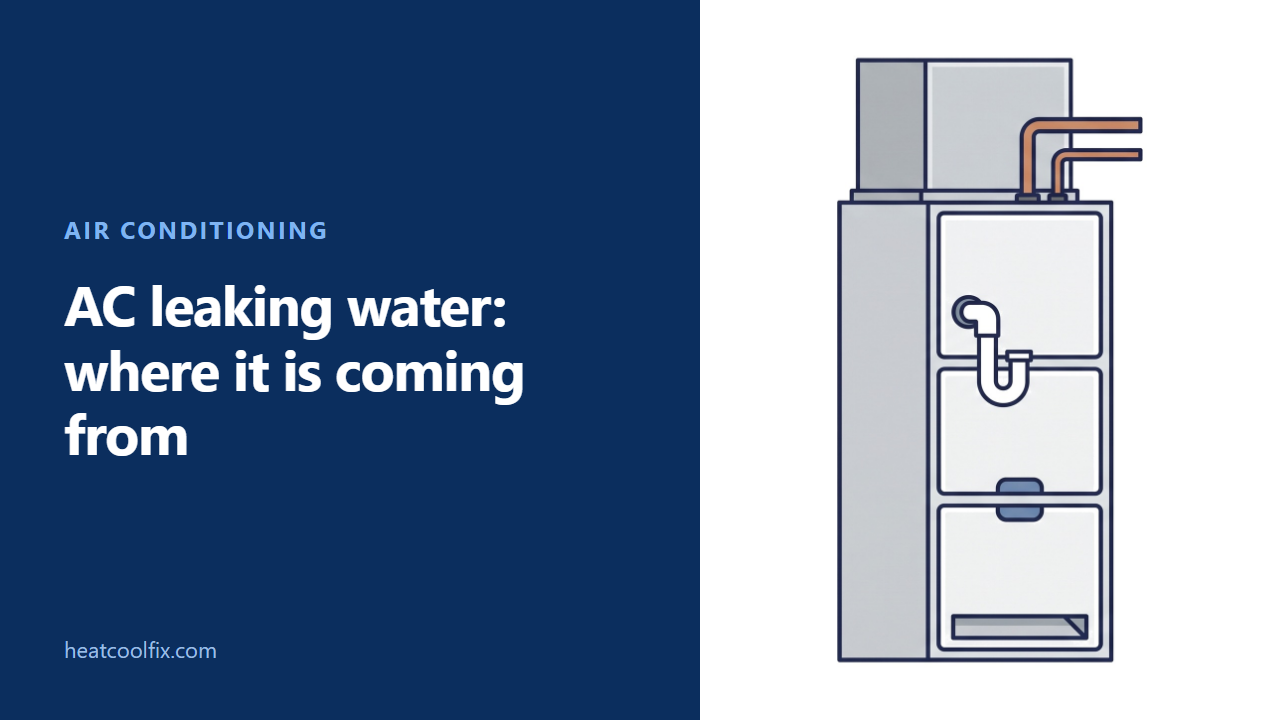
Dry everything, lay paper underneath and run it for an hour, because where the paper goes wet decides the job. A blocked drain overflowing the pan is most of them. A bare copper pipe sweating is not a leak at all. A window unit dripping indoors is almost always tilted the wrong way.
An AC leaking water is usually the same story. Cooling makes several gallons of water a day, and something in the path that carries it away has stopped working.
The useful first step costs nothing. Dry everything, put paper down and run it for an hour, because where the paper goes wet decides which of four jobs you have.
Before you start
What to carry: a torch, kitchen paper, a wet vacuum and a spirit level. Half an hour.
Gas or electric? The cooling coil sits on top of a gas furnace or inside an electric air handler, and both drain the same way. It matters only because water running down onto a gas furnace rusts the heat exchanger, so a leak above one is worth dealing with quickly.
How much water is normal? Several gallons a day out of the drain pipe in humid weather. A drain that has never dripped in summer is a drain that is not draining.
If the unit is in an attic or above a finished ceiling, treat this as urgent rather than a weekend job. The pan holds only a few pints, and once it is over the edge the next thing that happens is a ceiling coming down. Many systems have a float switch that shuts the cooling off to prevent exactly that, so cooling that has stopped along with the leak is the system protecting the house.
Where the water is coming from
Dry it, lay paper, run it for an hour
Wipe the unit, the pipes and the floor completely dry. Lay kitchen paper under the whole indoor unit and along the pipes where you can reach.
Run the cooling for an hour and come back.
Wet paper under the unit itself is the pan. Wet paper under a length of copper pipe away from the unit is condensation on that pipe, which is a different fix. Wet paper where the drain line runs is the line or its joints.
The blocked drain, which is most of them
Clear the line from the far end
The pan under the coil holds only a few pints, and it drains through a small plastic pipe that grows slime and blocks.
Take a wet vacuum to the open end outside, seal round it with a rag, and run it for two or three minutes. The clog comes out and the pan drains.
The full method, including what to pour down afterwards and why not bleach, is here: clearing an AC drain line properly.
On an older system, also look at the pan itself. They rust through, and a pan with a hole in it drips however clear the drain is.
The pipe that sweats, which is not a leak
Feel for bare copper
The big copper pipe running between the indoor unit and the outdoor one carries cold refrigerant, and it is wrapped in black foam for a reason.
Where that foam has split, gone missing, or was never fitted properly, the bare pipe behaves like a cold glass on a summer day. It runs with water, drips onto whatever is below, and every drop looks like a leak.
Run a hand along the pipe. Anywhere cold and bare gets a new sleeve of foam, which is cheap and slides on with a slit down one side.
It matters in an attic more than anywhere else, because that is where the air is hottest and wettest and where the ceiling is closest.
The trap, and a line that runs uphill
Look at the shape of the drain line
The drain has to fall the whole way. A run with a sag in it holds water and grows slime faster, and a run that goes uphill anywhere never drains at all until somebody fits a pump.
Near the unit there should also be a U shaped bend, a trap. It is not decoration. The blower makes the inside of the cabinet either lower or higher in pressure than the room, and without a trap that pressure either holds the water in the pan or blows it out. A system that has always dripped a bit since the day it was installed usually has no trap, or a trap that has dried out.
Check the pipe has not simply come off the pan spigot as well, which happens when somebody has been working nearby.
A window unit dripping indoors
A window unit is meant to sit with its back very slightly lower than its front, so the water it makes runs out of the back rather than into the room.
Put a level on it. If it is dead flat or tipped towards you, pack it up at the front, and a quarter of an inch across the depth of the unit is enough.
If the tilt is right and it still drips inside, the small drain hole in the base at the back is blocked. Clear it with a piece of wire.
Modern window units deliberately sling that water onto the outdoor coil to help it cool, which is why yours may make a flicking noise in humid weather. That is normal.
Water at the outdoor unit
In cooling weather the outdoor unit should be dry. Water under it is usually rain, or the indoor drain line ending there, and neither is a fault.
In winter on a heat pump it is a completely different matter. The outdoor unit makes water every time it defrosts, and that is supposed to happen: what a defrost cycle looks like.
What is not normal is a puddle that freezes around the base and stays, because that is a base pan that cannot drain.
Questions people ask
It leaks and it has also stopped cooling.
That is usually the float switch in the pan cutting the cooling off on purpose, and it comes back on its own once the drain runs: the full list for an AC that is not cooling.
It only leaks on the most humid days.
Then the drain is partly blocked rather than fully. It copes with a normal day and not with a day that makes twice the water.
There is ice on the unit and water underneath.
The ice is the real fault and the water is it melting. Thaw it before anything else: why a coil freezes and how to thaw it safely.
Can I just put a bucket under it?
For a day while you get to it, yes. As a plan, no, because whatever is behind it gets worse and the pan is not the only thing getting wet.
My mini split is dripping down the wall.
Same cause, a blocked drain, and on those the pipe runs out through the wall behind the head. It is usually cleared from outside.
How often should the drain be cleared?
Twice a season where it runs daily. It is fifteen minutes and it is the cheapest insurance on the whole system.
Sources: Trane "Air Handler Dripping Water: Causes and Solutions" (power off at the breaker, clogged drain and rusted pan) and "Troubleshooting the HVAC Air Handler Overflow Switch", Carrier "How to Clean AC Drain Line" (wet/dry vacuum at the outdoor end, float switch), GE Appliances room air conditioner manual 49-7389 (1/4 inch slant from front to rear) and GE support "Air Conditioners Water Sounds" (slinger ring), and American Standard "Got a Frozen Evaporator Coil? Don't Panic" (heat pump defrost)
Read next
 Air conditioning
Swamp Cooler Smells Bad? Musty, Fishy or New Pad Smell
Phoenix's and Portacool's troubleshooting charts both blame a musty or unpleasant smell from a swamp cooler on stale water in the pan
Air conditioning
Swamp Cooler Smells Bad? Musty, Fishy or New Pad Smell
Phoenix's and Portacool's troubleshooting charts both blame a musty or unpleasant smell from a swamp cooler on stale water in the pan
 Air conditioning
Swamp Cooler Not Cooling? Windows, Pads, Water and Pump
A swamp cooler only cools when its pads are soaking wet, the outdoor air is dry enough, and the air it blows
Air conditioning
Swamp Cooler Not Cooling? Windows, Pads, Water and Pump
A swamp cooler only cools when its pads are soaking wet, the outdoor air is dry enough, and the air it blows
 Air conditioning
What Size Dehumidifier Do I Need? Pints by Dampness
ENERGY STAR sizes a portable dehumidifier by how damp the space is: 20 to 30 pints a day for a damp room
Air conditioning
What Size Dehumidifier Do I Need? Pints by Dampness
ENERGY STAR sizes a portable dehumidifier by how damp the space is: 20 to 30 pints a day for a damp room
 Air conditioning
What Size Window Air Conditioner Do I Need? BTU Chart
Measure the floor area and read ENERGY STAR's chart: 5,000 BTU for 100 to 150 square feet, 6,000 up to 250, 8,000
Air conditioning
What Size Window Air Conditioner Do I Need? BTU Chart
Measure the floor area and read ENERGY STAR's chart: 5,000 BTU for 100 to 150 square feet, 6,000 up to 250, 8,000