AC Smells Musty, or Worse: What Each Smell Means
 By Ray Bennett · Updated 2 October 2026 · 6 min read · Checked against the sources at the end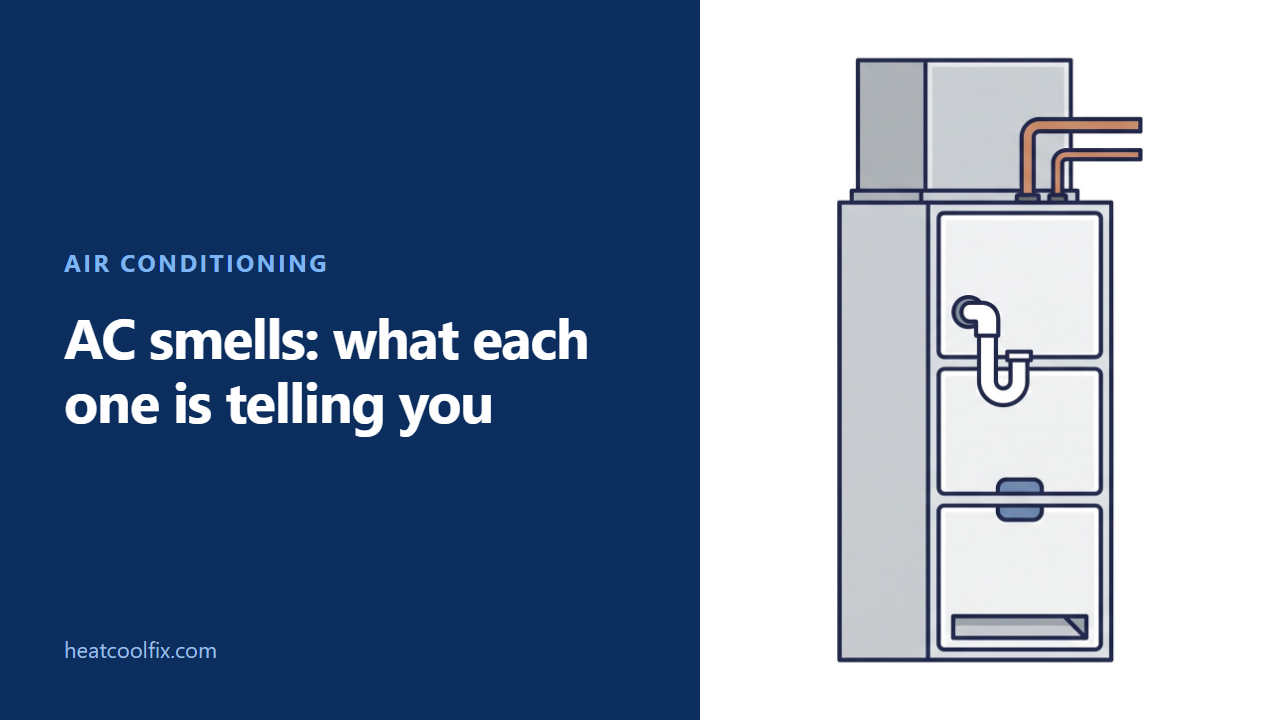
Two smells mean stop rather than clean. Rotten eggs or gas means leave the house and ring the gas company from outside. Burning means off at the breaker. Everything else is damp on the coil and in the drain pan, which is a weekend job rather than an emergency, and it comes back unless the drain is cleared too.
When an AC smells musty the cause is usually the same, damp sitting on a coil that is covered in dust. It is a weekend job and not an emergency.
But two smells that come out of the same vents are not that, and they need dealing with before anything else on this page.
The two that mean stop
Burning, or hot plastic. That is heat where there should not be any: a blower motor on its way out, a seized fan, or wiring getting hot. Off at the breaker, and leave it off until somebody has looked at it. The one exception is the first furnace run of autumn, which burns off the summer’s dust and smells hot for ten or fifteen minutes, Trane says. A burning smell from cooling in July is not that.
Before you start on the rest
What to carry: a torch, a new filter, a wet vacuum and a bottle of white vinegar. An hour.
Gas or electric? It changes where you look. A gas furnace with the cooling coil on top brings a flue and burners into it, which is why a gas smell matters there. An electric air handler has neither, so a bad smell from one is damp or wiring.
Note when it smells, before you clean anything
Only for the first minute after it starts, then it fades, is damp sitting on the coil being blown off.
All the time it runs, with no let up, is usually the drain pan and the pipe rather than the coil.
Only in some rooms is the ducting to those rooms, and that is the one case where duct cleaning is worth the money.
Musty, mildew, dirty socks
The coil is cold and wet all summer, and every scrap of dust that got past the filter is stuck to it. That is a good home for mould, and the air you breathe goes straight across it.
The water runs off into a shallow pan below, and out through a small pipe. Both of those sit damp and dark for months.
Dirty sock syndrome is the trade name for the version that hits heat pumps in spring and autumn, when the system keeps switching between heating and cooling and the coil never fully dries. It is the same growth and the same fix, and the other smells a heat pump makes in winter are here: what each heat pump smell means.
Filter, drain, then the coil
Change the filter first. A filter that has been in since spring can give off a smell of its own.
Then clear the drain line, because a blocked one leaves standing water in the pan all season: wet vacuum from the far end, then vinegar down the access tee.
Then the coil. With the filter out, get a torch on the fins. Grey felt across them means the smell is there, and that is a proper clean with the right chemical rather than anything you spray from a supermarket. It is a service call, and on a system that has never had one it is worth the money.
Then stop it coming back
Run the fan on for a few minutes after the cooling stops. That dries the coil instead of leaving it wet overnight, and a lot of systems have a setting that does it automatically.
Change the filter on a schedule rather than when you remember. Every one to three months depending on the house.
Clear the drain twice a season, and consider the tablets that sit in the pan and stop the growth.
On ultraviolet lamps, which get sold hard for this: they can help keep a cleaned coil clean, and they are not a way of cleaning a dirty one. Clean first, then decide.
The other smells, and what they usually are
Fish, or burning plastic. Those two are the same smell to most noses, and it is hot plastic insulation on something electrical. A motor, a capacitor or a wire getting hotter than it should. Treat it as the burning one above: off at the breaker, and leave it off.
Vinegar, or something sour. Usually the same damp and growth as the musty one, caught earlier. On a system that has just been running hard it can also be the faint smell an electric motor gives off, which is worth mentioning to whoever services it.
Drains, or sewage. This one has a specific cause. The condensate drain should have a U bend in it holding a little water, and when that dries out the pipe becomes an open path from wherever it discharges back into the house. Filling the trap or fitting one is the fix: the drain line, its trap and how to clear it.
Sweet, or a bit like chloroform. Some refrigerants have a faint sweet smell, so with poor cooling and ice on the pipes it is worth suspecting a leak. On its own, with the system cooling fine, it is more likely something in the house.
Like a car exhaust. On a system sharing space with a garage, or near a flue, this is worth taking seriously rather than deodorising. Carbon monoxide has no smell of its own, but the exhaust it comes with does.
Urine or ammonia. Usually an animal that got into the ducting and did not get out again. Unpleasant, not dangerous, and it needs finding rather than covering.
Cigarettes, cooking, damp. The coil and the filter hold whatever the house has been through. A new filter and a coil clean removes it.
A window unit that smells. Same story in a smaller box, and the tray at the bottom of a window unit is usually where it lives.
Questions people ask
Will duct cleaning fix a musty smell?
Usually not, because the source is the wet coil rather than the dry ducting. Clean the coil and the pan first, and if the smell has gone you have saved paying for duct cleaning.
It only smells for the first minute.
That is damp on the coil being blown off as it starts. Running the fan after each cooling cycle dries it and is the cheapest cure there is.
Can I spray something up the vents?
It covers the smell for a day and puts more for the mould to eat. It also does nothing about the water sitting in the pan.
My mini split smells and there is no ducting at all.
Same cause, inside the head on the wall, and the filters are the first thing: how to get at a mini split’s filters.
Is a musty smell actually bad for us?
For most people it is unpleasant rather than harmful, but it is worse for anybody with asthma or an allergy, and it is a sign the system needs attention either way.
It smells and it has also stopped cooling well.
Those two usually share a cause, because a coil thick enough to smell is a coil thick enough to choke the airflow: the full list for an AC that is not cooling.
Sources: Trane "Is This Normal? HVAC Smells and Sounds, Explained", "Notice Your Air Conditioner Smells Funny?" and "Why Does My AC Smell Musty?", Trane Commercial Help Center "Dirty Sock Syndrome", Carrier "Why Does My AC Smell?", and the gas and carbon monoxide warnings in Rheem use and care manual AP23698 and the Carrier 58SC0A furnace instructions
Read next
 Air conditioning
Swamp Cooler Smells Bad? Musty, Fishy or New Pad Smell
Phoenix's and Portacool's troubleshooting charts both blame a musty or unpleasant smell from a swamp cooler on stale water in the pan
Air conditioning
Swamp Cooler Smells Bad? Musty, Fishy or New Pad Smell
Phoenix's and Portacool's troubleshooting charts both blame a musty or unpleasant smell from a swamp cooler on stale water in the pan
 Air conditioning
Swamp Cooler Not Cooling? Windows, Pads, Water and Pump
A swamp cooler only cools when its pads are soaking wet, the outdoor air is dry enough, and the air it blows
Air conditioning
Swamp Cooler Not Cooling? Windows, Pads, Water and Pump
A swamp cooler only cools when its pads are soaking wet, the outdoor air is dry enough, and the air it blows
 Air conditioning
What Size Dehumidifier Do I Need? Pints by Dampness
ENERGY STAR sizes a portable dehumidifier by how damp the space is: 20 to 30 pints a day for a damp room
Air conditioning
What Size Dehumidifier Do I Need? Pints by Dampness
ENERGY STAR sizes a portable dehumidifier by how damp the space is: 20 to 30 pints a day for a damp room
 Air conditioning
What Size Window Air Conditioner Do I Need? BTU Chart
Measure the floor area and read ENERGY STAR's chart: 5,000 BTU for 100 to 150 square feet, 6,000 up to 250, 8,000
Air conditioning
What Size Window Air Conditioner Do I Need? BTU Chart
Measure the floor area and read ENERGY STAR's chart: 5,000 BTU for 100 to 150 square feet, 6,000 up to 250, 8,000