Boiler Expansion Tank Problems: Waterlogged or Failed
 By Ray Bennett · Updated 13 October 2026 · 8 min read · Checked against the sources at the end
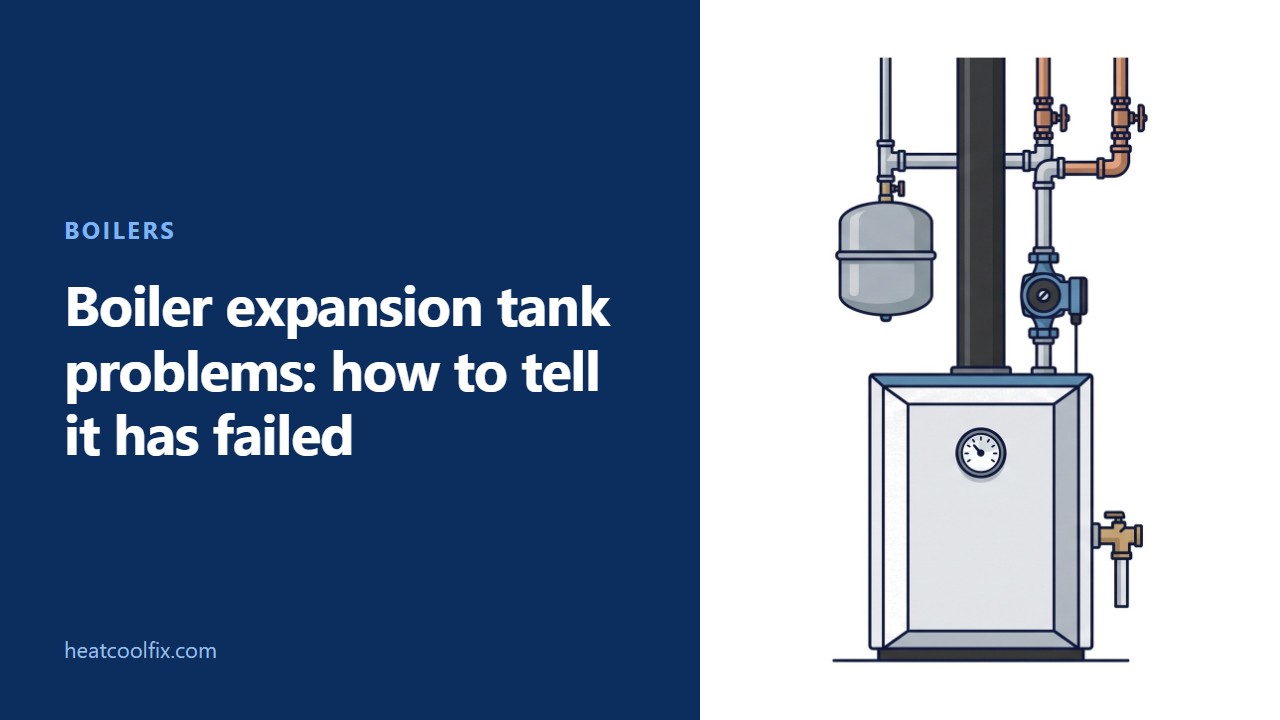
A failing boiler expansion tank shows at the relief valve and the gauge. Weil-McLain's EG and PEG manual gives frequent water from the relief valve as the sign of a tank too small or flooded, and Peerless lists a waterlogged tank or a failed diaphragm, fixed with a new tank. The tank is checked off the system with a tire gauge, a technician's job.
Boiler expansion tank problems show up at the relief valve and the gauge. Bell and Gossett explains the job: water expands when it is heated, and its diaphragm tank stores the expanded water and gives it back to the system as it cools.
When the tank cannot do that, the pressure has nowhere to go. Weil-McLain’s EG and PEG user manual gives frequent water from the relief valve as the sign of a tank that is too small or flooded, and says call a qualified service technician to check it.
Before you start
What to carry: a torch and a phone to photograph the tank’s label, the boiler’s gauge cold and hot, and anything wet. The tank’s own check needs a tire gauge with the tank off the system, a technician’s job.
Gas, oil or electric? It makes no difference: the tank is on the water side of a hot water boiler, whatever it burns. A steam boiler’s pressure is in boiler pressure.
Which tank is it? Lochinvar’s Knight manual says tanks may be open, closed, or diaphragm or bladder type. Amtrol’s Extrol and Bell and Gossett’s HFT are pre-charged diaphragm tanks, and they and Watts’s ETX come charged to 12 psi from the factory. A closed type tank has no diaphragm: Weil-McLain’s Ultra manual says the air in the system must return to it to keep its air cushion. Amtrol’s in-line Extrol models have an InSight cap.
Renting? New York’s tenants’ rights guide from the Attorney General says landlords are required to keep the plumbing and heating systems in good and safe working order, so tell the landlord.
Pressure off and cool first. Before any service, Bell and Gossett says reduce the system pressure to zero or isolate the tank, and let the system cool below 100 degrees.
Never shut the tank off while it runs. Navien’s NCB-H manual says the expansion tank must never be isolated from the boiler while the system runs, or the relief valve may discharge.
Relief valve water is hot. Watts says the relief valve discharges hot water, so it needs a drain line to a safe place, and you keep clear of it. Never plug or cap a relief valve or its pipe. Weil-McLain’s Aqua Plus manual says plugging a water heater’s relief valve or its pipe can cause excessive pressure, with severe injury or death, and Utica says never thread, plug or cap the discharge line.
What are you seeing?
Read the boiler’s gauge cold, then again with the heat running, and look at the relief valve’s pipe and the floor.
The relief valve drips or lets go when the boiler is hot, or the pressure climbs high as it heats: checks 1 to 3. The fill valve keeps adding water: checks 1 and 2. Water, rust or a discolored cap on the tank: check 4. The water heater’s relief valve weeps, such as overnight: check 5.
The boiler’s tank
Read the signs
The relief valve. Weil-McLain’s EG and PEG user manual lists frequent water from the relief valve with two tank causes, too small or flooded, and says call a qualified technician for both. Amtrol says a relief valve that drips after the boiler is restarted may mean the tank is wrongly charged or too small.
The water going in. Peerless lists four causes of a hot water boiler overfilling or taking too much fresh water. They are leaks, the tank’s charge pressure not right, a waterlogged tank or a failed diaphragm or bladder, and a fill valve not working or set too high, which makes the relief valve weep. Weil-McLain’s CGa manual says an undersized tank loses water through the relief valve while the fill valve adds more, and that boiler section failure can result.
The gauge. Bell and Gossett says a tank that is too small generally gives a higher pressure than desired once the system is hot. Reading it: boiler pressure.
How the tank is checked
Off the system and empty. Amtrol says check the charge with the tank isolated and empty of water, and Watts says a tire gauge only reads its tank’s air correctly once the tank is disconnected. Amtrol adds that checking lets a little air out, so the charge is restored each time.
What it should read. Amtrol says the charge matches the boiler fill valve’s setting, and Bell and Gossett says adjust it to equal the system’s fill pressure. Taco’s 007e sheet says that above 5,000 feet the fill pressure is at least 20 psi, with the tank’s charge raised to match.
What else is checked. Weil-McLain’s Aqua Plus manual adds failed gaskets or bladders, or a faulty Schrader valve, the air valve on the tank. Its technician’s test is to turn the boiler limit up and run the system hotter: if the relief valve lifts or the pressure climbs a lot, the tank is flooded or too small. Watts also checks the gauge itself, a fill valve letting water through, and water getting in from a leaking tankless coil.
Too small, or a plain tank losing its air
Too small. Bell and Gossett calls a tank that leaves the pressure high when hot a Summer/Winter installation, with the boiler always at temperature, and says the tank should be tagged to show it. Burnham’s K2 manual says antifreeze expands about 1.2 times as much as water, so a tank on an antifreeze system should be at least 1.2 times bigger. Weil-McLain’s Aqua Plus manual says the boiler water inside an Aqua Plus must be counted when sizing the tank.
A closed type tank. Weil-McLain’s Ultra manual says never fit automatic air vents on a closed type tank system: the air must stay in the system and return to the tank as its cushion, and an automatic vent lets it out and waterlogs the tank.
A leak, rust or a discolored cap
Every tank leaks in the end. Bell and Gossett says this tank, as all expansion tanks, will eventually leak, so it goes where a leak will not cause damage. Amtrol says a drip pan to a drain is needed wherever a leak could cause damage.
The InSight cap. Amtrol says the cap tip stays clear or white in normal use and turns discolored when the tank needs replacing. If it is discolored, contact the installer or a plumbing professional, and Amtrol says not to rely on the cap alone.
Replace, do not adjust. Peerless’s fix for a waterlogged tank or a failed diaphragm or bladder is a new tank, and Amtrol says replace a corroded or damaged tank rather than adjust its charge. Bell and Gossett says a damaged tank must be replaced.
The water heater’s tank
The other expansion tank, on the cold water
A different tank. Amtrol says its Extrol is for closed heating systems only, never domestic water, where it uses a Therm-X-Trol instead.
When one is needed. Weil-McLain’s Aqua Plus manual says a backflow preventer, check valve or pressure reducing valve on the cold water into a water heater means an expansion tank must be fitted on the cold supply. Without it, normal expansion keeps forcing open the T and P relief valve. Above 70 psi supply pressure, it says a pressure reducing valve and an expansion tank are needed.
The overnight weep. The Aqua Plus manual says the relief valve may weep from thermal expansion during long spells with no hot water used, such as overnight, and Utica says repeated discharge can be thermal expansion or a faulty valve. More in a water heater relief valve leaking.
After it is fixed
Yearly check. Amtrol says a professional plumber should check the complete system, the tank included, every year and more often as it ages.
The relief valve. Amtrol says a licensed professional should inspect the relief valve at least once every 3 years, or whenever it discharges, and replace it if it is corroded or does not work.
What each one takes
| What is wrong | What it takes |
|---|---|
| Charge lost on a diaphragm tank | A technician to recharge it, off the system |
| Waterlogged tank or failed diaphragm | A new tank |
| Tank too small | A bigger tank, sized by a technician |
| Air vent on a closed type tank | A technician to take it off |
| A leak, rust or a discolored cap | A new tank |
| Fill valve not working or set too high | A technician to check or replace it |
| No expansion tank on the water heater | A plumber to fit one |
Questions people ask
How do I know if my boiler expansion tank is bad?
The signs to look for: frequent water from the relief valve, or pressure climbing high as the boiler heats. Weil-McLain’s EG and PEG manual says call a technician, who checks the tank off the system with a tire gauge, as Watts and Weil-McLain’s Aqua Plus manual say.
What pressure should a boiler expansion tank have?
Amtrol’s Extrol, Bell and Gossett’s HFT and Watts’s ETX come charged to 12 psi from the factory, and Amtrol says the charge should match the boiler’s fill pressure. It is only read correctly with the tank off the system and empty.
Can a waterlogged expansion tank be fixed?
Peerless’s fix for a waterlogged tank, or one with a failed diaphragm or bladder, is a new tank. Weil-McLain’s Ultra manual says never fit an automatic air vent on a closed type tank system, because it lets the air out and waterlogs the tank.
Why is my expansion tank full of water?
Peerless lists a waterlogged air compression tank, and a diaphragm or bladder that has failed, both fixed with a new tank. A closed type tank waterlogs if an automatic air vent lets the air out of the system, Weil-McLain’s Ultra manual says.
How long does a boiler expansion tank last?
None of the makers here gives a life in years. Bell and Gossett says every expansion tank will eventually leak, and Amtrol gives its in-line Extrol tanks a 7-year limited warranty.
The other boiler guides: boiler pressure, a boiler circulator pump not working, an indirect water heater not heating and a boiler not working.
Sources: Bell and Gossett HFT tank manual, Amtrol Extrol instructions and brochure, Watts ETX and ETSX instructions, Weil-McLain CGa Series 3 and Ultra Series 4 boiler manuals, EG and PEG user manual and Aqua Plus indirect water heater manual, Peerless 63 and 64 boiler manual, Lochinvar Knight service manual, Navien NCB-H install manual, Burnham K2 manual, Utica H2O manual, Taco 007e instruction sheet and the New York Attorney General's tenants' rights guide
Read next
 Boilers
Lochinvar Noble Error Codes: Lockouts and Fault Messages
Lochinvar Noble error codes are words on the SMART SYSTEM display, such as Flame Fail: Ignition, Air Pressure Switch or LWCO. Faults
 Boilers
Weil-McLain ECO Tec Error Codes: Blower Fault and Lockouts
A Weil-McLain ECO Tec Series 2 names its faults on the touchscreen instead of using numbers. In a lockout the banner turns
 Boilers
Weil-McLain Evergreen Error Codes and Lockout Messages
A Weil-McLain Evergreen Pro shows its faults as words, not numbers: the display turns red and names the fault, such as IGNITION
 Boilers
Weil-McLain AquaBalance Error Codes: A01, F37 and A16
The Weil-McLain AquaBalance shows A or F with a number. A codes are hard lockouts: press RESET for 1 second once the