How to Clean an AC Condenser Coil Without Bending It
 By Ray Bennett · Updated 2 October 2026 · 5 min read · Checked against the sources at the end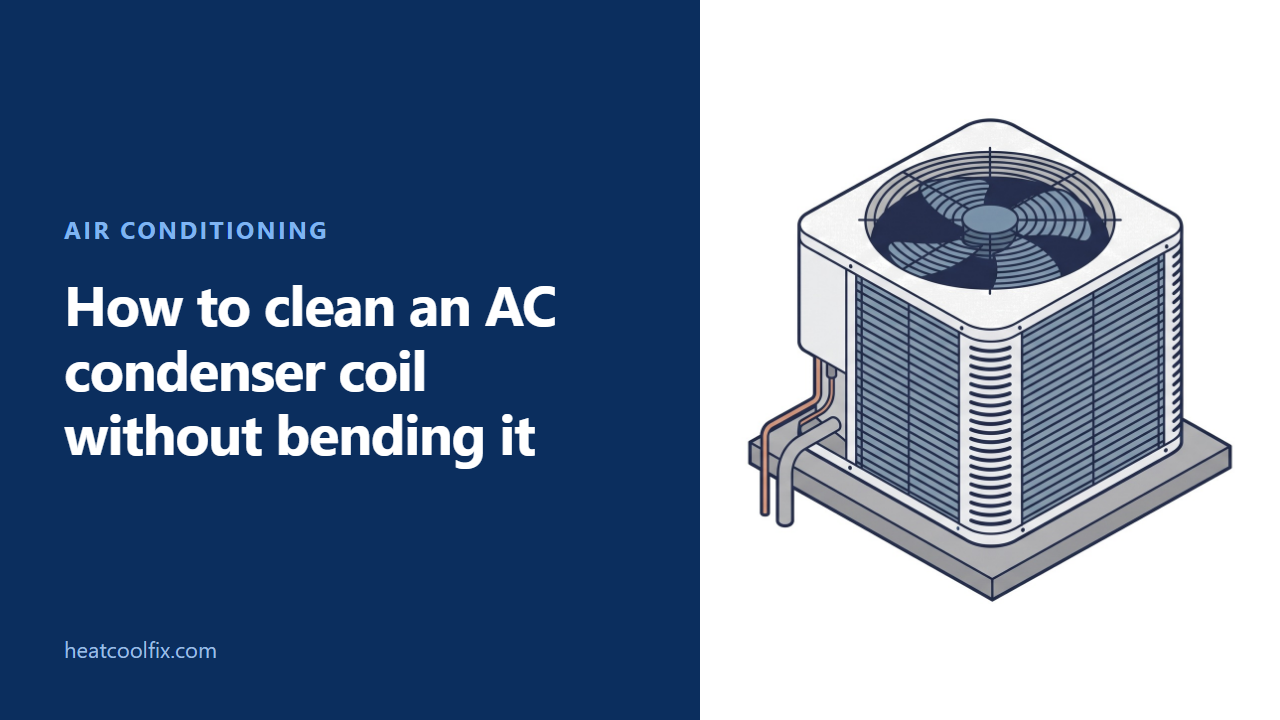
The outdoor unit throws your house's heat away through a thin metal coil, and when that coil is matted with fluff and grass it cannot, so the system runs longer and costs more. A garden hose, the power off and the water going the right way is all it takes. A pressure washer is the one thing that ruins it.
The outdoor unit is where the heat from inside your house actually goes. It is pushed through a thin metal coil wrapped round the unit, and the fan on top blows it away.
When that coil is covered in cottonwood fluff, grass clippings and dust, the heat cannot leave. The system runs longer, the bill goes up, and on the hottest afternoon of the year it is the reason the house will not cool down.
Before you start
What to carry: a garden hose with an ordinary nozzle, a soft brush, a screwdriver or nut driver, and a fin comb if you have one. Forty five minutes.
Pick a mild day. The system is going to be off for most of an hour.
Heat pump or air conditioner, it is the same job. A heat pump’s outdoor unit has the same coil and needs it more, because it works all year. Whether the house heats with gas or electric makes no difference here, because this is the cooling side.
Never use a pressure washer. Lennox says the aluminum fins are thin and easy to damage. A pressure washer folds them flat in seconds, and flattened fins block the air as badly as the dirt did.
Keep water out of the electrical box. The panel where the wires come in, usually on one corner, stays dry. Spray the coil, not the controls.
Clear round it first
Give it room to breathe
Cut back anything within about two feet of the sides. Shrubs, long grass, a fence panel, bins pushed up against it.
Nothing overhanging the top. The fan throws hot air straight up. A deck above it, a low branch, or a cover left on from winter sends that air straight back into the sides.
Clear the base. Leaves and grass build up inside the bottom of the cabinet and hold water against the metal.
Look at what the coil is wearing. A grey felt on the outside is cottonwood and dust, and it comes off easily. Greasy black dirt means it sits near a kitchen extract or a dryer vent, and it needs a cleaner.
Rinse it the right way
Hose it down, gently, in the right direction
Brush off the loose felt first, with a soft brush, stroking in the same direction the fins run. On most units that is up and down.
Spray along the fins, not across them. Hold the nozzle so the water runs in line with the fins. A gentle shower setting is plenty.
From the inside out is best, where you can reach. On many units the top with the fan lifts off once its screws are out. Lift it carefully and rest it to one side without pulling on the fan wires, then spray from inside so the dirt is pushed back out the way it came in. If the top will not come off easily, rinse from outside and leave it at that.
Greasy dirt needs a coil cleaner. Use a foaming cleaner sold for outdoor condenser coils, follow the label, and rinse it all off. Leave the acid cleaners to people who do this every day.
Straighten bent fins with a fin comb, gently, only where they are folded. A few bent fins do not matter. A whole flattened patch does.
Put it back and check it worked
Restore power and confirm it is cooling well
Refit the top and every screw, then leave it half an hour for the water to drain and dry.
Power on at the breaker, then the disconnect, and let the thermostat call for cooling.
Feel the air coming off the top. It should be warm and moving strongly. That warm air is the heat leaving your house.
Measure the result indoors. The air from a vent should be clearly colder than the air going into the return. The drop across the coil tells you whether the whole system is healthy: how to measure it with a kitchen thermometer.
If it still struggles on a hot day, the coil was only part of it: why a system runs all day and holds 78.
How often, and the coil inside
Once a year for most houses
Once a year in spring is right for most houses, before the first hot week.
Twice a year near cottonwood or poplar trees, beside a dusty road, or near a dryer or kitchen vent.
The indoor coil is a different job. It sits inside the air handler above or beside the furnace, behind panels, over a drain pan, and it is mostly not a homeowner job. Keeping the filter changed is what keeps it clean: how often, by filter thickness.
A coil that stays dirty after a rinse, or has green corrosion and oily patches, is worth a look for leaks rather than more cleaning: what an oily patch on a coil means.
Questions people ask
Can I spray water on the unit while it is running?
People do it on hot days to cool it, and it helps a little, but it does nothing for the dirt and puts water near live parts. Clean it properly with the power off instead.
Should I cover it in winter?
A top board against falling ice and leaves is fine. A full wrap traps moisture and invites nesting animals. Never cover a heat pump, because it runs all winter.
Is a dirty coil why my bill went up?
It can be part of it, especially in the first hot month. Work through the free causes in order: why a bill jumps when nothing changed.
Can I use dish soap?
A little in water with a soft brush on greasy dirt is gentle and rinses away. Rinse it all off, because anything left on the fins holds dust.
The fins are flattened all over. Is it ruined?
Usually not. A fin comb straightens them patiently, a section at a time. Very large flattened areas are worth a technician with the right tools.
Do I need to clean it if it looks clean?
Look from above and at an angle. A coil can look fine from straight on and be matted where you cannot see, especially at the bottom and on the side facing the prevailing wind.
Sources: Trane "How to Clean Condenser Coils" (two feet of clearance, no jet or power washer), Lennox "How to Clean Air Conditioner Fins" (brush, rinse from the inside out, fin comb) and "Should I Cover My AC Unit in Winter?", and Carrier's 25HBC5, 25HCC5 and 25HCE4 installation instructions (48 inches clear above the unit)
Read next
 Air conditioning
Swamp Cooler Smells Bad? Musty, Fishy or New Pad Smell
Phoenix's and Portacool's troubleshooting charts both blame a musty or unpleasant smell from a swamp cooler on stale water in the pan
Air conditioning
Swamp Cooler Smells Bad? Musty, Fishy or New Pad Smell
Phoenix's and Portacool's troubleshooting charts both blame a musty or unpleasant smell from a swamp cooler on stale water in the pan
 Air conditioning
Swamp Cooler Not Cooling? Windows, Pads, Water and Pump
A swamp cooler only cools when its pads are soaking wet, the outdoor air is dry enough, and the air it blows
Air conditioning
Swamp Cooler Not Cooling? Windows, Pads, Water and Pump
A swamp cooler only cools when its pads are soaking wet, the outdoor air is dry enough, and the air it blows
 Air conditioning
What Size Dehumidifier Do I Need? Pints by Dampness
ENERGY STAR sizes a portable dehumidifier by how damp the space is: 20 to 30 pints a day for a damp room
Air conditioning
What Size Dehumidifier Do I Need? Pints by Dampness
ENERGY STAR sizes a portable dehumidifier by how damp the space is: 20 to 30 pints a day for a damp room
 Air conditioning
What Size Window Air Conditioner Do I Need? BTU Chart
Measure the floor area and read ENERGY STAR's chart: 5,000 BTU for 100 to 150 square feet, 6,000 up to 250, 8,000
Air conditioning
What Size Window Air Conditioner Do I Need? BTU Chart
Measure the floor area and read ENERGY STAR's chart: 5,000 BTU for 100 to 150 square feet, 6,000 up to 250, 8,000