AC Making Noise: What Each One Is Coming From
 By Ray Bennett · Updated 2 October 2026 · 6 min read · Checked against the sources at the end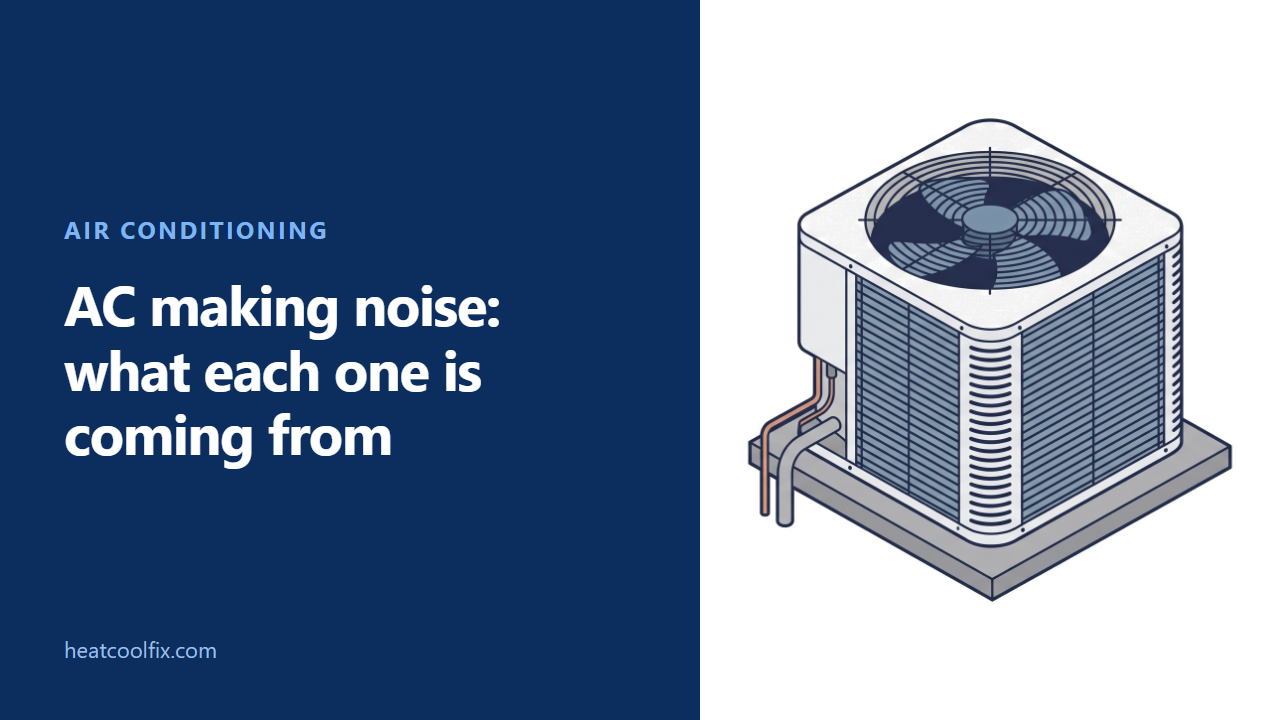
Four sounds mean switching it off rather than looking anything up: a scream, metal grinding, a loud hum with the fan standing still, and any noise with a burning smell. Everything else can wait. After that it comes down to which unit is making it, because the outdoor noises and the indoor ones have nothing in common and half the list is normal anyway.
An air conditioner has two machines in it, sitting thirty feet apart with a wall between them, and they make completely different noises. So the first job is not naming the sound, it is walking outside while it runs.
The second thing worth knowing is that plenty of what gets reported is the machine working normally. There is a list of those at the bottom, and it is worth reading before you pay anybody.
Before you start
What to carry: a torch and a screwdriver. Twenty minutes, and several of these cost nothing to put right.
Gas or electric? Neither applies here. Cooling has no flame and no flue anywhere in it, so none of the combustion noises belong on this page. If the same cabinet indoors also holds a gas furnace, its own noises are a separate list: what a buzzing or banging furnace means.
Set the thermostat down five degrees so you get a full start, a full run and a full stop to listen to rather than catching the end of one.
Metal grinding on metal. The fan blade is touching its guard or the motor has gone. Every minute it runs after that costs more to put right, and it is a five second job to switch it off.
Stop, or carry on?
Decide whether this is a stop or a look
The four on that card are the ones where switching off beats investigating. The rest of this page assumes you have none of them.
Switch it off at the breaker rather than at the thermostat. The thermostat stops it asking for cooling, and it leaves everything in the outdoor unit still live.
One more thing belongs in this group even though it is not a noise. If anybody in the house smells burning at the same time as hearing something new, treat it as the same instruction.
The unit outside
Stand next to it through one start and one stop
One click as it starts and one as it stops. That is the contactor, the switch that feeds the whole unit, and it is meant to click. Two clicks a cycle is right.
Rapid clicking, over and over, with nothing running properly. The same switch chattering instead of pulling in cleanly. It is a cheap part and it wears out, and it often goes with a system that tries to start and gives up: when the outdoor fan will not turn.
A loud hum with the fan standing still. Current going into something that is not moving. Usually the capacitor, sometimes a seized motor, and neither is a homeowner part because of what is stored inside that box: why a capacitor is different from every other cheap part.
Rattling that stops the moment you rest a hand on a panel. Panel screws. They shake loose over a couple of seasons and there are more of them than you would guess.
A rattle that rises and falls with the fan. Something in the fan guard. Leaves, twigs and the occasional stone, and a stone will mark the blades.
A single clunk as it shuts down. Refrigerant settling and the compressor stopping. Normal. A hard bang every single time is worth mentioning to whoever services it.
The unit inside
Work out whether it only happens while air is moving
A squeal as the blower starts. On an older belt driven blower that is the belt, and belts are cheap. On a direct drive one it is a dry motor bearing, and a squeal that gets worse weekly means the motor is on its way out.
Rattling only while the blower runs. The access panel first, then the filter, because a filter that does not sit square in its slot buzzes against the frame. Then the ductwork where it leaves the cabinet.
A boom or a pop a second after the blower starts, and again when it stops. That is a flat piece of ductwork flexing as the pressure comes up, like the bottom of an oil can. It is noise rather than damage, and it usually means the return is too small or the filter is choking it.
A steady whistle while air is moving. Air squeezed through something too small. Filter, then the vents, then the gap around the filter itself, because air rushing past the edge of a badly fitting filter sounds identical.
Gurgling, trickling or dripping. The condensate, and a little of it is normal. Sloshing is not, because it means the pan is holding water it should be losing: how to clear the drain before it comes through a ceiling.
A hum with absolutely nothing running. The transformer, which is live whenever the system has power. It is the one noise that carries on with the thermostat switched off.
The ones that are meant to happen
Worth reading before you call anybody, because all of these get reported as faults.
A low hum from outside the whole time it runs. The compressor. It is supposed to.
A hiss for a short while after it shuts down. Refrigerant pressures equalising. It stops on its own. A hiss that carries on while it runs is different: Trane says hissing is not a normal sound and can mean a refrigerant leak.
A pop or a tick from the ducts as they warm and cool. Sheet metal moving against timber.
Water trickling near the indoor unit while it runs. Condensate on its way out, which is the system doing exactly what it should on a humid day.
A whoosh from the vents that rises and falls. A variable speed blower changing its output.
What matters more than any of these is whether the noise is new. A sound that has been there since the system went in is how yours sounds. One that arrived this month has a cause, and one getting louder every week is a bearing, which only goes one way.
Questions people ask
It screams for two seconds at start up and then runs fine.
A short screech at the moment of starting points at the compressor struggling to get going, which usually means the capacitor. It is worth acting on, because that noise is the warning rather than the fault.
The outdoor unit is much louder than the neighbour’s.
Newer units are genuinely quieter, so age explains a lot of it. What matters is whether yours has got louder, not how it compares with somebody else’s.
It buzzes for a second every few minutes but nothing runs.
Something is trying to pull in and failing. The contactor and its low voltage supply are the place to start, and a blown board fuse gives the same picture: what the small fuse on the board means.
Can I spray oil on a squealing motor?
Most modern motors are sealed and there is nowhere for it to go, so it does nothing except make a mess. A squeal that has appeared is telling you the bearing is finished.
It only rattles on windy days.
Then look at what is around the unit rather than in it. A loose fence panel, a gutter, or the unit itself sitting slightly off its pad will all do it.
How loud is too loud?
One you can hear from indoors with the windows shut, when you never could before, has changed. That change is the useful measurement, not the volume itself.
Sources: Trane "Is This Normal? HVAC Smells and Sounds, Explained" (loud hum from the capacitor, contactor or fan motor, turn off for a high-pitched noise, burning smell, duct pinging), Bryant "What to Do When Your Bryant AC Fan Is Not Spinning" (hum with the blades still, grinding and screeching fan bearings), American Standard "Noises and Smells From Your HVAC System" (duct boom, belt screech), and Carrier service manual 24-25-9SM (contactor and 24 volt coil)
Read next
 Air conditioning
Swamp Cooler Smells Bad? Musty, Fishy or New Pad Smell
Phoenix's and Portacool's troubleshooting charts both blame a musty or unpleasant smell from a swamp cooler on stale water in the pan
Air conditioning
Swamp Cooler Smells Bad? Musty, Fishy or New Pad Smell
Phoenix's and Portacool's troubleshooting charts both blame a musty or unpleasant smell from a swamp cooler on stale water in the pan
 Air conditioning
Swamp Cooler Not Cooling? Windows, Pads, Water and Pump
A swamp cooler only cools when its pads are soaking wet, the outdoor air is dry enough, and the air it blows
Air conditioning
Swamp Cooler Not Cooling? Windows, Pads, Water and Pump
A swamp cooler only cools when its pads are soaking wet, the outdoor air is dry enough, and the air it blows
 Air conditioning
What Size Dehumidifier Do I Need? Pints by Dampness
ENERGY STAR sizes a portable dehumidifier by how damp the space is: 20 to 30 pints a day for a damp room
Air conditioning
What Size Dehumidifier Do I Need? Pints by Dampness
ENERGY STAR sizes a portable dehumidifier by how damp the space is: 20 to 30 pints a day for a damp room
 Air conditioning
What Size Window Air Conditioner Do I Need? BTU Chart
Measure the floor area and read ENERGY STAR's chart: 5,000 BTU for 100 to 150 square feet, 6,000 up to 250, 8,000
Air conditioning
What Size Window Air Conditioner Do I Need? BTU Chart
Measure the floor area and read ENERGY STAR's chart: 5,000 BTU for 100 to 150 square feet, 6,000 up to 250, 8,000