Evaporator Coil Problems: Ice, Water, Leaks and Dirt
 By Ray Bennett · Updated 2 October 2026 · 5 min read · Checked against the sources at the end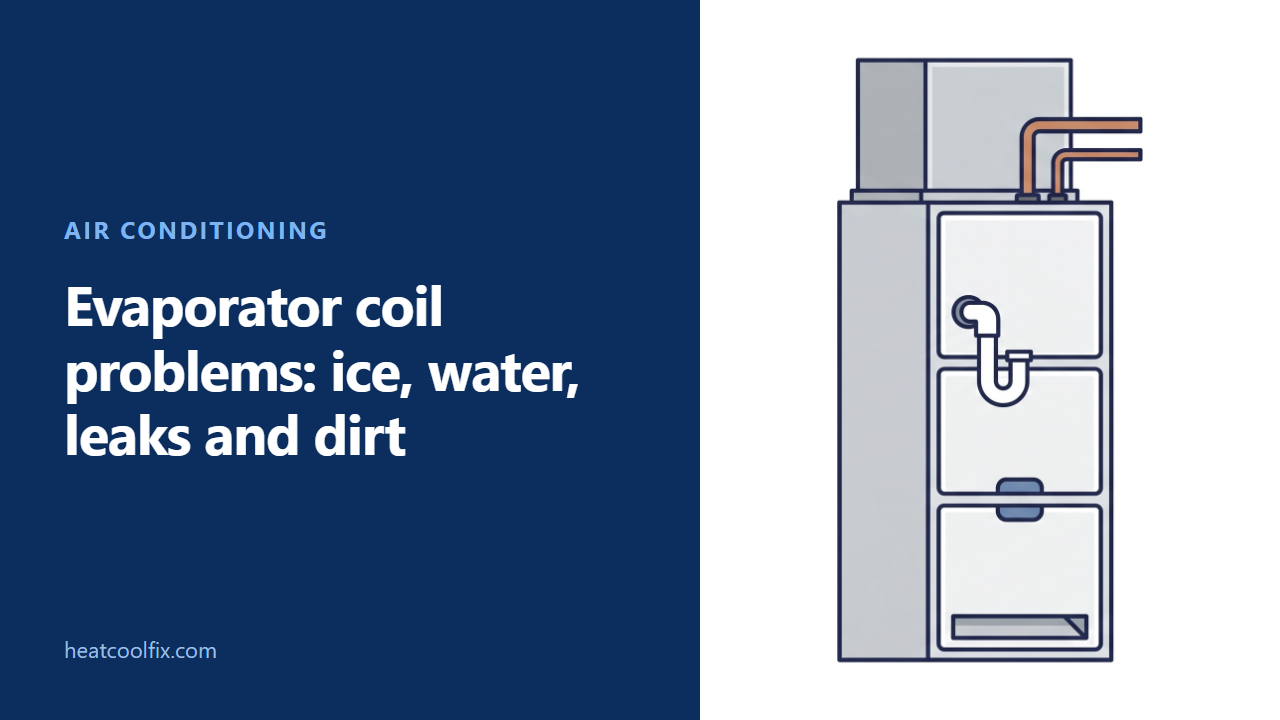
The evaporator coil is the cold coil indoors that takes heat and moisture out of the air. Its problems come in four kinds: ice, water escaping from its drain, a refrigerant leak, and dirt. They are linked. A Department of Energy guide says a dirty coil cuts airflow and will eventually freeze over, and that too little airflow can ice the coil and shorten the compressor's life.
The evaporator coil is the cold half of a central air conditioner or heat pump. It sits indoors, in a cabinet on top of the furnace or in the air handler. The Department of Energy describes it simply: cooling coils remove heat and humidity from the air using refrigerant, and a blower moves the air over them.
Most coil problems are one of four: ice, water, a refrigerant leak, or dirt. They feed each other, so the fix for one often starts with another.
Before you start
What to carry: a torch. Ten minutes to look.
Gas or electric? The coil is part of the electric cooling side. It may sit on a gas furnace or an electric air handler, and it works the same either way.
Where to look. The coil hides behind a panel on the cabinet above or beside the blower. You can usually see the copper lines entering it and the drain leaving it.
Refrigerant is a technician’s job. The Department of Energy says a low or leaking system needs a trained technician to repair the leak and recharge it.
What the coil does
Know the four problems
Ice. Too little air over the coil, or too little refrigerant in it.
Water. The coil is meant to be wet, because it pulls moisture out of the air. The trouble starts when that water cannot get away down the drain.
A refrigerant leak. The coil loses its charge, cools less, and can ice up.
Dirt. ENERGY STAR says dirty coils reduce the system’s ability to cool your home and make it run longer, which raises energy costs and shortens the equipment’s life.
Ice on the coil
Find out why it froze
Too little air. The Department of Energy’s guide says air conditioners are designed for 350 to 400 cubic feet of air a minute across the coil for each ton of cooling. Below 200, the coil can ice and the compressor’s life is greatly shortened.
What cuts the air. A clogged filter first. The Department of Energy says replacing or cleaning filters can cut an air conditioner’s energy use by 5 to 15 percent. Then a dirty coil, which the same guide says reduces airflow and will eventually freeze over.
Too little refrigerant. The guide lists coil freezing from a low refrigerant charge, restrictions and a faulty expansion valve.
It is common. The guide cites field measurements of 4,168 air conditioners where 72 percent had the wrong refrigerant charge and 44 percent had the wrong airflow.
Thawing it. Cooling off, fan on, filter checked: why an AC freezes up and how to thaw it.
Water from the coil
Keep the drain clear
Where the water goes. The coil’s water drips into a pan under it and leaves through a drain line.
A plugged drain. ENERGY STAR says a plugged drain can cause water damage in the house and affect indoor humidity. It lists the condensate drain on every annual check-up.
Keeping it open. The Department of Energy says to occasionally pass a stiff wire through the unit’s drain channels to prevent clogs: how to clear an AC drain line.
Water on the floor or the ceiling. The full list of where the water escapes: an AC leaking water.
Refrigerant leaks
Leave refrigerant to a technician
The fix. The Department of Energy says to call a trained technician to repair the leak and recharge the system. Both steps matter: the leak repaired first, then the charge restored.
The charge matters. ENERGY STAR says too much or too little refrigerant makes the system less efficient, raising energy costs and shortening the equipment’s life.
Why so many run low. The Department of Energy guide quotes one researcher’s view that many systems are undercharged because of refrigerant leaking out over time.
What a leak search and repair involve. Detectors, dye, and sometimes a new coil: an AC refrigerant leak.
Dirt on the coil
Have it checked every year
Every year. The Department of Energy says to check the evaporator coil every year and clean it as necessary. ENERGY STAR puts cleaning the evaporator and condenser coils on every cooling check-up.
How it is found. The Department of Energy guide says a technician can remove the coil’s inspection cover to check for fouling. The first sign may be low airflow.
Bent fins. The Department of Energy says bent coil fins can be straightened with a fin comb.
The outdoor coil too. The condenser outside collects dirt the same way: how to clean the outdoor coil.
Questions people ask
Why is my evaporator coil freezing up?
Too little air over it or too little refrigerant in it. Check the filter first. The Department of Energy’s guide says airflow below 200 cubic feet a minute per ton can ice the coil.
Why is my evaporator coil leaking water?
The coil is meant to be wet. Water escapes when the drain pan or drain line under it is blocked, or the pan is damaged. ENERGY STAR says a plugged drain can cause water damage.
What causes an evaporator coil to leak refrigerant?
The Department of Energy’s guide notes that many systems run undercharged because refrigerant leaks out over time. Finding the exact spot is a technician’s job, and the Department of Energy says to repair the leak and then recharge.
How often should the evaporator coil be cleaned?
Checked every year and cleaned as necessary, the Department of Energy says. ENERGY STAR puts coil cleaning on the annual cooling check-up.
Can I clean the evaporator coil myself?
It usually sits in a sealed cabinet with the refrigerant lines and the drain pan. The Department of Energy says to hire a certified professional when a unit needs more than basic maintenance.
Is a sweating evaporator coil normal?
Yes. The coil removes humidity from the air, so it is wet whenever it cools. The water should run to the pan and the drain.
Sources: U.S. Department of Energy "Energy Saver 101: Home Cooling" and the Building America "Measure Guideline: Air Conditioner Diagnostics, Maintenance, and Replacement" (2013), and the ENERGY STAR Maintenance Checklist
Read next
 Air conditioning
Swamp Cooler Smells Bad? Musty, Fishy or New Pad Smell
Phoenix's and Portacool's troubleshooting charts both blame a musty or unpleasant smell from a swamp cooler on stale water in the pan
Air conditioning
Swamp Cooler Smells Bad? Musty, Fishy or New Pad Smell
Phoenix's and Portacool's troubleshooting charts both blame a musty or unpleasant smell from a swamp cooler on stale water in the pan
 Air conditioning
Swamp Cooler Not Cooling? Windows, Pads, Water and Pump
A swamp cooler only cools when its pads are soaking wet, the outdoor air is dry enough, and the air it blows
Air conditioning
Swamp Cooler Not Cooling? Windows, Pads, Water and Pump
A swamp cooler only cools when its pads are soaking wet, the outdoor air is dry enough, and the air it blows
 Air conditioning
What Size Dehumidifier Do I Need? Pints by Dampness
ENERGY STAR sizes a portable dehumidifier by how damp the space is: 20 to 30 pints a day for a damp room
Air conditioning
What Size Dehumidifier Do I Need? Pints by Dampness
ENERGY STAR sizes a portable dehumidifier by how damp the space is: 20 to 30 pints a day for a damp room
 Air conditioning
What Size Window Air Conditioner Do I Need? BTU Chart
Measure the floor area and read ENERGY STAR's chart: 5,000 BTU for 100 to 150 square feet, 6,000 up to 250, 8,000
Air conditioning
What Size Window Air Conditioner Do I Need? BTU Chart
Measure the floor area and read ENERGY STAR's chart: 5,000 BTU for 100 to 150 square feet, 6,000 up to 250, 8,000