Heat Pump vs Air Conditioner: How to Tell and Which to Buy
 By Ray Bennett · Updated 26 September 2026 · 7 min read · Checked against the sources at the end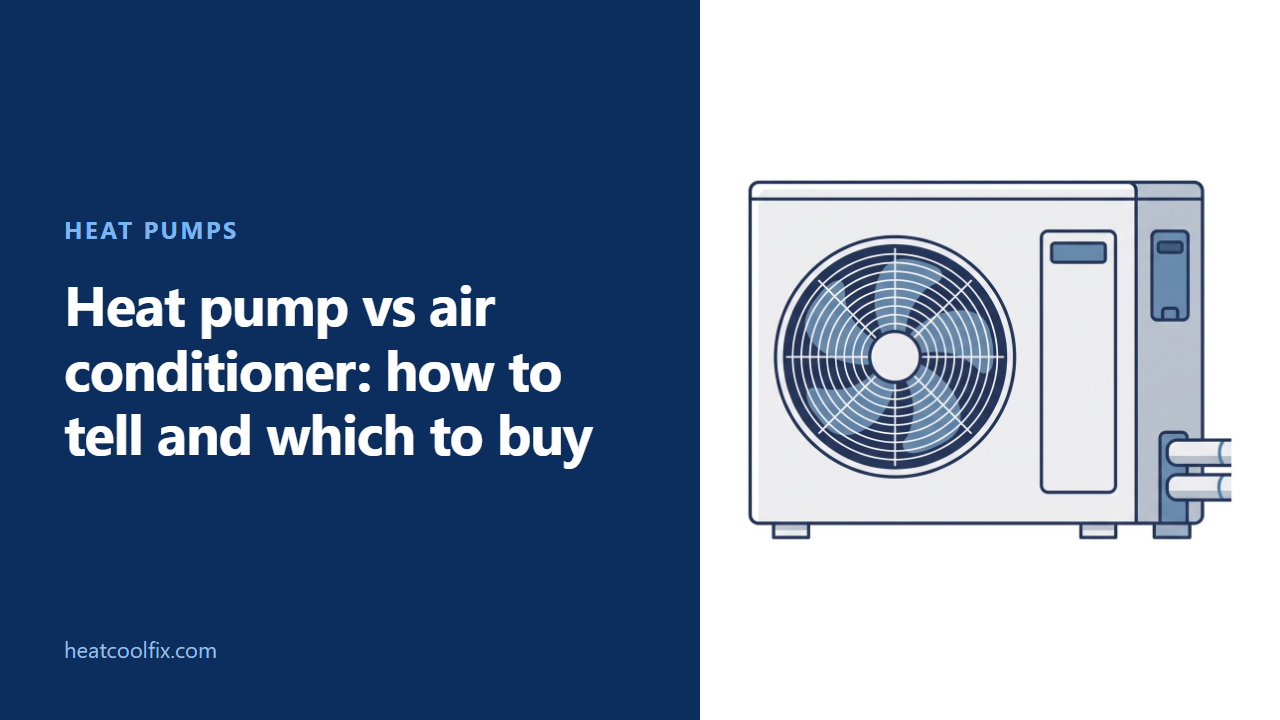
A heat pump is an air conditioner with a reversing valve, so it can run backwards and heat the house in winter. Carrier says both cool the same way. To tell which you have: a thermostat with EMER or AUX, an outdoor unit that runs while the house heats, or an EnergyGuide label with a heating rating, HSPF2 or HSPF, all point to a heat pump.
Heat pump vs air conditioner is less of a contest than it sounds. Trane describes a heat pump as an air conditioner and a heater in one outdoor unit, and apart from a few small technical differences the two cool a house the same way.
The difference is one part, and what it means for your heating. This page covers the part, how to tell which one you already have, and what the makers say about choosing.
Before you start
What to carry: a torch for the label on the outdoor unit, and a phone to photograph the model number. Ten minutes.
Gas or electric heat? With an air conditioner, the heat comes from something else, usually a furnace indoors. A heat pump uses electricity to move heat in from the outdoor air, and Trane says every heat pump should have a backup, either electric heat strips or a gas furnace.
Why it matters. The same outdoor box can be either one, and Carrier says they look virtually identical from outside. Knowing which you have changes how you read the thermostat, the noises and the bills.
Emergency heat is not a test switch. Trane says emergency heat shuts the heat pump down and is only for a true emergency, when the heat pump has failed and it is really cold outside. Leave the thermostat on Heat, or the test below shows a still outdoor unit even on a heat pump.
The one part that makes the difference
The reversing valve. Trane says the biggest difference is that a heat pump can heat as well as cool, and the part that lets it is the reversing valve, which reverses the refrigeration cycle. In summer both move heat out of the house. In winter the heat pump pulls heat from the outdoor air and brings it in.
What an air conditioner does in winter. Nothing. Carrier says a traditional furnace operates entirely indoors, so the outdoor unit of an air conditioner stays silent all winter.
Cooling is the same job. Carrier says both systems operate identically in cooling mode, and both are rated in SEER2 and EER2 for cooling. A heat pump carries a heating rating as well, HSPF2: what SEER2 means.
Which one do you have?
Look at the thermostat
Carrier says the fastest check is the thermostat. A setting marked EMER, for emergency heat, or AUX, for auxiliary heat, almost certainly means a heat pump. A furnace with an air conditioner does not have them.
What those settings do: aux heat on the thermostat.
Watch the outdoor unit while the house heats
Carrier’s test: set the thermostat to Heat and raise it a degree or two, enough to start the system, then go outside. If the outdoor fan is running and blowing cold air out of the top while the house is being heated, it is a heat pump.
A still outdoor unit does not prove an air conditioner. Trane says raising the setting more than 3 or 4 degrees brings on the backup heat, and on a dual fuel system the furnace and the heat pump do not run together. Check the thermostat and the label as well.
Now and then it defrosts for a few minutes. Trane says the outdoor fan may stop and a cloud of steam can rise. That is normal, so wait for the fan to start again before you decide: which heat pump noises are normal.
Read the labels on the outdoor unit
The EnergyGuide label. Carrier says if the yellow label shows an HSPF2 heating rating as well as SEER2, the unit is a heat pump. An air conditioner only shows cooling ratings. An older label says HSPF and SEER, without the 2, and means the same.
The model number. Carrier says its R-410A heat pumps start with 25 and its R-454B heat pumps with 27, and that searching any maker’s model number online shows which kind it is: reading the label.
The valve itself. With the power off, Carrier says a brass part with three tubes on one side and one on the other, seen down through the top grille, is a reversing valve.
How they compare
Efficiency. Both come in high efficiency models. Trane’s best air conditioner is rated up to 21.5 SEER2 and its best heat pump up to 20.5, and Carrier lists air conditioners up to 21 SEER2 and heat pumps up to 23. For heating, Trane says a heat pump can be up to 300 percent efficient, against about 98 percent for the most efficient gas furnace.
Cost to buy. Trane says a heat pump and an air conditioner cost about the same for comparable units of the same brand, though a heat pump system may need ductwork or electrical panel work. Carrier says a heat pump often costs more up front for the outdoor unit, but can remove the need for a separate furnace.
Cost to run. Trane says that at equal efficiency there is little difference in cooling costs, and that a new heat pump can cut heating and cooling costs where a new air conditioner only cuts cooling. How much depends on your fuel prices: heat pump or furnace.
How long they last. Trane puts a well maintained central air conditioner at about 15 years and a heat pump at 12 to 15, because the heat pump runs nearly all year. It says to service an air conditioner each spring, and a heat pump in spring and fall: how often to service it.
Which one to choose
Match the choice to your climate and your furnace
A heat pump. Carrier says choose one if you want a single system for heating and cooling, or live where winters are moderate and electricity is cheaper than fossil fuel. Trane says a heat pump with an air handler suits mild to moderate climates, and cold climate models heat in far lower temperatures: how cold is too cold for a heat pump.
An air conditioner. Carrier says choose one if you live somewhere very hot where heating is rarely needed, or already have a reliable, high efficiency furnace you plan to keep.
Both at once. A heat pump paired with a gas furnace is a dual fuel system. Carrier says it uses the heat pump on mild days and switches to the furnace when temperatures plunge. A Trane product manager calls it a fantastic option for a home that already has a furnace and an air conditioner.
Either way, size it properly. Trane says an improperly sized or poorly installed system will leave you less comfortable than you should be: what size heat pump do I need.
What each one costs
| The step | Cost |
|---|---|
| The five checks above | Nothing |
| A new heat pump system, installed | 6,000 to 25,000 dollars, Carrier says, depending on the size and the house |
| A new air conditioner | About the same as a comparable heat pump of the same brand, Trane says |
Questions people ask
Is a heat pump the same as an air conditioner?
For cooling, nearly. Trane says apart from a few small technical differences they cool the same way. The heat pump adds a reversing valve so it can heat as well.
Can a heat pump replace an air conditioner?
Yes, Carrier says. It gives the same cooling and adds heating. Trane says a heat pump needs a compatible air handler or gas furnace indoors.
How do I know if my outdoor unit is a heat pump?
Check the thermostat for EMER or AUX, watch the outdoor unit while the house heats on a mild day, read the EnergyGuide label for a heating rating, or search the model number online. Carrier says the model number gives a sure answer.
Why is my outdoor unit running in winter?
Most likely because it is a heat pump. Carrier says an air conditioner’s outdoor unit stays silent in winter, since the furnace does the heating indoors. If the label says air conditioner and it still runs in winter, have it checked.
Which lasts longer, a heat pump or an air conditioner?
With proper maintenance, Trane puts an air conditioner at about 15 years and a heat pump at 12 to 15, because the heat pump runs nearly all year. It adds that an air conditioner may wear out sooner in Florida or south Texas.
Is a heat pump cheaper to run than an air conditioner?
For cooling, about the same at equal efficiency, Trane says. A heat pump can also cut the heating bill, which an air conditioner cannot touch, and Carrier says how much depends on your climate and the heating it replaces.
Sources: Carrier "Heat Pump vs. Air Conditioner: Which Is Right for You?" and "How Do I Know If I Have a Heat Pump?", Trane "Heat Pump vs Air Conditioner: Which One Is Right for You" and "What Is Auxiliary Heat in a Heat Pump System?" and "What Is the Heat Pump Defrost Cycle?"
Read next
 Heat pumps
What Size Heat Pump Do I Need? Tons, Load and Backup Heat
Ask for a Manual J, which ENERGY STAR says your contractor should use. Square foot rules give odd answers for heat pumps:
Heat pumps
What Size Heat Pump Do I Need? Tons, Load and Backup Heat
Ask for a Manual J, which ENERGY STAR says your contractor should use. Square foot rules give odd answers for heat pumps:
 Heat pumps
Heat Pump Smells Like Burning or Musty: What Each Means
A burning dust smell on the first cold day is normal and fades on its own; Trane says in 10 to 15
Heat pumps
Heat Pump Smells Like Burning or Musty: What Each Means
A burning dust smell on the first cold day is normal and fades on its own; Trane says in 10 to 15
 Heat pumps
Heat Pump vs Furnace: Which Costs Less to Run?
It depends on your prices and your winters. A furnace burns fuel and only heats. A heat pump moves heat in on
Heat pumps
Heat Pump vs Furnace: Which Costs Less to Run?
It depends on your prices and your winters. A furnace burns fuel and only heats. A heat pump moves heat in on
 Heat pumps
How Cold Is Too Cold for a Heat Pump? What the Makers Say
It depends on the heat pump. Trane says the best standard heat pumps still give full heating capacity at about 32°F, and
Heat pumps
How Cold Is Too Cold for a Heat Pump? What the Makers Say
It depends on the heat pump. Trane says the best standard heat pumps still give full heating capacity at about 32°F, and