How Often Does It Actually Need Servicing?
 By Ray Bennett · Updated 2 October 2026 · 5 min read · Checked against the sources at the end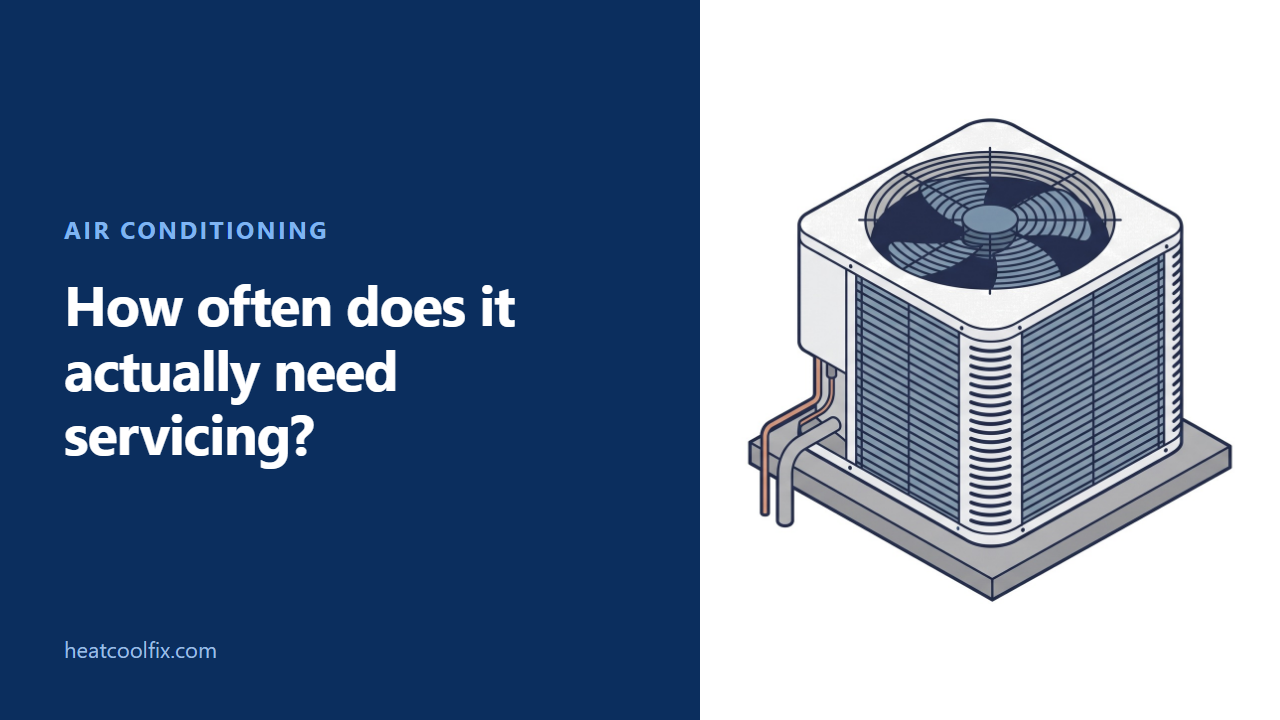
Once before the cooling season and once before the heating season, and on a house with both that is two visits or one very thorough one. The useful question is not how often but what has to be on the invoice, because a visit that produces no measured numbers was a look round with a clipboard.
The honest answer to how often is boring and short. Once a year for the cooling side, before the weather turns hot, and once a year for the heating side, before it turns cold.
The far more useful question is what that visit has to contain. A service that leaves no measured numbers behind is a look round with a clipboard, and it costs the same as a real one.
Before you start
What to carry: last year’s invoice, if you have one, and a torch. Ten minutes of reading.
Gas or electric? It changes what matters most. On a gas furnace the burners, the flame sensor and the heat exchanger are the heart of the visit, and one of those is a safety check. On an electric system there is no combustion at all, so the money goes on the cooling side and the electrical connections.
Know which parts are yours. Some of what gets sold as servicing is a job you can do in two minutes, and some of it genuinely needs a meter and a gauge set.
Anything sold at the door on the strength of a free check. Sanitising treatments, lamps fitted inside the ductwork, and routine duct cleaning are all sold this way. None of them is the reason a system fails, and the things that are the reason are cheaper.
Twice a year, and what each visit is for
Book them before the season, not during it
Before the cooling season. Spring, while nobody is desperate. The outdoor coil washed, the condensate drain cleared, the capacitor measured, the refrigerant charge checked and the electrical connections tightened.
Before the heating season. Early autumn. Burners and the flame sensor cleaned, the ignition checked, combustion measured on a gas furnace, and the heat exchanger inspected.
A house with both. Two visits, or one long one at a sensible moment. What you should not do is book either of them in the middle of a heatwave or a cold snap, when every firm in the county is running on emergencies.
The filter is yours. Every month or two, and nobody visits often enough to do it for you. It is one of the most important maintenance jobs on the whole system, and a cheap one: what a badly fitting one does to the house.
What has to be on the invoice
Read the paperwork before you pay
The refrigerant charge, as a number. Pressures and temperatures, or a superheat and subcooling figure. Checked is a measurement. Fine is an opinion.
The capacitor, as a number. They fade before they fail, and a reading well below the number printed on the side is a part about to die on the hottest afternoon of the year: why that part matters so much.
The outdoor coil, actually washed. Not brushed, not glanced at. ENERGY STAR says dirty coils make the system run longer, which raises the running cost and shortens its life.
On a gas furnace, the heat exchanger seen. With a camera or a mirror and a light. This is the safety item, because a crack puts combustion gas into the house: what that smells like.
Amp draws and the temperature rise or drop. Two more numbers, and both of them say whether the machine is working as hard as it should or harder.
What you can do yourself
Four jobs, no tools, twice a year
The filter, on a date. Not when it looks bad.
Rinse the outdoor coil. Power off at the breaker, then a gentle hose from the inside outwards. Never a pressure washer. It is most of what the spring visit does for that unit.
Clear round the outdoor unit. Trane says two feet of space all round. Shrubs cut back, leaves out of the fan guard.
Pour water down the condensate drain. Or clear it properly once a year before it finds your ceiling: how to do that.
What is genuinely not yours is anything behind an electrical panel, anything involving refrigerant, and anything to do with combustion. Those are the parts you are paying for.
Is a service plan worth it?
It depends entirely on what is inside it. A plan that buys you two proper visits, a discount on parts and a place near the front of the queue in July is usually worth the money, because the queue is the part you cannot buy later.
A plan that buys two visual inspections and nothing measured is worse than paying for one good visit.
The other honest thing to say is that servicing does not stop things failing. It catches some of them early, it keeps the running cost down, and it keeps a warranty alive. A system that has never been touched in ten years is not doomed, it is simply running worse and costing more than it needs to, and it will fail without warning rather than with it.
Questions people ask
Mine has never been serviced and it works fine.
Quite possibly. What you cannot see is how much more it is costing to run and whether a heat exchanger has started to crack. The argument for a first visit is finding out, not fixing something.
Is a spring visit really different from an autumn one?
Completely. One is about the outdoor unit, the refrigerant and the drain. The other is about burners, ignition and combustion. A firm that does the same thing in both is doing one of them badly.
They said my system needs a top up every year.
Then it has a leak and nobody has looked for it. A sealed system does not consume refrigerant, so an annual top up is an annual payment for a repair that never happens.
Are the UV lamps and sanitising sprays worth it?
They are the most heavily sold extras and the least connected to why systems break. Cleaning the coil and keeping the drain clear does far more for the same money.
What if it is still under warranty?
Read the terms. A lot of manufacturer warranties require documented annual servicing, and a missing invoice is how claims get refused years later.
It just got serviced and now it is broken.
Worth a phone call rather than a new firm. A panel not latched, a fan speed changed or a wire knocked off are all easy to do and quick to undo: the panel switch catches people constantly.
Sources: ENERGY STAR "Maintenance Checklist", Trane "Central AC Maintenance: Routine Tasks and Tips" (filter, two feet of clearance), and Lennox "How to Clean Air Conditioner Fins" (rinse from the inside out)
Read next
 Air conditioning
Swamp Cooler Smells Bad? Musty, Fishy or New Pad Smell
Phoenix's and Portacool's troubleshooting charts both blame a musty or unpleasant smell from a swamp cooler on stale water in the pan
Air conditioning
Swamp Cooler Smells Bad? Musty, Fishy or New Pad Smell
Phoenix's and Portacool's troubleshooting charts both blame a musty or unpleasant smell from a swamp cooler on stale water in the pan
 Air conditioning
Swamp Cooler Not Cooling? Windows, Pads, Water and Pump
A swamp cooler only cools when its pads are soaking wet, the outdoor air is dry enough, and the air it blows
Air conditioning
Swamp Cooler Not Cooling? Windows, Pads, Water and Pump
A swamp cooler only cools when its pads are soaking wet, the outdoor air is dry enough, and the air it blows
 Air conditioning
What Size Dehumidifier Do I Need? Pints by Dampness
ENERGY STAR sizes a portable dehumidifier by how damp the space is: 20 to 30 pints a day for a damp room
Air conditioning
What Size Dehumidifier Do I Need? Pints by Dampness
ENERGY STAR sizes a portable dehumidifier by how damp the space is: 20 to 30 pints a day for a damp room
 Air conditioning
What Size Window Air Conditioner Do I Need? BTU Chart
Measure the floor area and read ENERGY STAR's chart: 5,000 BTU for 100 to 150 square feet, 6,000 up to 250, 8,000
Air conditioning
What Size Window Air Conditioner Do I Need? BTU Chart
Measure the floor area and read ENERGY STAR's chart: 5,000 BTU for 100 to 150 square feet, 6,000 up to 250, 8,000