Boiler Keeps Turning Off or Short Cycling? What to Check
 By Ray Bennett · Updated 17 October 2026 · 13 min read · Checked against the sources at the end
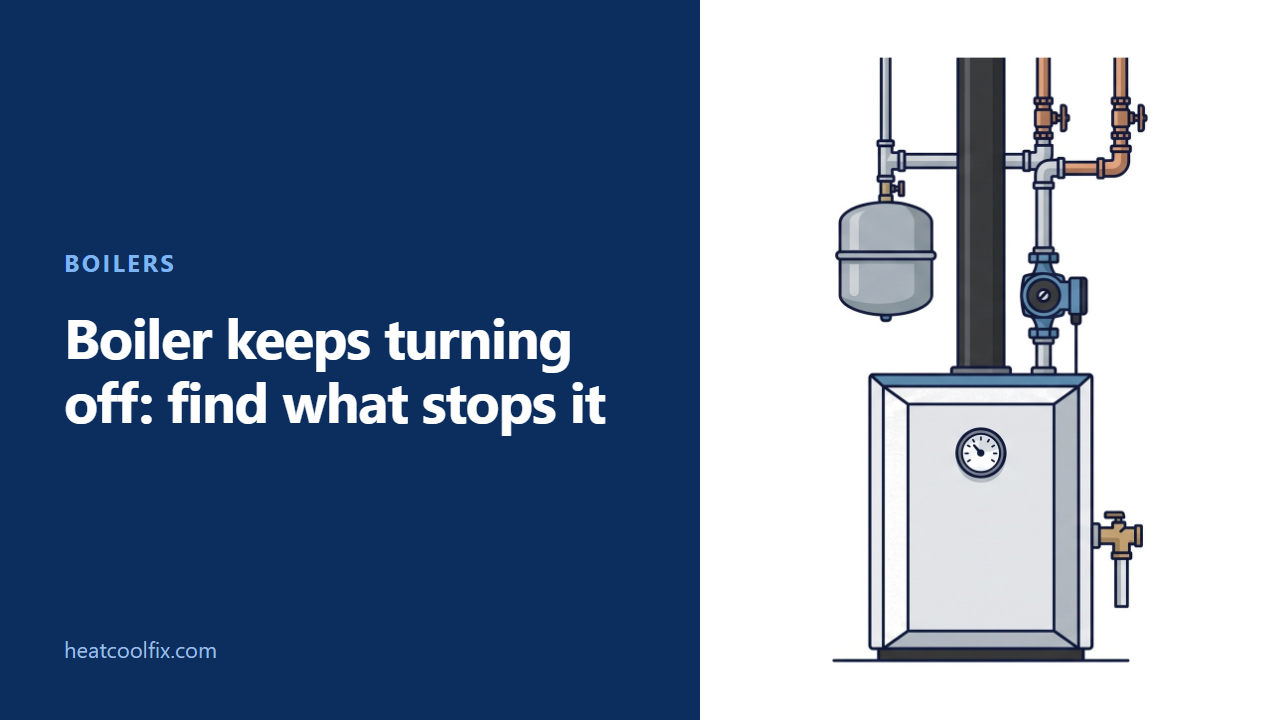
Watch one stop. A boiler that stops at its set temperature, pauses while it heats tap water, or waits a few minutes between starts can be doing what its maker designed. Short runs with the house still cold point to the thermostat, pressure, air, a closed valve, the settings, the vent or a boiler too big. Codes and lockouts have their own check, and so does a tripping breaker.
When a boiler keeps turning off, one of its controls, its power or its fuel is stopping it, and the job is to find out which.
Some stops are normal, but short cycling needs fixing: U.S. Boiler describes a boiler firing at full throttle for a few minutes, then shutting down a few minutes later, and HTP says it wears parts early.
Before you start
What to carry: a torch, a phone to time the burner and a pen for any code. Allow time to watch a few starts.
Gas, oil or electric? This page is for gas and oil boilers; a boiler that trips its electric breaker is check 5. On propane, HTP says ignition failure is especially noticeable after a tank has run empty, if the lines are not purged, and Mississippi’s fire marshal says many states require a leak check before the gas goes back on.
Hot water or steam? A steam boiler has a glass tube on its side showing the water inside, and Pennco says water must be visible in it at all times. A hot water boiler has a gauge for pressure and temperature.
Renting? Tell the landlord or superintendent. New York City’s housing agency says tenants without heat can call 311.
A carbon monoxide alarm. CPSC says do not look for the source: get outside, call 911 or the fire department, and stay out until the responders say you can go back. Burnham says soot near the burner points to a possible carbon monoxide hazard: shut the boiler down and have it inspected. More in a carbon monoxide alarm going off.
Never bypass a control. Weil-McLain says never bypass a safety limit or reset a manual reset limit without finding the cause, and Burnham says never jump out any safety or operating control.
Vent and rollout switches. Burnham and Peerless say a tripped flame rollout switch, or the blocked vent switch on a chimney vented boiler, needs a technician to find the cause before the boiler runs again.
Overheating. If it overheats or the gas will not shut off, Weil-McLain and Buderus say keep the pump powered and shut the gas off at a valve outside the boiler. On oil, Carlin and Wayne say shut the oil supply to the burner and leave the pump switch on.
Watch one stop first
Stay by the boiler through a start and a stop, time how many minutes the burner runs, and write down any code: Viessmann says the code helps the contractor prepare. Taco also says to watch the water temperature as it stops, to see whether the boiler’s own temperature control is cycling it.
No code, a restart a few minutes later, and a house that never warms up is short cycling: checks 1 to 3, and the vent in check 4. A stop when the water is hot, while tap water runs, or a wait of a few minutes can be normal, below. A code or a lockout is check 4, or 7 on oil, a tripping breaker check 5, and steam and oil are checks 6 and 7.
Stops that are part of normal running
The water is hot enough. Peerless says the water limit on its Series 63/64 stops the boiler at the set temperature and restarts it about 15 degrees below, and Triangle Tube says its Prestige keeps the pump running in between.
A built-in wait. Several makers hold off the next start to prevent short cycling: 3 minutes by default on Navien’s NCB-H, Peerless’s PureFire and Bosch’s Greenstar, and 1 minute on Lochinvar’s Knight. Burnham calls it a normal delay.
Tap water first. Navien says its combi does not heat the house while it heats tap water. Viessmann says to wait while its boiler heats the tank, or on its combi, to stop drawing hot water, and Burnham’s K2WTC gives tap water the first 60 minutes by default.
It fires with no heat called for. Navien’s NCB-H pre-heats tap water by default, and U.S. Boiler’s Alliance SL tank calls for heat when it cools a set amount below its setting. Weil-McLain says boilers that heat tap water must run year round, and with an outdoor sensor, Viessmann’s Vitodens 100 fires below 41 degrees outside for frost protection.
A warm day. With an outdoor sensor, a boiler can stop heating above a set outdoor temperature, 80 degrees by default on Lochinvar’s Knight.
When the house never warms up
The thermostat: where it hangs and how it is set
Where it hangs. Weil-McLain’s first answer to rapid cycling is a thermostat in a draft or near heat: it belongs on an inside wall. Burnham adds fireplaces, pipes, lamps, televisions and sunlight, and Taco says no radiator under it.
A digital cycle rate. Honeywell’s FocusPRO comes set to 5 cycles an hour and its T8775 to 6, both furnace settings, where their tables give 3 for hot water and 1 for steam. Honeywell says a trained, experienced technician installs them. Sensi says its slow cycle rate suits most homes with hot water or steam heat, and owners can change it in the app.
An older dial thermostat. If it has a heat anticipator, a small pointer marked in amps, Burnham’s installer instructions raise it 0.1 or 0.2 amps when the boiler short cycles without warming the room.
The wiring. Taco says to check for bad connections, and for telephone wire used in place of thermostat wire. Leave that to a technician.
Pressure, air, valves and the pump
The gauge. Some hot water boilers stop the burner when the pressure falls too low: below 7 psi on NTI’s FTVN, and 7.2 on Triangle Tube’s Prestige with the CTRLMax control or 10 on its older TriMax one. Topping up is in boiler pressure too low or too high, and NTI says a boiler that keeps needing water is turned off and checked for leaks by a technician.
Air. Weil-McLain says air interferes with circulation, and its fix for radiators or baseboard that stay cold is bleeding them, as in a radiator not heating. Viessmann says bleeding can drop the pressure, so look at the gauge again afterwards.
Valves. Weil-McLain’s owner table for rapid cycling says to check every valve to and from the boiler and return it to its proper setting. Bosch says that when its GB142 is at its set temperature, the issue could be the heat not reaching the zones.
The pump. Peerless says a pump too small for a high efficiency boiler can let the water heat too quickly, so the boiler shuts off and short cycles, and Grundfos says a pump left off over the summer can seize with lime. Both are a technician’s job.
The settings, small zones and a boiler too big
The boiler’s temperature. For a burner that switches off before the room is warm, Viessmann’s owner table on its Vitodens 100-W lists a fault in the air supply or venting, for the contractor, and heating water set too low, raised at the boiler’s dial. Weil-McLain says a higher limit setting decreases cycling, a technician’s job on its WGO oil boiler.
The differential. That is how far the water cools before the burner restarts, Lochinvar says. Peerless lists one set too narrow as a cause of rapid cycling, and Taco and Weil-McLain say to widen it if the boiler cycles too often. On Lochinvar’s Knight and Honeywell’s L7224U it sits behind an installer setting.
Small zones. Caleffi has seen wall hung condensing boilers on many small zones run under a minute. Its example is a boiler whose lowest output is 20,000 Btu an hour feeding a zone that needs 3,000, so the water heats fast and the boiler switches off. Caleffi’s most common cure with these boilers is a buffer tank of extra water.
Too big for the house. Burnham says a grossly oversized boiler cycles excessively and fails early. DOE says newer systems are still likely to be oversized and can often be modified to reduce their capacity, and Weil-McLain says matching the WM97+’s maximum firing rate to the heat load reduces cycling.
Codes, lockouts and the breaker
A code, a blocked vent or a lockout that comes back
Blocking or lockout. NTI and HTP sort codes in two: a blocking error clears and the boiler restarts by itself, while a lockout waits for the reset button, which HTP says is pressed after a qualified technician has repaired the boiler. Some clear after a wait: Weil-McLain’s Ultra resets an ignition fault by itself after an hour.
The vent outside. On a condensing boiler vented through a wall you can reach from the ground, Burnham says look for a bees’ nest or ice; on its boilers, the burner should light about 30 seconds after it is cleared. Weil-McLain says a clogged air intake or vent can make a boiler stall out or lock out, and National Grid says to clear vents of snow and ice. If you find nothing, or cannot reach it, Burnham says call a gas technician.
A vent fault with no code. Burnham says a blocked vent makes its Alpine and K2WT stop the start and try again, showing the cause only while the pressure switch is open. Viessmann says continuous short cycling of its Vitodens can mean a leaking venting system, a job for the contractor.
Code 110 on a Navien. Navien’s NCB-H table calls it an exhaust blockage: make sure the exhaust pipe is clear, and clean the air filter, which Navien says to do every 3 to 4 months with the boiler off and its power disconnected, letting it dry before it goes back.
The condensate drain. Peerless’s PureFire and Lochinvar’s Knight stop when the condensate drain is blocked. Weil-McLain and Lochinvar say the trap must be full of water whenever the boiler runs, or flue gas escapes from the drain, and Burnham says a blocked drain means gas off and a technician. NTI says a frozen condensate line can block the vent.
Stops that turn into a lockout. Weil-McLain’s Ultra restarts itself when the water heats too quickly, and Triangle Tube’s newer Prestige when its supply and return temperatures split too far, but both need a manual reset after 5 times. Burnham ties too big a split to too little flow: check 2.
Resets. Rinnai’s Q-Series manual says press Reset once and call the installer if the fault stays, and Viessmann says never reset several times in quick succession. Triangle Tube’s Prestige and NTI’s FTVN lock out after 5 resets in 15 minutes. Reading a lockout: a boiler not working.
It trips the breaker or a GFCI outlet
How it should be wired. Burnham and Bosch want a boiler on its own circuit, and Rinnai says no extension cord or adapter plug with its I-Series Plus.
A GFCI outlet. CPSC says the electrical code has required GFCIs in unfinished basements since 1990, in new building work. Leviton says one trips when current leaks where it should not, often from moisture, damaged wiring or a faulty appliance, and that one tripping again right after a reset may mean a wiring problem or a faulty device. Weil-McLain says never run a boiler whose controls have been sprayed with water.
When to call. NFPA’s safety tips say to call a qualified electrician or the landlord about breakers that trip often. Navien says a short circuit blows its NCB-H’s internal fuses, and Bosch says a second blown fuse on its GB142 can mean a failed part: both are for a technician.
Steam boilers and oil burners
Steam: the pressure control and the water line
What is normal. Pennco says the water in the glass may rise and fall as a steam boiler cycles, as long as it stays visible. Burnham says the Hydrolevel low water cutoff on its Independence stops the burners for 90 seconds after 20 minutes of firing.
Pressure. DOE’s steam balancing guide says one-pipe steam should typically run at ½ to 1½ psig, and wrong settings can cause short cycles. Weil-McLain says a wider differential gives longer cycles, Bell and Gossett says never raise the pressure control to cure a heating problem, and Burnham says a steam boiler too big for its radiators short cycles on pressure.
Vents and water. Peerless and Weil-McLain list air vents or traps that do not let the air out as a cause of rapid cycling. Weil-McLain says a modern steam boiler with only a low water cutoff can shut down and cycle while water returns from the pipes, and Burnham blames wet steam from wrong piping near the boiler.
Topping up. With no automatic feeder and the low water light on, Burnham’s manual says wait at least 15 minutes for the water to return, then feed water by hand up to the normal water line, and call if you cannot see the water. Weil-McLain warns that cold water in a hot boiler can crack it, and Peerless says turn the gas off and call. Burnham says water more than once a month calls for a check for leaks or bad vents.
Oil: a burner that stops and restarts
The basics. Weil-McLain’s list: the service switch, the fuses or breaker, the thermostat, the oil valves and enough oil in the tank. U.S. Boiler warns that a tank gauge can stick, and that oil in outside tanks can gel in the cold.
It stops, then tries again a minute later. Resideo’s R7184 shuts the burner down when the flame is lost, waits 60 seconds and tries again, and locks out after three losses in a row. U.S. Boiler’s list for that pattern starts with the cad cell flame sensor, air in the oil line, the nozzle and too much draft.
One reset. Weil-McLain says press the reset button only once, because repeated presses put oil in the combustion chamber and a burner must never fire with oil in it: if it still does not fire, call a technician. Resideo’s R7184 and Beckett’s GeniSys restrict resets after three lockouts: Honeywell R7184 reset and Beckett GeniSys reset.
Why short cycling is worth fixing
Caleffi says short cycling can mean tens of thousands of starts in a season, wearing parts such as hot surface igniters. Bosch adds more emissions and less comfort, and U.S. Boiler says it wastes fuel. A boiler shut down by a fault in cold weather can leave an empty house’s pipes to freeze within hours, Beckett says: see frozen pipes.
What each one takes
| What stops it | What it takes |
|---|---|
| Set temperature, tap water, a built-in wait | Nothing, if the house warms up |
| Where the thermostat hangs, or its cycle rate | A setting, or a technician to move it |
| Low pressure or air | Topping up cold and bleeding, or a technician |
| A closed valve or a stuck pump | Returning the valve to its setting, or a technician |
| Settings, small zones, a boiler too big | The boiler’s dial, then a technician: settings, a buffer tank or a lower firing rate |
| Vent, air filter or condensate drain | A wall vent or filter you can reach, power off; a technician for the rest |
| A tripping breaker or GFCI | An electrician, or a technician for the boiler’s fuses |
| Steam pressure, vents or water line | Topping up the maker’s way, or a technician |
| An oil burner that locks out | One reset, then a technician |
Questions people ask
How often should a boiler turn on and off?
Honeywell’s tables give 3 cycles an hour for hot water heat and 1 for steam, and Caleffi says a run of at least 10 minutes is often suggested.
Why does my boiler come on when the heating is off?
It may be keeping tap water ready: Navien’s NCB-H pre-heats by default. With an outdoor sensor, Viessmann’s Vitodens 100 also fires below 41 degrees outside for frost protection.
Why does the heating stop when someone takes a shower?
Tap water can come first: Navien’s NCB-H stops heating while it makes hot water, and Burnham’s K2WTC gives hot water the first 60 minutes by default.
How many times can I reset my boiler?
Rinnai’s Q-Series manual says once, and Triangle Tube’s Prestige and NTI’s FTVN lock out after 5 resets in 15 minutes. Burnham and Peerless say a tripped blocked vent or rollout switch is not reset at all until a technician has found the cause.
Can a boiler that is too big be fixed without replacing it?
Sometimes. DOE says newer systems that are oversized can often be modified to reduce their capacity, and Caleffi names a buffer tank as the most common cure with low mass boilers.
The other boiler guides: a boiler not working, boiler pressure too low or too high, a boiler making noise and a boiler or radiator that smells.
Sources: Weil-McLain gas boilers user manual 550-100-226, EG/PEG Series 7, CGa Series 3, Ultra Series 4, WM97+ Series 2, GV90+, WGO Series 4 and SGO Series 4 manuals, its outdoor reset controls manual and high efficiency boiler maintenance page, U.S. Boiler Company (Burnham) cast iron and condensing user manuals, Alpine, K2WT, K2WTC, Series 2E, Independence, V8H and MPO-IQ instructions, its Alliance SL indirect water heater manual and technical articles, Peerless Series 63/64 manuals, PureFire manual and contractor FAQ, Pennco boiler user's manual, Lochinvar Knight user and service manuals, Triangle Tube Prestige manuals, Navien NCB-H and NCB-E manuals, NTI FTVN Series II manual, HTP glossary and Elite Plus manual, Viessmann Vitodens operating and venting instructions, Vitodens 200 troubleshooting guide and bleeding guide, Bosch Greenstar instructions and condensing boiler support pages, Buderus GB142 instructions, Rinnai I-Series Plus and Q-Series manuals, Honeywell FocusPRO, T8775, T87F and L7224U instructions, Resideo PA404 Pressuretrol and R7184 oil primary guides, Beckett GeniSys product sheet and control manual, Carlin burner supplement, Wayne burner manual, Sensi cycle rate help page, Taco SR501 instructions and FAQ, Caleffi idronics 17, Grundfos UPS3 manual, Leviton GFCI guide, CPSC carbon monoxide questions and answers and GFCI fact sheet, NFPA electrical safety tips, Con Edison, Peoples Gas and National Grid safety pages, Mississippi State Fire Marshal propane safety, DOE furnaces and boilers page and steam balancing guideline, Bell and Gossett Steam Team and NYC HPD tenant rights page
Read next
 Boilers
Lochinvar Noble Error Codes: Lockouts and Fault Messages
Lochinvar Noble error codes are words on the SMART SYSTEM display, such as Flame Fail: Ignition, Air Pressure Switch or LWCO. Faults
 Boilers
Weil-McLain ECO Tec Error Codes: Blower Fault and Lockouts
A Weil-McLain ECO Tec Series 2 names its faults on the touchscreen instead of using numbers. In a lockout the banner turns
 Boilers
Weil-McLain Evergreen Error Codes and Lockout Messages
A Weil-McLain Evergreen Pro shows its faults as words, not numbers: the display turns red and names the fault, such as IGNITION
 Boilers
Weil-McLain AquaBalance Error Codes: A01, F37 and A16
The Weil-McLain AquaBalance shows A or F with a number. A codes are hard lockouts: press RESET for 1 second once the